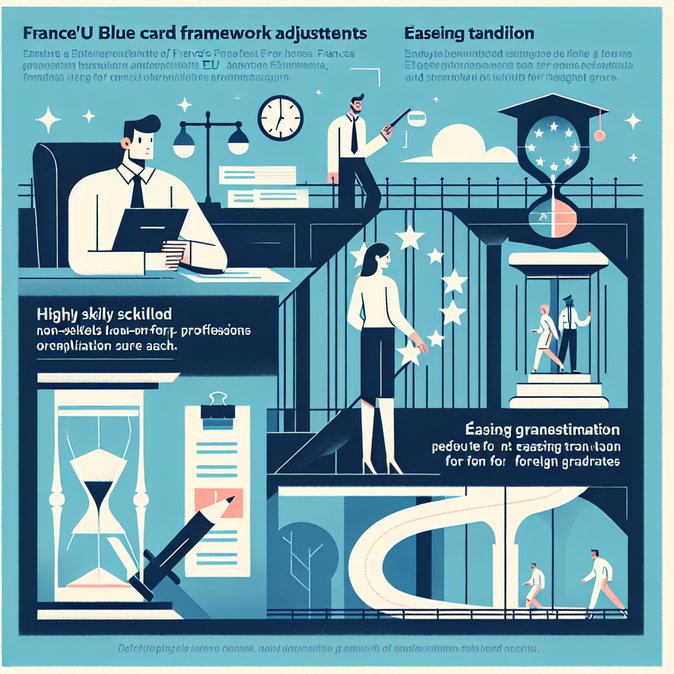
A decree published in the Journal Officiel on 24 April and analysed by Revue Fiduciaire on 27 April clarifies multiple aspects of the EU Blue Card programme as transposed into French law. Key takeaways: (1) the minimum gross-salary requirement remains indexed to 1.2 times the average reference wage but explicit figures will be set by an annual arrêté; (2) applicants switching from student status now benefit from a simplified work-authorisation exemption; (3) holders who lose their job must register with Pôle Emploi within one month to preserve their right to remain; and (4) prefectures gain authority to verify that the host employer is not subject to labour-law sanctions before issuing or renewing the permit.
The Blue Card, relaunched across the EU under Directive 2021/1883, is positioned as France’s flagship route for highly qualified third-country nationals. By tightening compliance checks and deadlines, the decree aims to deter abuse while making the scheme more portable for legitimate talent.
For employers, the most immediate impact is procedural: HR teams must ensure that any disciplinary or illegal-work findings against the company are cleared before they sponsor a Blue Card, or risk refusal. They must also notify authorities within three months of any change in working conditions that could affect salary thresholds.
![France issues decree fine-tuning EU Blue Card rules and raising compliance stakes for employers]()
As a practical aid, VisaHQ’s France desk (https://www.visahq.com/france/) can streamline the paperwork, appointment booking and fee payment steps for both employers and individual professionals, making it easier to keep pace with the decree’s new thresholds and compliance verifications.
Mobility specialists welcome the student-to-Blue-Card pathway, which could help retain foreign graduates from French universities in STEM fields. However, the unemployment-registration rule may catch some assignees unaware if a project ends abruptly. Advisers recommend integrating an “off-boarding” checklist that includes Pôle Emploi enrolment and health-insurance continuity.
The decree fits into a broader EU push for labour mobility while safeguarding local markets. France issued roughly 8,500 Blue Cards in 2025, up 34 % year on year, with IT engineers, data scientists and healthcare managers the largest cohorts. The Interior Ministry expects the 2026 figure to exceed 10,000. Multinationals should update immigration handbooks and liaise with counsel to verify that compensation packages meet the soon-to-be-published 2026 minimum—widely expected to hover around €59,000 gross per annum. Failure to do so could delay onboarding or trigger audits.
The Blue Card, relaunched across the EU under Directive 2021/1883, is positioned as France’s flagship route for highly qualified third-country nationals. By tightening compliance checks and deadlines, the decree aims to deter abuse while making the scheme more portable for legitimate talent.
For employers, the most immediate impact is procedural: HR teams must ensure that any disciplinary or illegal-work findings against the company are cleared before they sponsor a Blue Card, or risk refusal. They must also notify authorities within three months of any change in working conditions that could affect salary thresholds.

As a practical aid, VisaHQ’s France desk (https://www.visahq.com/france/) can streamline the paperwork, appointment booking and fee payment steps for both employers and individual professionals, making it easier to keep pace with the decree’s new thresholds and compliance verifications.
Mobility specialists welcome the student-to-Blue-Card pathway, which could help retain foreign graduates from French universities in STEM fields. However, the unemployment-registration rule may catch some assignees unaware if a project ends abruptly. Advisers recommend integrating an “off-boarding” checklist that includes Pôle Emploi enrolment and health-insurance continuity.
The decree fits into a broader EU push for labour mobility while safeguarding local markets. France issued roughly 8,500 Blue Cards in 2025, up 34 % year on year, with IT engineers, data scientists and healthcare managers the largest cohorts. The Interior Ministry expects the 2026 figure to exceed 10,000. Multinationals should update immigration handbooks and liaise with counsel to verify that compensation packages meet the soon-to-be-published 2026 minimum—widely expected to hover around €59,000 gross per annum. Failure to do so could delay onboarding or trigger audits.