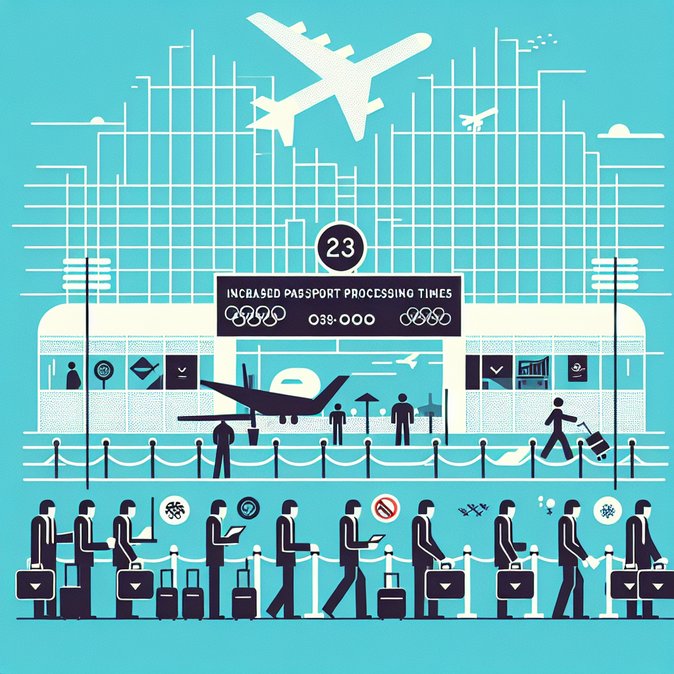
France’s international gateways are feeling the first real stress test of the European Union’s new Biometric Entry/Exit System (EES), which became fully operational on 10 April 2026. Data analysed by queue-monitoring firm Qsensor show that average wait times at passport control in Paris-Charles-de-Gaulle (CDG) and Paris-Orly (ORY) have risen by roughly 25 % since the launch, but the headline figure hides much sharper spikes.
![Biometric Entry/Exit System Triggers Two-Hour Queues at French Airports as Summer Rush Looms]()
If your organisation wants to spare travellers the worst of these delays, VisaHQ can help. Its dedicated France page (https://www.visahq.com/france/) tracks the latest EES requirements, offers step-by-step visa and passport pre-registration support, and provides concierge services that let corporate mobility teams streamline documentation long before employees reach the queue.
When multiple long-haul flights land within the same 20-minute window, non-EU travellers have reported lines stretching to 1 ½–2 hours, primarily because each passenger must complete a photo and four-fingerprint scan before seeing an officer. French border police say the technology is working “as designed” but acknowledge that staffing models were drawn up using average processing times of 40–50 seconds per traveller. Under peak loads, the biometric capture step alone can take that long, doubling the per-passenger transaction time. Airport operator ADP has re-opened mothballed queuing space in Halls 2E and 3 at CDG and plans to install 60 additional self-service registration kiosks before 1 June. The delays are already rippling into airline operations. Air France and easyJet have quietly extended minimum connection times for Schengen-to-non-Schengen transfers at CDG by 15 minutes, while long-haul carriers are urging transit passengers to leave at least three hours between flights. Ground-handling firms report an uptick in missed connections, especially among travellers arriving from North America on overnight services that converge in the 07:00–09:00 wave. For corporate mobility managers, the immediate advice is practical: insist that employees download the EU’s “Travel to Europe” app and pre-register their passport details; schedule morning meetings in Paris no earlier than noon on arrival days; and avoid tight intra-EU connections until the system stabilises. Looking ahead, the Interior Ministry has promised to fast-track “Registered Traveller” and crew-lane expansions by July, but unions warn that additional staff will be hard to recruit in time for the Olympic peak. If the bottlenecks persist, airlines may be forced to thin summer schedules or shift capacity to secondary airports such as Lyon or Nice, potentially reshaping corporate travel patterns across France.

If your organisation wants to spare travellers the worst of these delays, VisaHQ can help. Its dedicated France page (https://www.visahq.com/france/) tracks the latest EES requirements, offers step-by-step visa and passport pre-registration support, and provides concierge services that let corporate mobility teams streamline documentation long before employees reach the queue.
When multiple long-haul flights land within the same 20-minute window, non-EU travellers have reported lines stretching to 1 ½–2 hours, primarily because each passenger must complete a photo and four-fingerprint scan before seeing an officer. French border police say the technology is working “as designed” but acknowledge that staffing models were drawn up using average processing times of 40–50 seconds per traveller. Under peak loads, the biometric capture step alone can take that long, doubling the per-passenger transaction time. Airport operator ADP has re-opened mothballed queuing space in Halls 2E and 3 at CDG and plans to install 60 additional self-service registration kiosks before 1 June. The delays are already rippling into airline operations. Air France and easyJet have quietly extended minimum connection times for Schengen-to-non-Schengen transfers at CDG by 15 minutes, while long-haul carriers are urging transit passengers to leave at least three hours between flights. Ground-handling firms report an uptick in missed connections, especially among travellers arriving from North America on overnight services that converge in the 07:00–09:00 wave. For corporate mobility managers, the immediate advice is practical: insist that employees download the EU’s “Travel to Europe” app and pre-register their passport details; schedule morning meetings in Paris no earlier than noon on arrival days; and avoid tight intra-EU connections until the system stabilises. Looking ahead, the Interior Ministry has promised to fast-track “Registered Traveller” and crew-lane expansions by July, but unions warn that additional staff will be hard to recruit in time for the Olympic peak. If the bottlenecks persist, airlines may be forced to thin summer schedules or shift capacity to secondary airports such as Lyon or Nice, potentially reshaping corporate travel patterns across France.