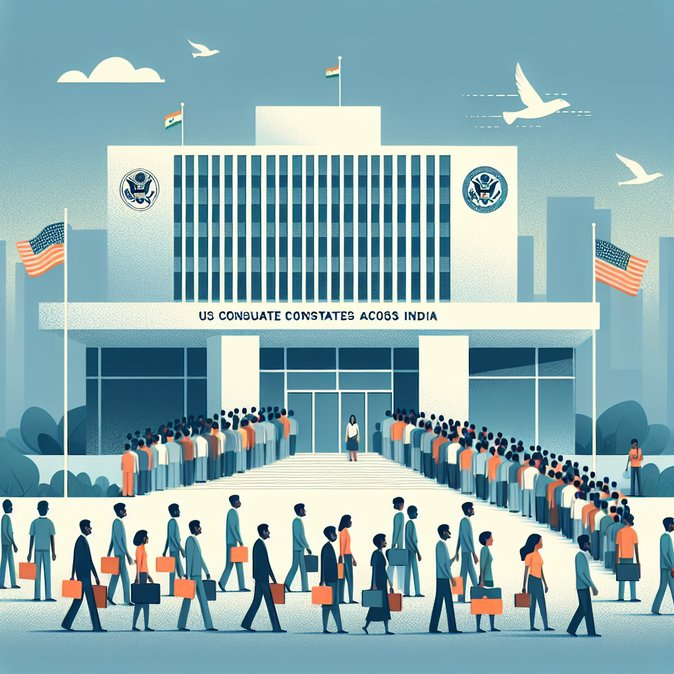
After a five-month drought that pushed appointment dates as far out as 2027, US consulates in Delhi, Mumbai, Chennai, Hyderabad and Kolkata have started opening limited interview slots for H-1B, H-4 and F-1 visas. The Financial Express reports that batches of dates began appearing on the scheduling portal in mid-April, and the Murthy Law Firm confirms “significant improvement” across all posts as of 23 April 2026. The backlog stemmed from stricter social-media vetting introduced on 15 December 2025, which slashed daily interview capacity.
![US Consulates in India Release Fresh H-1B and F-1 Interview Slots After Months-Long Freeze]()
Applicants who find themselves refreshing the portal at odd hours might consider turning to a professional facilitation service. VisaHQ, for instance, tracks slot availability in real time, alerts users when interview dates appear and offers guidance on document preparation for H-1B, H-4 and F-1 cases. Its India page (https://www.visahq.com/india/) also lists work-arounds for other travel documents, giving travellers and mobility teams an extra layer of support while the official system remains volatile.
Compounding matters, the State Department ended “third-country national” processing, forcing Indian applicants to book exclusively in India. Thousands of H-1B workers visiting family became stranded, while students heading for the Fall 2026 intake faced planning chaos. Although new slots are positive news, demand still outstrips supply. Mobility managers are advising employees not to travel unless essential, because missed interviews could still delay return to the US by months. Students with prior F-1 refusals remain excluded from early dates, and consultants warn that the system may take the rest of 2026 to stabilise. Companies with large US-bound assignee pools are reviving contingency plans: scheduling in-country status changes where possible, staggering business trips and pre-booking premium processing for extension petitions to avoid consular visits. The episode underscores the fragility of consular capacity as a single-point-of-failure in global mobility programmes.

Applicants who find themselves refreshing the portal at odd hours might consider turning to a professional facilitation service. VisaHQ, for instance, tracks slot availability in real time, alerts users when interview dates appear and offers guidance on document preparation for H-1B, H-4 and F-1 cases. Its India page (https://www.visahq.com/india/) also lists work-arounds for other travel documents, giving travellers and mobility teams an extra layer of support while the official system remains volatile.
Compounding matters, the State Department ended “third-country national” processing, forcing Indian applicants to book exclusively in India. Thousands of H-1B workers visiting family became stranded, while students heading for the Fall 2026 intake faced planning chaos. Although new slots are positive news, demand still outstrips supply. Mobility managers are advising employees not to travel unless essential, because missed interviews could still delay return to the US by months. Students with prior F-1 refusals remain excluded from early dates, and consultants warn that the system may take the rest of 2026 to stabilise. Companies with large US-bound assignee pools are reviving contingency plans: scheduling in-country status changes where possible, staggering business trips and pre-booking premium processing for extension petitions to avoid consular visits. The episode underscores the fragility of consular capacity as a single-point-of-failure in global mobility programmes.