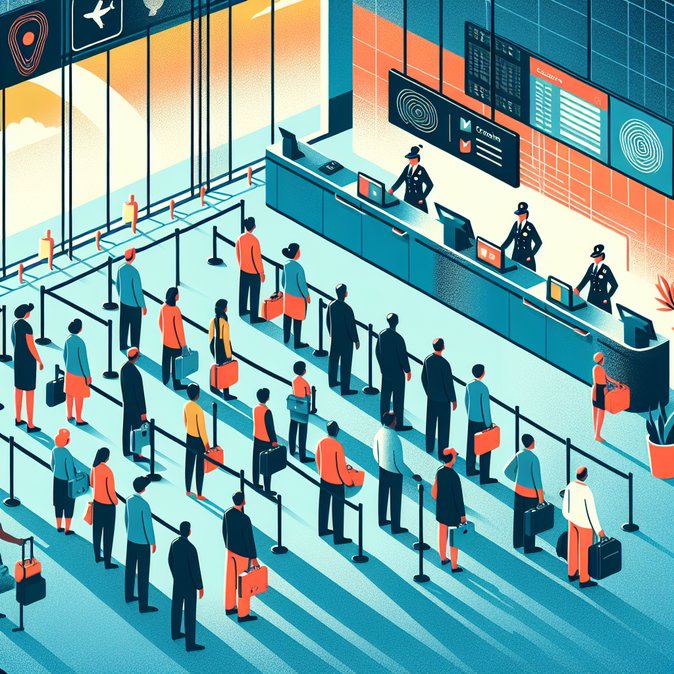
Barely a week after Austria activated the European Union’s new Entry/Exit System (EES) at all external borders on 10 April 2026, Vienna-Schwechat Airport is struggling to cope with the first major holiday rush. Travellers arriving from the United States, the United Kingdom and other visa-exempt third countries report waits of up to three hours for the initial biometric enrolment that replaces the traditional passport stamp. Airport management says first-time registration is taking an average of four minutes per person—far above the EU’s 70-second target—because many passengers arrive unprepared for the simultaneous fingerprint and facial-image capture. Airlines have already had to off-load connecting passengers who were still stuck in control queues when boarding closed; corporate travel managers are temporarily re-routing senior executives through Munich or Zurich until throughput improves. In response, the Interior Ministry has redeployed sixty additional border-police officers to Vienna and Salzburg airports and is piloting a fast-track lane for short-stay business travellers who hold recognised trusted-traveller cards. Officials stress that delays will fall as more frequent travellers complete their one-time enrolment and as self-service kiosks come fully online next month, but acknowledge that the Easter peak has exposed a short-term capacity gap. For multinational companies that use Vienna as a hub for Central and Eastern Europe, the disruption is more than a nuisance: missed connections ripple through tight meeting schedules, while per-diem budgets rise as travellers are forced to overnight. Mobility managers are advising employees to add at least 90 minutes to normal check-in times, carry printed proof of onward travel for secondary checks and register advance passenger information accurately to avoid additional manual processing.
![Long queues at Vienna-Schwechat after full switch-on of EU Entry/Exit System]()
In that context, travellers who want expert help navigating the new border formalities can turn to VisaHQ. Through its Austria portal (https://www.visahq.com/austria/), the service monitors EES developments in real time, provides personalised checklists and will be ready to pre-file data for the forthcoming ETIAS authorisation—saving passengers time and reducing the risk of last-minute surprises at the checkpoint.
Longer term, Austria sees the EES as essential to restoring confidence in Schengen external-border security and to paving the way for the delayed ETIAS electronic travel authorisation in late 2026. The challenge will be ensuring that the promised future efficiency gains materialise quickly enough to prevent Vienna’s reputation as a convenient business gateway from suffering lasting damage.

In that context, travellers who want expert help navigating the new border formalities can turn to VisaHQ. Through its Austria portal (https://www.visahq.com/austria/), the service monitors EES developments in real time, provides personalised checklists and will be ready to pre-file data for the forthcoming ETIAS authorisation—saving passengers time and reducing the risk of last-minute surprises at the checkpoint.
Longer term, Austria sees the EES as essential to restoring confidence in Schengen external-border security and to paving the way for the delayed ETIAS electronic travel authorisation in late 2026. The challenge will be ensuring that the promised future efficiency gains materialise quickly enough to prevent Vienna’s reputation as a convenient business gateway from suffering lasting damage.