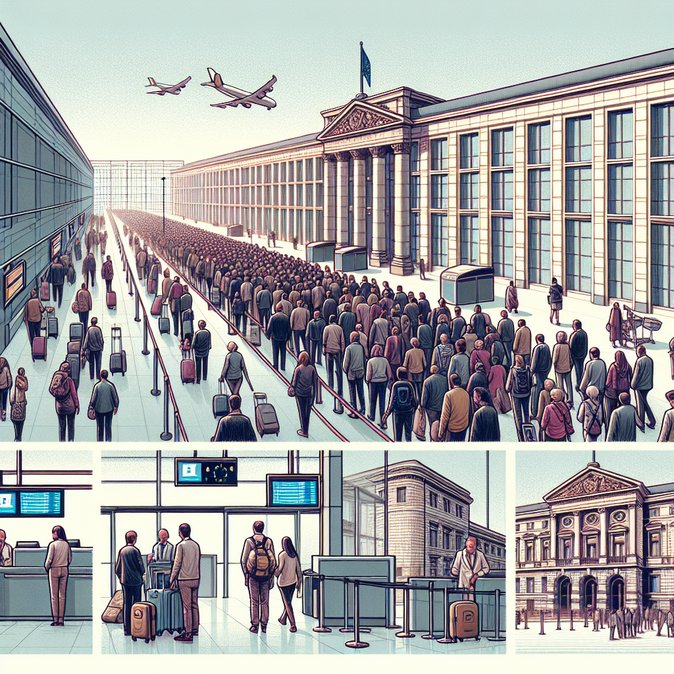
Italian airports are experiencing the first serious growing pains of the European Union’s new Entry/Exit System (EES), a fully digital register that replaces manual passport stamping for non-EU travellers. The system, which became mandatory on 10 April, requires every third-country passenger to scan their passport, have their photograph taken and submit four fingerprints before proceeding to immigration control. According to Airports Council International Europe (ACI Europe), the extra processing time has already produced queues of two to three hours in a dozen major gateways—including Rome Fiumicino, Milan Malpensa and Venice Marco Polo—and left more than a hundred travellers stranded when an easyJet flight from Milan to Manchester closed its doors before they could clear the formalities. Border officials say that a single first-time registration can take up to five minutes if a kiosk fails to read fingerprints, while the European Commission insists the average is 70 seconds. Even that figure represents a sizeable jump from the ten-second manual stamp that business travellers were used to. With summer traffic still weeks away, ACI’s director Olivier Jankovec has warned that “without the power to suspend registrations when queues become unmanageable, airports will grind to a halt.”
Italy’s Interior Ministry is reported to be working on contingency staffing plans, including the fast-tracking of 450 auxiliary officers from the Guardia di Finanza to reinforce border booths at Fiumicino and Malpensa from May. For globally mobile companies, the immediate impact is felt in missed connections, longer duty-of-care exposure and higher costs. Travel managers for several Milan-based multinationals told Il Sole 24 Ore that they are re-routing executives through Zurich or Vienna to minimise the risk of an Italian outbound bottleneck, and advising staff to arrive at the airport four hours before departure.
![Italy Faces Three-Hour Passport Queues as EU Entry/Exit System Goes Live]()
For travellers and program managers looking for extra peace of mind, VisaHQ can streamline the paperwork and preparation needed for smooth entry to Italy. The company offers real-time updates on EES requirements, passport validity checks and facilitated visa and residence services; more information is available at https://www.visahq.com/italy/
Airlines are equally worried: ITA Airways has updated its Conditions of Carriage to state that passengers who miss a flight because of EES delays will not be re-booked free of charge unless the authorities formally declare a force-majeure disruption. The government sees little room for manoeuvre. Italy backed the biometric system as a security upgrade after the 2015 Paris attacks, and officials point out that law-enforcement hits are already rising—nearly 700 travellers with outstanding warrants were flagged across the bloc in the first five days of operation, according to Commission data. Nevertheless, Rome is lobbying Brussels for a 90-day ‘grace period’ that would allow repeat visitors with a clean passport-control record to bypass full biometric capture during peak hours, a proposal now under review by the EU Council’s Justice and Home Affairs working group. Practical tips for companies and travellers: (1) register once and keep the confirmation QR-code handy—repeat visits within three years require only a passport scan; (2) use airports with the newest self-service kiosks (Rome FCO’s Terminal 3 and Milan MXP’s Terminal 1) where failure rates are lower; (3) build extra buffer time into meetings and flight schedules; and (4) remind U.S. and U.K. employees that the EES is separate from ETIAS, the travel authorisation that is now expected to launch in late 2026.
Italy’s Interior Ministry is reported to be working on contingency staffing plans, including the fast-tracking of 450 auxiliary officers from the Guardia di Finanza to reinforce border booths at Fiumicino and Malpensa from May. For globally mobile companies, the immediate impact is felt in missed connections, longer duty-of-care exposure and higher costs. Travel managers for several Milan-based multinationals told Il Sole 24 Ore that they are re-routing executives through Zurich or Vienna to minimise the risk of an Italian outbound bottleneck, and advising staff to arrive at the airport four hours before departure.
For travellers and program managers looking for extra peace of mind, VisaHQ can streamline the paperwork and preparation needed for smooth entry to Italy. The company offers real-time updates on EES requirements, passport validity checks and facilitated visa and residence services; more information is available at https://www.visahq.com/italy/
Airlines are equally worried: ITA Airways has updated its Conditions of Carriage to state that passengers who miss a flight because of EES delays will not be re-booked free of charge unless the authorities formally declare a force-majeure disruption. The government sees little room for manoeuvre. Italy backed the biometric system as a security upgrade after the 2015 Paris attacks, and officials point out that law-enforcement hits are already rising—nearly 700 travellers with outstanding warrants were flagged across the bloc in the first five days of operation, according to Commission data. Nevertheless, Rome is lobbying Brussels for a 90-day ‘grace period’ that would allow repeat visitors with a clean passport-control record to bypass full biometric capture during peak hours, a proposal now under review by the EU Council’s Justice and Home Affairs working group. Practical tips for companies and travellers: (1) register once and keep the confirmation QR-code handy—repeat visits within three years require only a passport scan; (2) use airports with the newest self-service kiosks (Rome FCO’s Terminal 3 and Milan MXP’s Terminal 1) where failure rates are lower; (3) build extra buffer time into meetings and flight schedules; and (4) remind U.S. and U.K. employees that the EES is separate from ETIAS, the travel authorisation that is now expected to launch in late 2026.