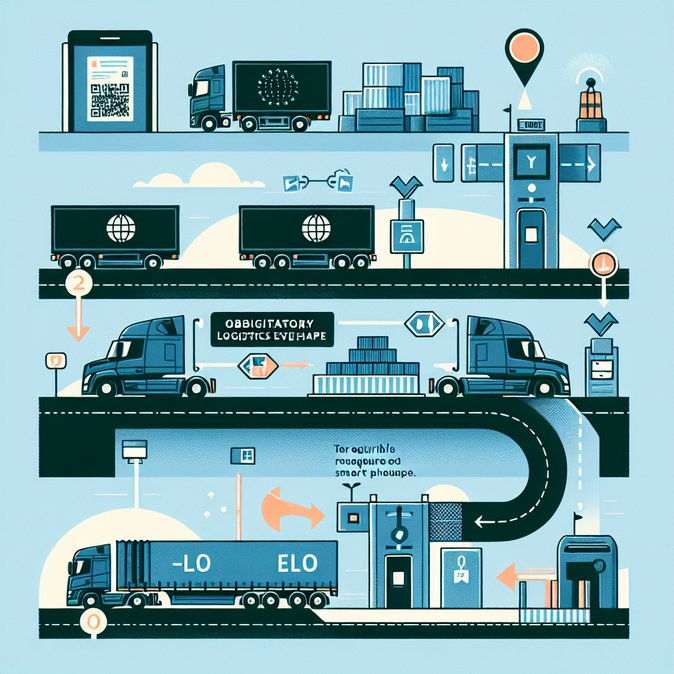
Hauliers moving freight between France and the United Kingdom have just one week left to adjust to a new digital paperwork mandate. French Customs confirmed on 13 April that, from 20 April 2026, every truck—loaded or empty—using the so-called Smart Border at Calais, Dunkirk or the Channel Tunnel must present an ELO (Envelope Logistique Obligatoire) barcode at check-in. Vehicles arriving without an ELO risk being refused boarding or having their customs declarations rejected in transit. The ELO consolidates all key border references—ENS safety filings, MRN numbers and transit data—into a single scannable code that is linked to the truck for the entire crossing. While the application has been live on the douane.gouv.fr portal since April 2025, uptake among smaller operators remains patchy. French officials stress that ‘one truck equals one ELO’ and recommend creating the envelope only after the ENS reference is issued to avoid mismatches.
![Truckers face ‘no ELO, no crossing’ rule on France-UK Smart Border from 20 April]()
Companies that need extra reassurance when preparing cross-border documentation can tap into VisaHQ’s services. Their France page (https://www.visahq.com/france/) keeps all the latest requirements in one place and allows fleet managers to organise driver visas, passport validity checks and supporting customs paperwork alongside ELO creation, streamlining compliance ahead of the new deadline.
Logistics companies should revisit their standard-operating procedures immediately. The sequencing is critical: file the Import Control System 2 (ICS2) safety declaration, obtain the ENS MRN, generate the ELO, then dispatch the vehicle. Any break in the chain could force drivers to park in holding areas, triggering costly delays and missing ferry slots. The new rule arrives as cross-Channel volumes rebound to pre-Brexit levels and just ahead of a summer peak freight period linked to construction projects for the Paris Olympics. Failure to comply could snarl just-in-time supply chains for automotive plants in northern France and distribution hubs in the Midlands. 3PLs should test their IT interfaces with the Customs API this week and train drivers to present the barcode—paper or digital—at French ferry terminals.

Companies that need extra reassurance when preparing cross-border documentation can tap into VisaHQ’s services. Their France page (https://www.visahq.com/france/) keeps all the latest requirements in one place and allows fleet managers to organise driver visas, passport validity checks and supporting customs paperwork alongside ELO creation, streamlining compliance ahead of the new deadline.
Logistics companies should revisit their standard-operating procedures immediately. The sequencing is critical: file the Import Control System 2 (ICS2) safety declaration, obtain the ENS MRN, generate the ELO, then dispatch the vehicle. Any break in the chain could force drivers to park in holding areas, triggering costly delays and missing ferry slots. The new rule arrives as cross-Channel volumes rebound to pre-Brexit levels and just ahead of a summer peak freight period linked to construction projects for the Paris Olympics. Failure to comply could snarl just-in-time supply chains for automotive plants in northern France and distribution hubs in the Midlands. 3PLs should test their IT interfaces with the Customs API this week and train drivers to present the barcode—paper or digital—at French ferry terminals.