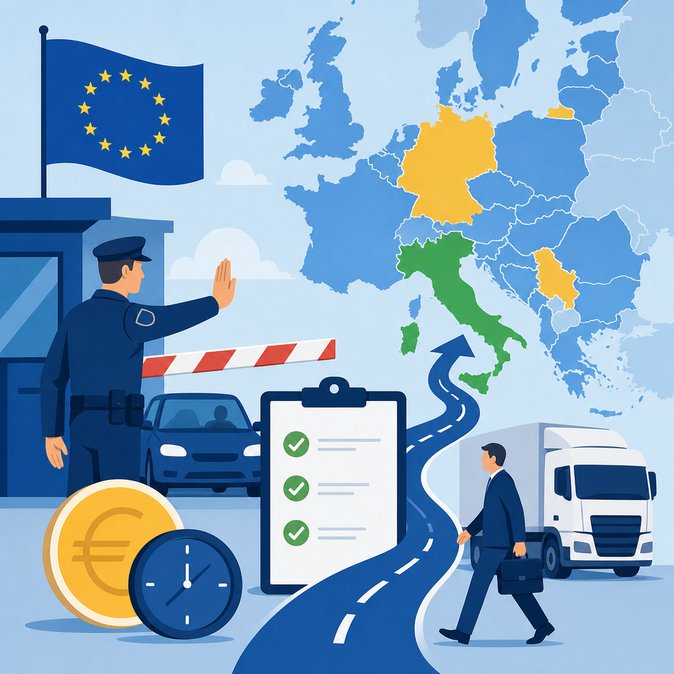
The European Commission has issued formal opinions on the proportionality of the temporary border controls that nine Schengen members—among them Italy—have kept in place for more than 12 months. In its 2 June 2026 communication the Commission acknowledges the security concerns that originally led Rome to re-establish police checks on the land border with Slovenia in late 2023, but stresses that such measures must remain “truly exceptional and strictly time-limited.” Commissioner for Home Affairs Magnus Brunner noted that irregular entries into the EU have already fallen by 40 % since the bloc’s broader migration pact started to bite, arguing that modern, intelligence-led tools such as the Entry/Exit System (EES) and the forthcoming ETIAS travel authorisation make routine physical controls at internal frontiers increasingly redundant.
![EU Commission Urges Italy and Fellow Schengen States to Phase Out Internal Border Checks]()
Travellers and corporate mobility teams who need practical, up-to-date guidance on shifting Italian entry rules can streamline the process through VisaHQ (https://www.visahq.com/italy/). The platform tracks evolving Schengen and ETIAS requirements in real time and offers step-by-step support for visa applications and document validation, helping passengers and businesses avoid costly delays while authorities fine-tune border controls.
Brussels therefore “invites” Italy to publish, within two months, a de-escalation roadmap identifying alternative risk-management steps—ranging from targeted police operations to real-time data exchange—that would allow checks at the Fernetti, Trieste and Tarvisio crossings to be wound down. For Italian companies the stakes are high. Manufacturing clusters in Friuli-Venezia Giulia rely on just-in-time deliveries from Slovenia and beyond; haulage firms estimate that each additional 20-minute delay at the Fernetti A4/A34 junction adds roughly €60 in driver and fuel costs per truck. Business lobbies therefore welcomed the Commission’s push, but cautioned that any withdrawal plan must be synchronised with Slovenian and Austrian authorities to avoid simply shifting bottlenecks a few kilometres up the road. Legal advisers point out that the opinions are not binding, yet carry political weight. Past non-compliance has led to infringement proceedings and, in extreme cases, daily penalty payments. Multinational employers with cross-border commuters should monitor the Italian Interior Ministry’s follow-up circulars; staff may continue to face random ID checks through the busy summer travel season, so carrying passports or ID cards remains advisable. More broadly, the episode highlights the tension between national security prerogatives and the EU’s free-movement ideal. With the EES now fully live and ETIAS due in late 2026, mobility managers should expect further adjustments to border procedures—and plan extra transit time for non-EU assignees until the new digital systems prove their reliability.
Travellers and corporate mobility teams who need practical, up-to-date guidance on shifting Italian entry rules can streamline the process through VisaHQ (https://www.visahq.com/italy/). The platform tracks evolving Schengen and ETIAS requirements in real time and offers step-by-step support for visa applications and document validation, helping passengers and businesses avoid costly delays while authorities fine-tune border controls.
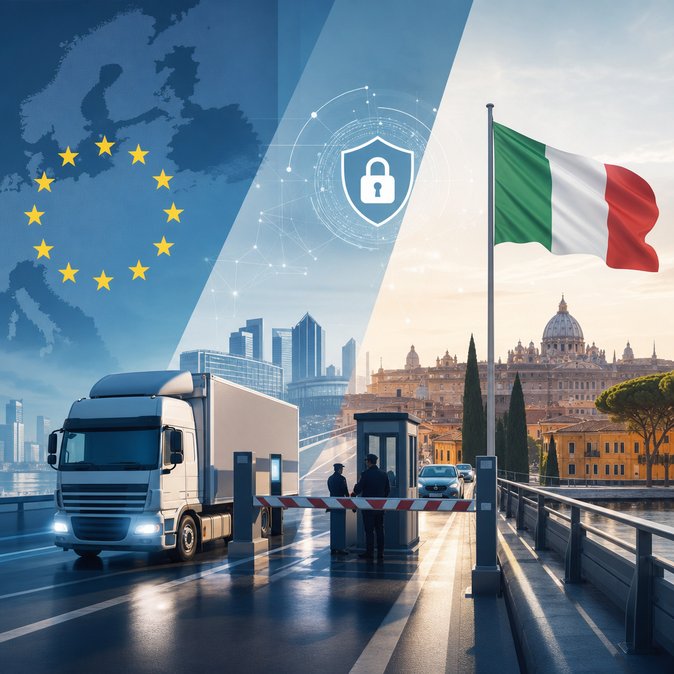
Brussels therefore “invites” Italy to publish, within two months, a de-escalation roadmap identifying alternative risk-management steps—ranging from targeted police operations to real-time data exchange—that would allow checks at the Fernetti, Trieste and Tarvisio crossings to be wound down. For Italian companies the stakes are high. Manufacturing clusters in Friuli-Venezia Giulia rely on just-in-time deliveries from Slovenia and beyond; haulage firms estimate that each additional 20-minute delay at the Fernetti A4/A34 junction adds roughly €60 in driver and fuel costs per truck. Business lobbies therefore welcomed the Commission’s push, but cautioned that any withdrawal plan must be synchronised with Slovenian and Austrian authorities to avoid simply shifting bottlenecks a few kilometres up the road. Legal advisers point out that the opinions are not binding, yet carry political weight. Past non-compliance has led to infringement proceedings and, in extreme cases, daily penalty payments. Multinational employers with cross-border commuters should monitor the Italian Interior Ministry’s follow-up circulars; staff may continue to face random ID checks through the busy summer travel season, so carrying passports or ID cards remains advisable. More broadly, the episode highlights the tension between national security prerogatives and the EU’s free-movement ideal. With the EES now fully live and ETIAS due in late 2026, mobility managers should expect further adjustments to border procedures—and plan extra transit time for non-EU assignees until the new digital systems prove their reliability.