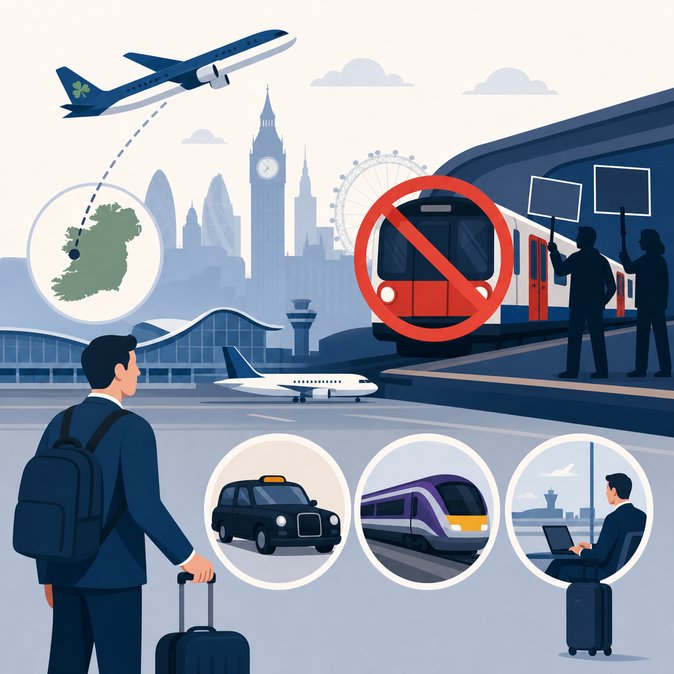
Irish executives heading to the UK capital this week have been advised to budget extra transfer time after strikes by the Rail, Maritime and Transport (RMT) union shut multiple London Underground lines on 2 June, with a second 24-hour walk-out scheduled for 4 June. Transport for London (TfL) confirmed there will be no service on the Piccadilly line—which links Heathrow Terminals 2, 3, 4 and 5 to central London—between early afternoon and late evening, forcing arriving passengers onto rail-replacement buses or the higher-cost Heathrow Express.
![London Underground strikes create knock-on headaches for Irish business travellers transiting Heathrow]()
If the last-minute travel upheaval means you need to review documentation or secure an urgent UK visa, VisaHQ can streamline the process. The company’s Ireland portal (https://www.visahq.com/ireland/) provides step-by-step guidance on application forms, transit rules and courier options, helping Irish professionals adjust itineraries quickly when strikes or other disruptions hit.
With more than 50 daily flights connecting Dublin, Cork, Shannon and Belfast to Heathrow, the Tube disruption affects hundreds of Irish commuters attending board meetings, industry conferences and embassy appointments. Travel-management companies are urging clients to pre-book taxis and allow at least 90 minutes to clear the airport and reach central districts such as Canary Wharf or the West End. Those connecting to onward Eurostar or domestic rail services via Paddington, King’s Cross or St Pancras may need to factor in longer surface journeys. The strike centres on proposed changes to driver scheduling that introduce an optional four-day work-week but could lengthen individual shifts. Although TfL insists the plan is voluntary, the RMT argues it would erode safety margin and work-life balance. ACAS-brokered talks failed to yield an agreement, prompting the two-day action. TfL expects limited services before 06:30 and after 21:00, but advises passengers to finish journeys early. Irish firms with time-sensitive engagements in London are revising itineraries: some have moved meetings online while others are routing travellers to London City or Gatwick, though both options carry higher fares and potential slot constraints. The Irish Business & Employers Confederation (Ibec) said the episode underscores the strategic value of direct European services from Dublin, bypassing Heathrow where feasible. While the immediate disruption is London-centric, it highlights a broader trend of transport-sector labour unrest across Europe. Mobility managers should monitor emerging strike ballots in France, Spain and Italy that could compound summer travel complexity for Ireland-based multinationals.

If the last-minute travel upheaval means you need to review documentation or secure an urgent UK visa, VisaHQ can streamline the process. The company’s Ireland portal (https://www.visahq.com/ireland/) provides step-by-step guidance on application forms, transit rules and courier options, helping Irish professionals adjust itineraries quickly when strikes or other disruptions hit.
With more than 50 daily flights connecting Dublin, Cork, Shannon and Belfast to Heathrow, the Tube disruption affects hundreds of Irish commuters attending board meetings, industry conferences and embassy appointments. Travel-management companies are urging clients to pre-book taxis and allow at least 90 minutes to clear the airport and reach central districts such as Canary Wharf or the West End. Those connecting to onward Eurostar or domestic rail services via Paddington, King’s Cross or St Pancras may need to factor in longer surface journeys. The strike centres on proposed changes to driver scheduling that introduce an optional four-day work-week but could lengthen individual shifts. Although TfL insists the plan is voluntary, the RMT argues it would erode safety margin and work-life balance. ACAS-brokered talks failed to yield an agreement, prompting the two-day action. TfL expects limited services before 06:30 and after 21:00, but advises passengers to finish journeys early. Irish firms with time-sensitive engagements in London are revising itineraries: some have moved meetings online while others are routing travellers to London City or Gatwick, though both options carry higher fares and potential slot constraints. The Irish Business & Employers Confederation (Ibec) said the episode underscores the strategic value of direct European services from Dublin, bypassing Heathrow where feasible. While the immediate disruption is London-centric, it highlights a broader trend of transport-sector labour unrest across Europe. Mobility managers should monitor emerging strike ballots in France, Spain and Italy that could compound summer travel complexity for Ireland-based multinationals.