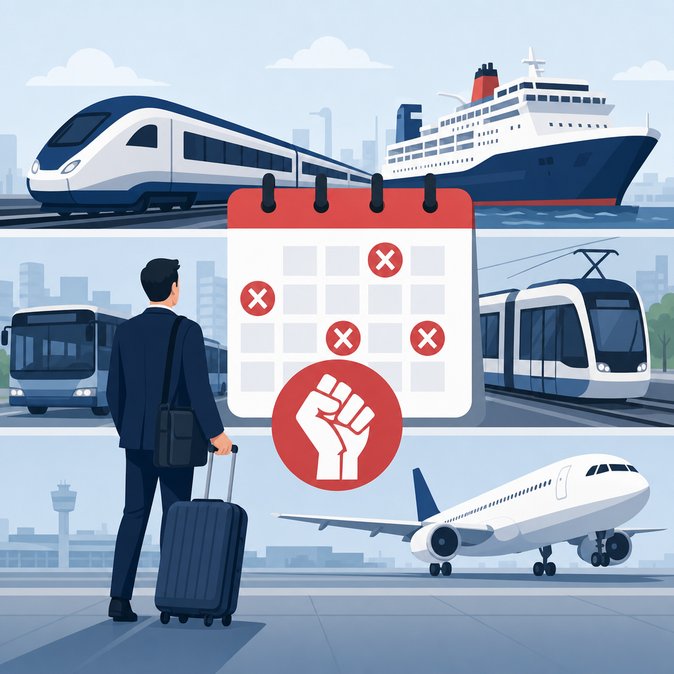
Italy’s busy summer conference and holiday season is set to collide with a dense calendar of industrial action. A strike digest published by Sky TG24 on 1 June lays out more than two dozen walk-outs planned between 8 and 30 June, many of them in the transport sector. Local transit stoppages kick off on 8 June in Messina, Catania and several Emilia-Romagna cities, while a nationwide eight-hour rail strike called by six unions is scheduled for 11 June. Maritime unions have separate actions on 10 and 11 June, targeting port services in Ravenna and fast-ferry operator BluJet in the Strait of Messina. For air travellers, the critical date is 13 June, when air-navigation service ENAV staff at Verona airport, ground-handling crews at Milan Linate, and parts of Cagliari’s Sogaerd workforce will stop for periods ranging from four to 18 hours. Although minimum-service guarantees will keep some flights moving, travellers should expect ripple-effects throughout the network as rotations and crews fall out of sequence. Under Italy’s strike‐regulation law, employers must publish contingency timetables at least 24 hours in advance.
![June Wave of Transport Strikes Could Snarl Travel Across Italy]()
Meanwhile, international travelers who still need to secure the correct entry documents can save valuable time by using VisaHQ’s online platform. The service streamlines Italian visa applications, provides real-time status updates, and can coordinate courier delivery—an advantage when last-minute itinerary changes are likely. Find full details at https://www.visahq.com/italy/
Corporate mobility managers are therefore advised to monitor airline alerts closely, consider ticket flexibility for critical trips and brief travellers on their right to care and re-routing under EU261. Employers with posted workers should also check whether contractual deadlines can be tolled if journeys are delayed by a legally protected strike – Italian courts have accepted force-majeure arguments in previous nationwide transport actions. Beyond immediate disruption, June’s strike wave highlights lingering labour-cost and staffing tensions as transport operators navigate higher wage settlements and still-uneven post-pandemic demand. Companies running tight project schedules in Italy this month would be wise to build extra lead-time into itineraries and shipping windows.

Meanwhile, international travelers who still need to secure the correct entry documents can save valuable time by using VisaHQ’s online platform. The service streamlines Italian visa applications, provides real-time status updates, and can coordinate courier delivery—an advantage when last-minute itinerary changes are likely. Find full details at https://www.visahq.com/italy/
Corporate mobility managers are therefore advised to monitor airline alerts closely, consider ticket flexibility for critical trips and brief travellers on their right to care and re-routing under EU261. Employers with posted workers should also check whether contractual deadlines can be tolled if journeys are delayed by a legally protected strike – Italian courts have accepted force-majeure arguments in previous nationwide transport actions. Beyond immediate disruption, June’s strike wave highlights lingering labour-cost and staffing tensions as transport operators navigate higher wage settlements and still-uneven post-pandemic demand. Companies running tight project schedules in Italy this month would be wise to build extra lead-time into itineraries and shipping windows.