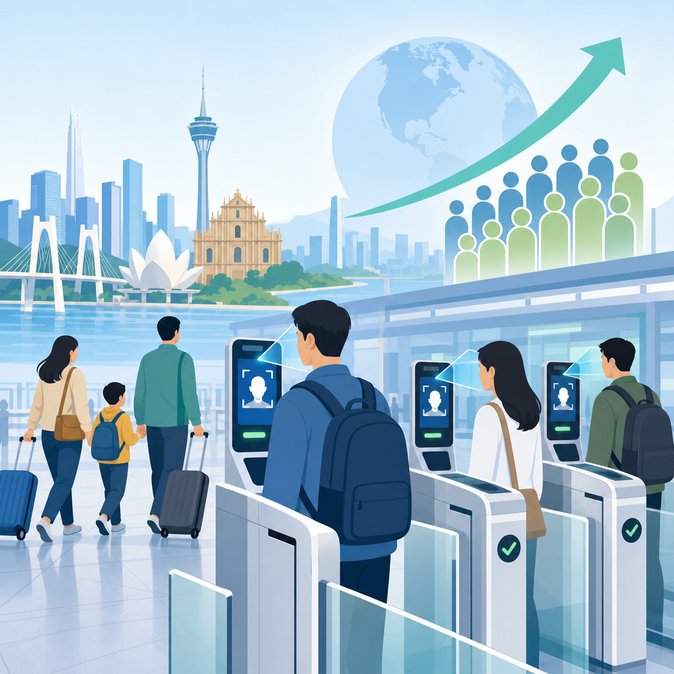
China’s busiest land-sea border hub has hit a milestone long before the year is half over. Zhuhai Border Inspection, which manages the Hong Kong-Zhuhai-Macau Bridge, Hengqin and other checkpoints, confirmed on 30 May that cumulative traveller throughput for 2026 has topped 100 million, a target reached 16 days earlier than in 2025. Foreign nationals accounted for roughly one million entries so far—a 25 percent jump year-on-year—mirroring the rebound in international conferences and casino-related tourism on the Macau side. Officials attribute the acceleration to the rapid roll-out of “brush-face” smart e-channels. Since mid-2024, the station has replaced traditional fingerprint kiosks with AI-driven facial-verification gates linked to the National Immigration Administration’s risk engine.
![Zhuhai border inspection passes 100 million travellers for 2026—16 days ahead of last year as facial-recognition gates dominate]()
For travellers who still need a visa despite the growing array of exemptions, VisaHQ can streamline the paperwork. The online service walks you through China’s application requirements, submits documents on your behalf and provides live status alerts—ideal for businesspeople shuttling between Hong Kong, Macau and Guangdong’s manufacturing hubs. Check the latest options at https://www.visahq.com/china/ before planning your next crossing.
More than 70 percent of departures and arrivals now clear immigration in under 20 seconds, and the agency expects that ratio to reach 90 percent by the National Day Golden Week. Infrastructure upgrades are dovetailing with policy liberalisation. Macau residents can use electronic self-service lanes with their Home Return Permits, while increasing numbers of Hong Kong business travellers are using the 168-hour visa-free transit to attend meetings in nearby Zhongshan and Foshan. The border force has also embedded customs, immigration and quarantine officials into a joint command centre, shortening the average vehicle inspection on the Bridge to 45 seconds—crucial for just-in-time supply chains serving the Pearl River Delta’s electronics clusters. For companies relocating staff between Macau and mainland project sites, the data confirm that the GBA’s most critical choke point is becoming less of a bottleneck. HR teams should encourage frequent commuters to enrol in the facial e-channel system, which is free but requires a one-time biometric capture. Travellers should also note that during peak summer weekends, pedestrian volumes still exceed design capacity; scheduling crossings outside 10:00–12:00 and 17:00–19:00 reduces wait-time risk.

For travellers who still need a visa despite the growing array of exemptions, VisaHQ can streamline the paperwork. The online service walks you through China’s application requirements, submits documents on your behalf and provides live status alerts—ideal for businesspeople shuttling between Hong Kong, Macau and Guangdong’s manufacturing hubs. Check the latest options at https://www.visahq.com/china/ before planning your next crossing.
More than 70 percent of departures and arrivals now clear immigration in under 20 seconds, and the agency expects that ratio to reach 90 percent by the National Day Golden Week. Infrastructure upgrades are dovetailing with policy liberalisation. Macau residents can use electronic self-service lanes with their Home Return Permits, while increasing numbers of Hong Kong business travellers are using the 168-hour visa-free transit to attend meetings in nearby Zhongshan and Foshan. The border force has also embedded customs, immigration and quarantine officials into a joint command centre, shortening the average vehicle inspection on the Bridge to 45 seconds—crucial for just-in-time supply chains serving the Pearl River Delta’s electronics clusters. For companies relocating staff between Macau and mainland project sites, the data confirm that the GBA’s most critical choke point is becoming less of a bottleneck. HR teams should encourage frequent commuters to enrol in the facial e-channel system, which is free but requires a one-time biometric capture. Travellers should also note that during peak summer weekends, pedestrian volumes still exceed design capacity; scheduling crossings outside 10:00–12:00 and 17:00–19:00 reduces wait-time risk.