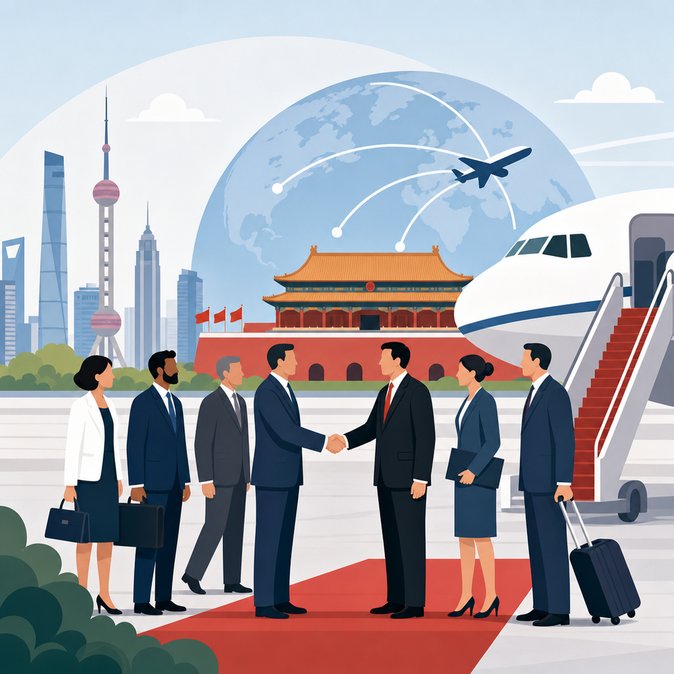
BEIJING – A People’s Daily commentary published on 27 May highlights a surge of foreign leaders and business delegations visiting China in recent months, arguing that the trend reflects global confidence in the country’s development trajectory and expanded opening-up. Author He Yin notes that since early May heads of state from Tajikistan, the United States, Russia, Pakistan and Serbia have all chosen Beijing as a diplomatic first stop, joining earlier visits by leaders from France, South Korea, Canada, the UK and others. Behind the uptick is a toolbox of mobility facilitators rolled out by Chinese authorities: a fast-growing roster of visa-free countries now covering much of Europe, Latin America and the Gulf; 240-hour transit exemptions at 65 ports; and pilot electronic visa systems in India and South Africa. Combined with restored direct flights and a business-friendly health-check regime, these measures have slashed trip-planning friction for official delegations and corporate entourages alike.
![Commentary: Wave of High-Level Visits to Beijing Underscores China’s ‘Open-Door’ Diplomacy]()
For individual travelers and corporate mobility teams trying to keep pace with these shifting rules, VisaHQ offers a one-stop solution: the platform tracks every Chinese entry policy change in real time, pre-screens documentation and submits visa applications online, even arranging courier pickup of passports when required. Its China portal (https://www.visahq.com/china/) can shave days off the approval cycle and is equally handy for securing travel documents to other global markets.
For multinationals the commentary’s timing is symbolic. President Xi Jinping told CEOs accompanying U.S. President Donald Trump that China will “open its door still wider,” while AmCham China’s latest survey shows 52 percent of U.S. firms expect to be profitable in 2026, up six points year-on-year. Analysts note that ease of physical access is a prerequisite for such investment optimism. The op-ed also frames mobility as soft power. By welcoming diverse leaders—from G7 economies to Global South partners—Beijing positions itself as a diplomatic “bridge builder” and projects an image of stability amid global turbulence. Business travel consultants say the flurry of summits is already driving demand for premium air seats and short-notice hotel blocks, prompting companies to revisit China-entry playbooks suspended during the pandemic era. Practically, firms are advised to monitor protocol windows: during state visits certain air routes and downtown perimeters face temporary restrictions, and foreign travelers should file event schedules with local public-security bureaus to ensure smooth accreditation. Yet the overarching message is clear: China’s high-level welcome mat is back, and organisations that master the new mobility rules will gain privileged access to an increasingly pivotal market.

For individual travelers and corporate mobility teams trying to keep pace with these shifting rules, VisaHQ offers a one-stop solution: the platform tracks every Chinese entry policy change in real time, pre-screens documentation and submits visa applications online, even arranging courier pickup of passports when required. Its China portal (https://www.visahq.com/china/) can shave days off the approval cycle and is equally handy for securing travel documents to other global markets.
For multinationals the commentary’s timing is symbolic. President Xi Jinping told CEOs accompanying U.S. President Donald Trump that China will “open its door still wider,” while AmCham China’s latest survey shows 52 percent of U.S. firms expect to be profitable in 2026, up six points year-on-year. Analysts note that ease of physical access is a prerequisite for such investment optimism. The op-ed also frames mobility as soft power. By welcoming diverse leaders—from G7 economies to Global South partners—Beijing positions itself as a diplomatic “bridge builder” and projects an image of stability amid global turbulence. Business travel consultants say the flurry of summits is already driving demand for premium air seats and short-notice hotel blocks, prompting companies to revisit China-entry playbooks suspended during the pandemic era. Practically, firms are advised to monitor protocol windows: during state visits certain air routes and downtown perimeters face temporary restrictions, and foreign travelers should file event schedules with local public-security bureaus to ensure smooth accreditation. Yet the overarching message is clear: China’s high-level welcome mat is back, and organisations that master the new mobility rules will gain privileged access to an increasingly pivotal market.