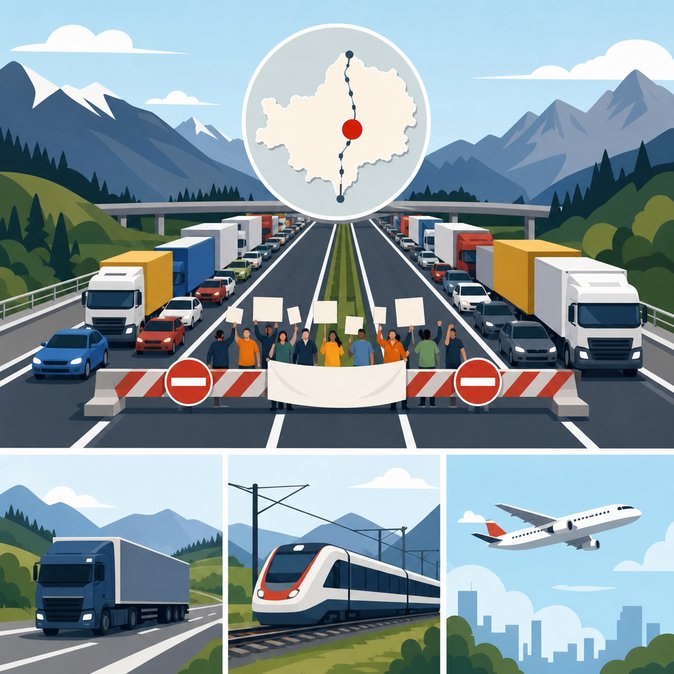
Austria’s motorway operator ASFINAG and the Tirol provincial government have urged travellers to avoid the Brenner route entirely this Saturday, 30 May 2026, when an authorised environmental demonstration will block the A13 motorway between Schönberg toll plaza and the Italian border from 11:00 to 19:00 (LKW from 09:00). Authorities predict gridlock not only on the A13 but also on alternative north-south arteries such as the Tauern (A10) and Pyhrn (A9) motorways, which are already strained by Whitsun holiday traffic from Germany and Italy’s 2 June public holiday.
![Brenner corridor to shut on 30 May: Austria issues stark warning to business travellers and freight operators]()
If you suddenly need to reroute personnel through Austria because of the closure, VisaHQ can streamline the visa or transit-document process for drivers, technicians and other mobile staff. Their Austria portal (https://www.visahq.com/austria/) lets companies check real-time entry requirements, submit applications online and receive alerts on any rule changes—vital when contingency plans force last-minute itinerary shifts.
Tirol will simultaneously close secondary roads in the Wipptal to prevent rat-running; even local residents will face detours. Extra traffic managers, police and tunnel crews are being deployed, and overnight works in the Landeck Tunnel have been paused to free capacity. For companies moving mobile workers, project cargo or time-critical samples through the Alps, the advice is clear: reschedule movements or reroute via Switzerland or the Tauern–Katschberg axis, adding at least half a day’s buffer. Firms that must travel should top up fuel, carry water and expect multi-hour queues at border approaches. Airlines have reported a spike in last-minute bookings on Munich-Innsbruck flights as travellers seek to bypass the road closure. The blockade has provoked sharp criticism south of the border: Italian politicians warn of economic fallout, noting that up to 10 % of Italy’s trade flows over the Brenner each day. German media, meanwhile, point to the protest as the latest flashpoint in the long-running Alpine transit dispute between Austria, Italy and Bavaria over emissions, nightly HGV quotas and weekend driving bans. With peak summer traffic only weeks away, mobility managers with pan-European road programmes should map contingency routes and brief drivers on Austria’s ad-hoc closure powers under its Demonstrationsgesetz. The incident also underscores the importance of multimodal options—especially the Brenner Base Tunnel rail link, now scheduled to open in 2030—for sustainable employee mobility across the Alps.
If you suddenly need to reroute personnel through Austria because of the closure, VisaHQ can streamline the visa or transit-document process for drivers, technicians and other mobile staff. Their Austria portal (https://www.visahq.com/austria/) lets companies check real-time entry requirements, submit applications online and receive alerts on any rule changes—vital when contingency plans force last-minute itinerary shifts.
Tirol will simultaneously close secondary roads in the Wipptal to prevent rat-running; even local residents will face detours. Extra traffic managers, police and tunnel crews are being deployed, and overnight works in the Landeck Tunnel have been paused to free capacity. For companies moving mobile workers, project cargo or time-critical samples through the Alps, the advice is clear: reschedule movements or reroute via Switzerland or the Tauern–Katschberg axis, adding at least half a day’s buffer. Firms that must travel should top up fuel, carry water and expect multi-hour queues at border approaches. Airlines have reported a spike in last-minute bookings on Munich-Innsbruck flights as travellers seek to bypass the road closure. The blockade has provoked sharp criticism south of the border: Italian politicians warn of economic fallout, noting that up to 10 % of Italy’s trade flows over the Brenner each day. German media, meanwhile, point to the protest as the latest flashpoint in the long-running Alpine transit dispute between Austria, Italy and Bavaria over emissions, nightly HGV quotas and weekend driving bans. With peak summer traffic only weeks away, mobility managers with pan-European road programmes should map contingency routes and brief drivers on Austria’s ad-hoc closure powers under its Demonstrationsgesetz. The incident also underscores the importance of multimodal options—especially the Brenner Base Tunnel rail link, now scheduled to open in 2030—for sustainable employee mobility across the Alps.
More From Austria
View all
Interior Minister Karner in Romania: Austria reaffirms hard line on Schengen expansion and border security

Austria records 45 % plunge in asylum claims, citing tougher controls and EU cooperation