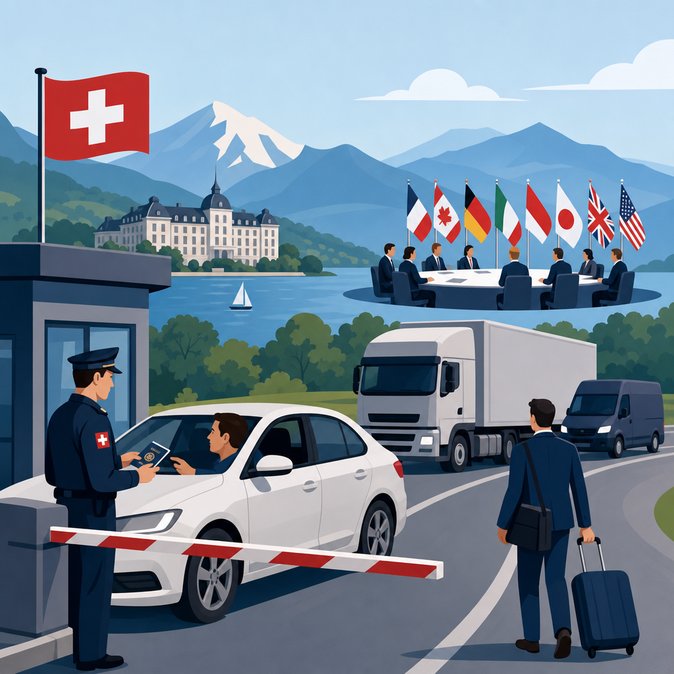
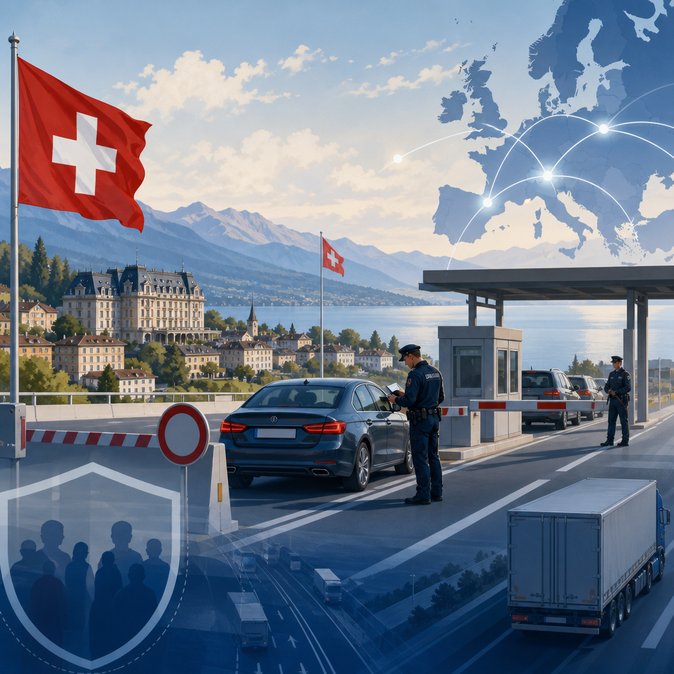
Switzerland will temporarily suspend the principle of free movement within the Schengen area and re-introduce controls on its land and lake borders with France from 10 to 19 June 2026. The Federal Council’s notification, published via the EU’s Schengen Early-Warning Mechanism, states that the measure is strictly linked to security around the G7 leaders’ meeting in neighbouring Évian-les-Bains (15-17 June). Passport and customs checks will affect road, rail and lake routes around Geneva and the Rhône valley, and mobile units will operate up to 20 km inside Swiss territory. Commercial drivers and cross-border commuters should therefore plan for extended journey times and carry proof of employment or assignment letters. The Swiss step comes as two other Schengen members have just prolonged their own internal checks. The Netherlands will keep controls on its German and Belgian borders (as well as at internal-Schengen airports) until at least 30 September 2026, citing continued irregular migration pressure and people-smuggling networks. Italy has likewise extended checks on the Slovenian land border until 18 December 2026 because of terrorism and migration concerns. All three notifications rely on Article 25-1 of the Schengen Borders Code, which authorises temporary controls when public order or internal security are at risk.
![Switzerland to re-impose Schengen border checks for 10–19 June G7 summit as Netherlands & Italy prolong controls]()
If you need clarity on what documents to carry or how these temporary measures might affect your travel plans, VisaHQ’s Switzerland portal (https://www.visahq.com/switzerland/) provides real-time updates on Schengen entry rules, visa options, and passport services—helping both companies and individual travelers stay compliant and avoid delays at the border.
For companies moving staff or goods through Switzerland in mid-June, the most immediate impact will be potential queuing at the Bardonnex, Vallard and Saint-Gingolph crossings and tighter scrutiny of vehicle manifests on the Geneva–Paris rail corridor. Although the controls are scheduled for just nine days, freight forwarders warn that pre-G7 security zones tend to be set up several days earlier, while dismantling often drags on beyond the official end-date. The episode is another reminder that Schengen internal borders are no longer de-facto open. According to the European Commission, eight members—including Germany, Austria and Denmark—already maintain some form of internal check, mainly for migration management. The Commission is expected to publish updated guidance later this year clarifying how often, and for how long, such measures can be renewed. Travel managers should brief employees driving rental cars from France into Switzerland to allow at least an extra 30-45 minutes, keep IDs readily accessible and budget for possible spot vehicle searches. HR teams planning short-term assignments that straddle the G7 week may prefer to route flights through Zürich or Basel to avoid the Lake Geneva pressure zone.
If you need clarity on what documents to carry or how these temporary measures might affect your travel plans, VisaHQ’s Switzerland portal (https://www.visahq.com/switzerland/) provides real-time updates on Schengen entry rules, visa options, and passport services—helping both companies and individual travelers stay compliant and avoid delays at the border.
For companies moving staff or goods through Switzerland in mid-June, the most immediate impact will be potential queuing at the Bardonnex, Vallard and Saint-Gingolph crossings and tighter scrutiny of vehicle manifests on the Geneva–Paris rail corridor. Although the controls are scheduled for just nine days, freight forwarders warn that pre-G7 security zones tend to be set up several days earlier, while dismantling often drags on beyond the official end-date. The episode is another reminder that Schengen internal borders are no longer de-facto open. According to the European Commission, eight members—including Germany, Austria and Denmark—already maintain some form of internal check, mainly for migration management. The Commission is expected to publish updated guidance later this year clarifying how often, and for how long, such measures can be renewed. Travel managers should brief employees driving rental cars from France into Switzerland to allow at least an extra 30-45 minutes, keep IDs readily accessible and budget for possible spot vehicle searches. HR teams planning short-term assignments that straddle the G7 week may prefer to route flights through Zürich or Basel to avoid the Lake Geneva pressure zone.