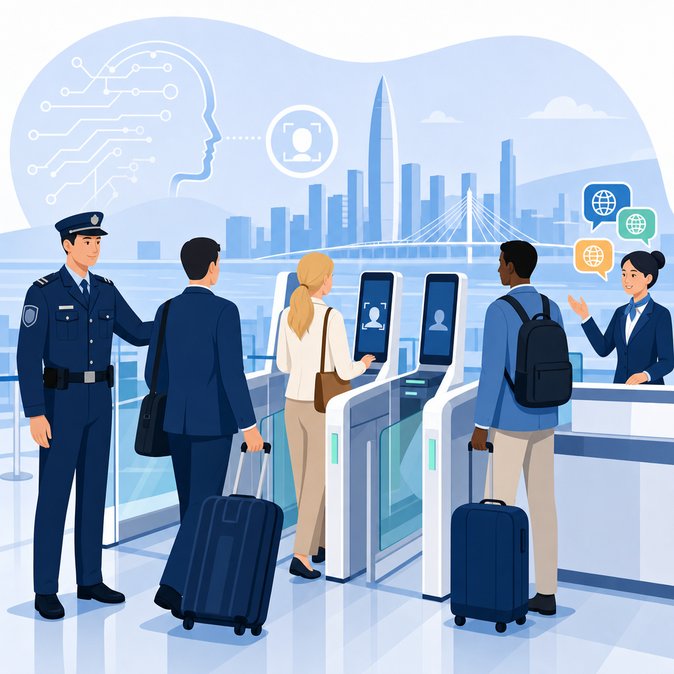
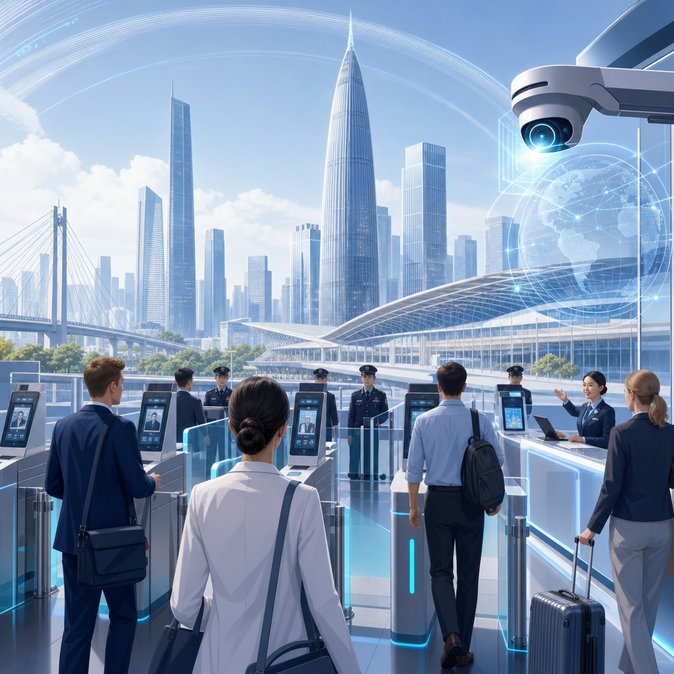
As the 22nd China (Shenzhen) International Cultural Industries Fair (ICIF) opened on 21 May 2026, the Huanggang Border-Checkpoint Brigade rolled out a package of facilitation measures that shaved average clearance times for foreign exhibitors to under three minutes. The brigade, which oversees the Huanggang and Futian land ports as well as a bonded-zone freight lane, reported more than 90 000 cross-border movements between 16 and 19 May—of which 14 000 were foreign nationals, a year-on-year surge. Key upgrades include pre-event manifest sharing with organisers, dynamic lane-allocation based on AI traffic forecasts, and roving multilingual “border concierges” equipped with tablet scanners that guide visitors through China’s digital entry-card system.
![Shenzhen’s Huanggang Checkpoint Deploys ‘Smart Border’ Toolkit to Speed ICIF Exhibitor Arrivals]()
For participants who still need to sort out their China travel documents, VisaHQ can simplify the visa process with online applications, courier passport pickup, and real-time status updates—visit https://www.visahq.com/china/ to get started before your next exhibition.
Additional e-gates were activated during midnight freight peaks to ensure exhibition cargo and accompanying technicians cleared simultaneously. Exhibitors voiced approval. Pierre Dubois, a French creator of wearable art, recounted completing formalities in under 90 seconds despite arriving at peak hour with multiple sample cases. A Singaporean digital-media designer praised officers for assisting with QR-code self-declaration, enabling her to reach the show’s AI Culture Tech Pavilion before midnight soft-opening. For mobility managers the case study illustrates China’s push to merge physical and digital border controls ahead of the 2027 Universiade that Shenzhen will co-host. Companies planning trade-show delegations can expect similar “smart border” pilots at Guangzhou’s Baiyun Airport and Shanghai’s Hongqiao rail hub later this year. Nevertheless, travellers must still ensure that battery packs, VR headsets and other high-value demo gear comply with customs rules to avoid secondary inspection. Strategically, the smoother flow dovetails with the Greater Bay Area’s objective of becoming Asia’s premier convention and exhibition ecosystem, reducing friction costs for creative-industry SMEs entering the mainland market.
For participants who still need to sort out their China travel documents, VisaHQ can simplify the visa process with online applications, courier passport pickup, and real-time status updates—visit https://www.visahq.com/china/ to get started before your next exhibition.
Additional e-gates were activated during midnight freight peaks to ensure exhibition cargo and accompanying technicians cleared simultaneously. Exhibitors voiced approval. Pierre Dubois, a French creator of wearable art, recounted completing formalities in under 90 seconds despite arriving at peak hour with multiple sample cases. A Singaporean digital-media designer praised officers for assisting with QR-code self-declaration, enabling her to reach the show’s AI Culture Tech Pavilion before midnight soft-opening. For mobility managers the case study illustrates China’s push to merge physical and digital border controls ahead of the 2027 Universiade that Shenzhen will co-host. Companies planning trade-show delegations can expect similar “smart border” pilots at Guangzhou’s Baiyun Airport and Shanghai’s Hongqiao rail hub later this year. Nevertheless, travellers must still ensure that battery packs, VR headsets and other high-value demo gear comply with customs rules to avoid secondary inspection. Strategically, the smoother flow dovetails with the Greater Bay Area’s objective of becoming Asia’s premier convention and exhibition ecosystem, reducing friction costs for creative-industry SMEs entering the mainland market.