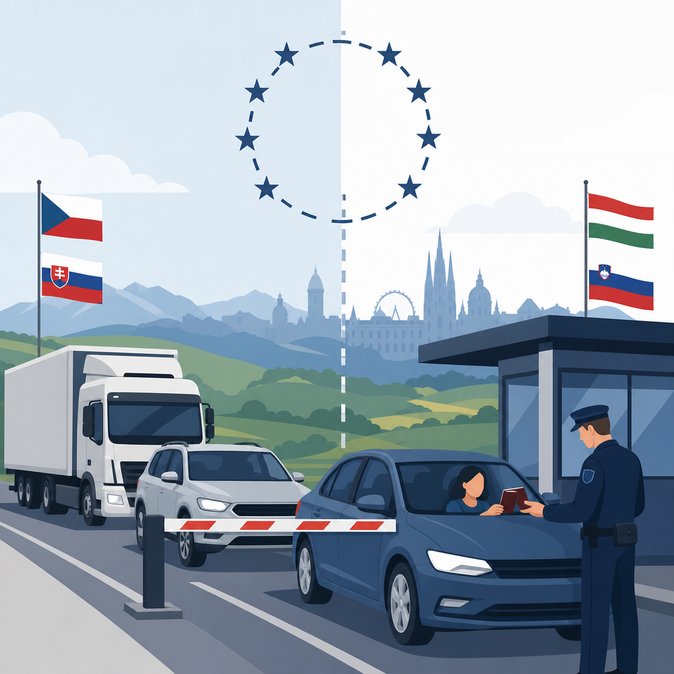
The Ministry of the Interior has confirmed that Austria will continue the temporary re-introduction of controls at its land and river borders with Czechia, Slovakia, Hungary and Slovenia until at least 15 June 2026. The extension, published on 20 May 2026 in the EU’s notification register, cites persistent risks linked to irregular migration along the Western Balkan route, Russia’s war against Ukraine and the regional security situation in the Middle East. Practically, the measure does not close the frontiers; rather, travellers should expect ad-hoc document inspections at motorway lay-bys, rail crossings and inside cross-border buses. EU citizens must carry an ID card or passport, while third-country nationals are advised to keep passports, visas or residence cards, proof of accommodation and evidence of trip purpose at hand.
![Austria prolongs internal Schengen border checks with four neighbours until mid-2026]()
For travellers needing clarity on which papers to pack or how to secure the right visa in time, VisaHQ can streamline the process. Through its Austria hub (https://www.visahq.com/austria/), the service lets users check real-time entry rules, order courier-assisted visa processing and receive alerts on any new border measures, giving both leisure visitors and corporate mobility teams a convenient single source of truth.
Logistics companies may face schedule variability on key corridors linking Vienna with Bratislava, Brno, Budapest and Ljubljana, and should factor extra buffer time into just-in-time deliveries. Austria’s move adds to a growing patchwork of internal controls across the Schengen Area. Germany, France, Italy, Poland, Denmark, Sweden and others have similar measures in place, meaning that businesses orchestrating multi-country itineraries must map checkpoints carefully. Legal experts warn that while EU law allows such controls in exceptional circumstances, the political cost of normalising them could be increased compliance burdens and reduced labour mobility in Central Europe. For mobility managers the advice is two-fold: brief travellers on possible roadside stops—especially those driving company cars—and double-check 90/180-day Schengen calculations, as overstays discovered at an internal checkpoint can still trigger fines or re-entry bans.

For travellers needing clarity on which papers to pack or how to secure the right visa in time, VisaHQ can streamline the process. Through its Austria hub (https://www.visahq.com/austria/), the service lets users check real-time entry rules, order courier-assisted visa processing and receive alerts on any new border measures, giving both leisure visitors and corporate mobility teams a convenient single source of truth.
Logistics companies may face schedule variability on key corridors linking Vienna with Bratislava, Brno, Budapest and Ljubljana, and should factor extra buffer time into just-in-time deliveries. Austria’s move adds to a growing patchwork of internal controls across the Schengen Area. Germany, France, Italy, Poland, Denmark, Sweden and others have similar measures in place, meaning that businesses orchestrating multi-country itineraries must map checkpoints carefully. Legal experts warn that while EU law allows such controls in exceptional circumstances, the political cost of normalising them could be increased compliance burdens and reduced labour mobility in Central Europe. For mobility managers the advice is two-fold: brief travellers on possible roadside stops—especially those driving company cars—and double-check 90/180-day Schengen calculations, as overstays discovered at an internal checkpoint can still trigger fines or re-entry bans.