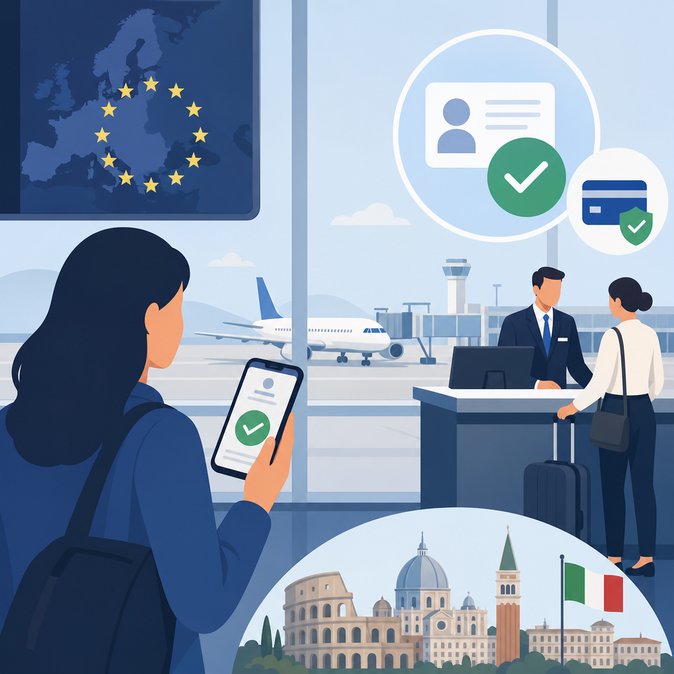
The European Commission’s annual ‘State of Schengen’ report, released late on 18 May and spotlighted by several industry briefings on 19 May, sets an unambiguous go-live window for ETIAS—the European Travel Information and Authorisation System—between October and December 2026. With the Entry/Exit System (EES) now fully rolled-out and logging more than 60 million crossings since 10 April, Brussels says it is time to move on to pre-travel screening of visa-exempt visitors. For Italy the countdown is immediate: Rome-Fiumicino, Milan-Malpensa and Venice-Marco Polo will have to integrate airline DCS (Departure Control System) ‘board/no-board’ messages and ensure that self-service kiosks can scan the new ETIAS authorisation code. The Ministry of the Interior confirms that border police are testing the interface, while ENAC has warned carriers that non-compliant boarding could trigger fines of up to €4 000 per passenger. Italy’s tourism-reliant SMEs—hotels, conference venues and destination-management companies—must factor an extra €7 fee and a 96-hour authorisation buffer into client itineraries. The Commission urges all Schengen states to launch information campaigns by November 2026, targeting tour operators, cruise lines and business-aviation handlers. Confindustria Alberghi is pushing for a joint campaign with ENIT to avoid last-minute cancellations similar to those seen when the United States introduced ESTA.
![Commission confirms ETIAS launch for Q4 2026; Italy’s travel sector told to start preparations]()
Travellers and Italian businesses looking for a streamlined way to handle the new paperwork may turn to specialised visa and travel-authorisation providers. VisaHQ, for example, already supports Italian-bound and outbound clients with real-time status tracking, digital document uploads and proactive renewal reminders; its dedicated Italy portal (https://www.visahq.com/italy/) will be updated to include ETIAS submission as soon as the system opens, giving tour operators and mobility managers a single dashboard for Schengen as well as worldwide visa requirements.
Travel-management companies say corporates will need to preload employee passport data into booking tools so that ETIAS validity is checked automatically at reservation stage. Italy’s data-protection authority (Garante Privacy) has opened a fast-track consultation on how ETIAS data will interface with national PNR and watch-list databases; early guidance indicates that storage on Italian servers will be minimal, with most processing handled by the central EU hub in Strasbourg. Meanwhile, software vendors such as SITA and Amadeus have begun pitching middleware solutions to Italian airports; contracts need to be signed by February 2027 to avoid capacity bottlenecks during the Jubilee year rush. Action points for mobility managers: update traveller-briefing templates, allocate ETIAS costs in 2027 budget cycles, and liaise with HRIS providers to capture authorisation numbers alongside visa data. The overarching message from Brussels is clear: ETIAS is finally happening, and Italy’s travel ecosystem has 18 months to get ready.

Travellers and Italian businesses looking for a streamlined way to handle the new paperwork may turn to specialised visa and travel-authorisation providers. VisaHQ, for example, already supports Italian-bound and outbound clients with real-time status tracking, digital document uploads and proactive renewal reminders; its dedicated Italy portal (https://www.visahq.com/italy/) will be updated to include ETIAS submission as soon as the system opens, giving tour operators and mobility managers a single dashboard for Schengen as well as worldwide visa requirements.
Travel-management companies say corporates will need to preload employee passport data into booking tools so that ETIAS validity is checked automatically at reservation stage. Italy’s data-protection authority (Garante Privacy) has opened a fast-track consultation on how ETIAS data will interface with national PNR and watch-list databases; early guidance indicates that storage on Italian servers will be minimal, with most processing handled by the central EU hub in Strasbourg. Meanwhile, software vendors such as SITA and Amadeus have begun pitching middleware solutions to Italian airports; contracts need to be signed by February 2027 to avoid capacity bottlenecks during the Jubilee year rush. Action points for mobility managers: update traveller-briefing templates, allocate ETIAS costs in 2027 budget cycles, and liaise with HRIS providers to capture authorisation numbers alongside visa data. The overarching message from Brussels is clear: ETIAS is finally happening, and Italy’s travel ecosystem has 18 months to get ready.