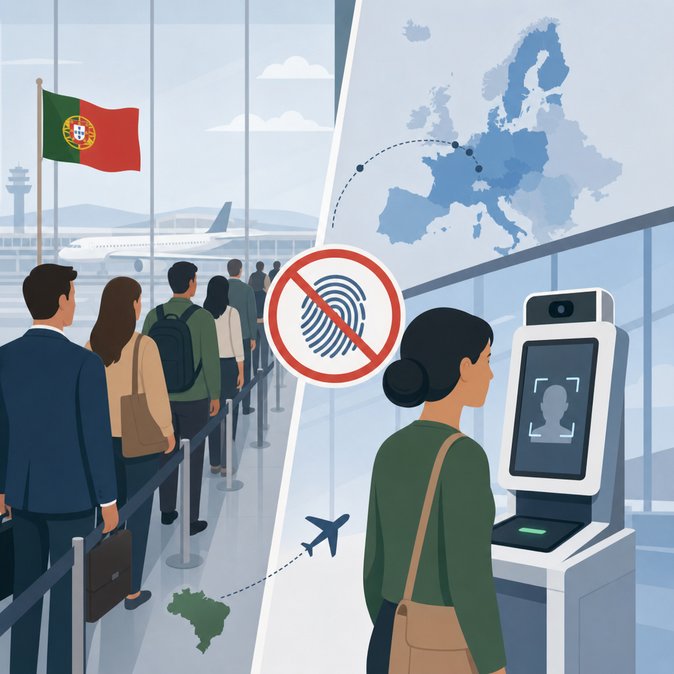
Portuguese Prime Minister Luís Montenegro signalled on 18 May 2026 that his government is prepared to pause the European Union’s new Entry/Exit System (EES) at Lisbon and Faro airports if immigration lines again spiral out of control in the peak summer months. The public warning is significant for Brazilian travellers, who represent the largest non-EU source market in Portugal and have been disproportionately affected by the lengthy biometric capture process required for every third-country national. What Is at Stake. The EES—rolled out in February—collects fingerprints and facial images from passengers entering or exiting the Schengen Area. While designed to curb overstays, the system has doubled average processing times at Lisbon Humberto Delgado Airport, prompting airlines such as Ryanair and TAP to demand operational relief before the June holiday rush. Montenegro told reporters that a “temporary suspension of biometric collection” is on the table, echoing a two-day halt imposed over Easter when queues exceeded four hours. Impact on Brazilian Passengers and Corporates. • Brazilians on short-stay trips who miss connecting flights currently face re-booking costs that employers cannot recover. • Frequent-flyer executives must submit fingerprints at every crossing until the EU’s central database recognises their profile, disrupting tight deal-making schedules. • Family visitors have seen undocumented minors forced into manual lanes, compounding delays.
![Lisbon Considers Suspending EU Entry/Exit Biometric System to Ease Summer Queues]()
VisaHQ can help Brazilians and the companies that manage their travel adapt quickly to these shifting rules. Its dedicated portal (https://www.visahq.com/brazil/) monitors Schengen entry alerts in real time and pre-screens documentation, allowing travellers to sidestep avoidable hold-ups and letting corporate coordinators re-book or reroute staff before costs mount.
Operational Measures. The Interior Ministry says 300 additional border officers will graduate by mid-June and that ten new e-Gates will be installed in Lisbon. Nonetheless, officials admit that discretion exists under EU rules to suspend biometric capture “for limited periods” to preserve public order and economic activity. Carriers are revising minimum connection times and advising Brazilian tour groups to arrive at the airport at least four hours before departure. Why It Matters. A stop-start approach to EES enforcement would create compliance uncertainty: Brazilian travellers might exit Portugal with no biometric stamp but re-enter Spain days later and incur an ‘incomplete record’ flag. Travel-risk teams should brief employees to keep boarding passes and hotel invoices as evidence of lawful stay until the system stabilises.
VisaHQ can help Brazilians and the companies that manage their travel adapt quickly to these shifting rules. Its dedicated portal (https://www.visahq.com/brazil/) monitors Schengen entry alerts in real time and pre-screens documentation, allowing travellers to sidestep avoidable hold-ups and letting corporate coordinators re-book or reroute staff before costs mount.
Operational Measures. The Interior Ministry says 300 additional border officers will graduate by mid-June and that ten new e-Gates will be installed in Lisbon. Nonetheless, officials admit that discretion exists under EU rules to suspend biometric capture “for limited periods” to preserve public order and economic activity. Carriers are revising minimum connection times and advising Brazilian tour groups to arrive at the airport at least four hours before departure. Why It Matters. A stop-start approach to EES enforcement would create compliance uncertainty: Brazilian travellers might exit Portugal with no biometric stamp but re-enter Spain days later and incur an ‘incomplete record’ flag. Travel-risk teams should brief employees to keep boarding passes and hotel invoices as evidence of lawful stay until the system stabilises.