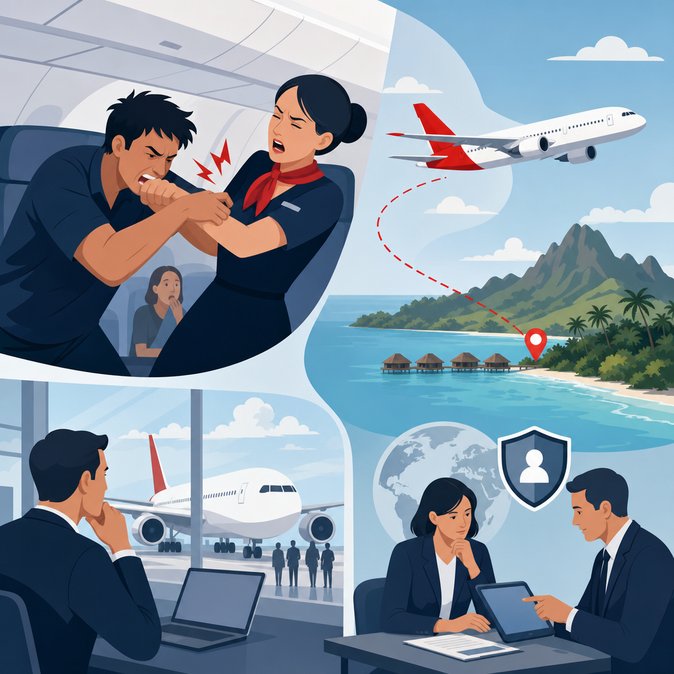
An international Qantas service (QF 21) from Melbourne to Dallas was forced to divert to Papeete, Tahiti on 17 May 2026 after a 45-year-old male passenger allegedly bit a flight attendant and repeatedly ignored safety instructions. The Boeing 787 had been airborne for seven hours when the incident escalated, prompting the captain to request an unscheduled landing so French Polynesian police and medical staff could board the aircraft. Qantas confirmed the crew member received medical treatment and the passenger was issued with an immediate network-wide ‘no-fly’ ban. After refuelling and completing paperwork with local authorities, the aircraft continued to Dallas, arriving 10 hours behind schedule. While physical altercations on long-haul flights remain rare—occurring on roughly 1 in 20,000 sectors, according to IATA—Australia’s flag-carrier has reported a 12 percent rise in disruptive-passenger events since hard-liquor sales resumed in late 2025. For mobility managers the case highlights two operational pressures. First, duty-of-care obligations extend beyond destination security; they now encompass in-flight risk assessments and post-incident welfare checks. Second, diversion costs are mounting. An unscheduled tech stop of this kind typically adds US $250,000 in fuel, crew and passenger re-accommodation expenses—costs that airline insiders say will feed into 2027 contract negotiations with corporate accounts. Travel-risk providers are advising clients to refresh pre-departure briefings, emphasising alcohol limits and zero-tolerance rules under Australia’s Aviation Transport Security Regulations.
![Qantas Melbourne–Dallas flight diverts to Tahiti after passenger bites crew member, triggering travel-risk review]()
At the documentation stage, VisaHQ can ease the administrative burden for corporate travel teams by automating visa and passport checks for each leg of a journey. Its Australia platform (https://www.visahq.com/australia/) offers real-time entry-requirement updates for more than 200 destinations, enabling mobility managers to integrate immigration compliance into the same duty-of-care framework they use for airline safety protocols.
Companies with frequent trans-Pacific travel should also validate contingency plans for missed connections and disrupted work schedules, particularly while North American hub capacity remains stretched. French Polynesia’s Directorate of Civil Aviation has opened an inquiry; if charges are laid under local law the passenger could face fines and imprisonment, and Qantas may seek civil damages. The episode adds to a recent series of high-profile in-flight disturbances globally, reinforcing airlines’ push for an international blacklist that would prevent offenders from simply switching carriers.

At the documentation stage, VisaHQ can ease the administrative burden for corporate travel teams by automating visa and passport checks for each leg of a journey. Its Australia platform (https://www.visahq.com/australia/) offers real-time entry-requirement updates for more than 200 destinations, enabling mobility managers to integrate immigration compliance into the same duty-of-care framework they use for airline safety protocols.
Companies with frequent trans-Pacific travel should also validate contingency plans for missed connections and disrupted work schedules, particularly while North American hub capacity remains stretched. French Polynesia’s Directorate of Civil Aviation has opened an inquiry; if charges are laid under local law the passenger could face fines and imprisonment, and Qantas may seek civil damages. The episode adds to a recent series of high-profile in-flight disturbances globally, reinforcing airlines’ push for an international blacklist that would prevent offenders from simply switching carriers.