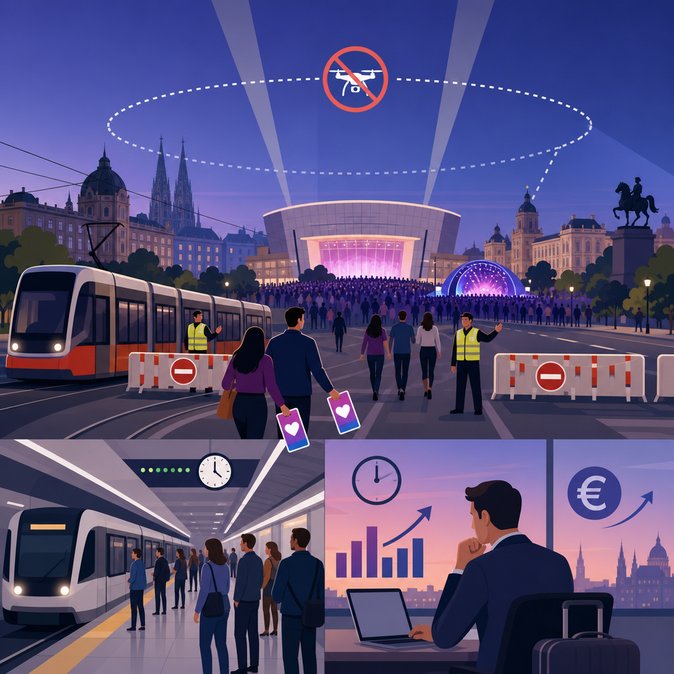
Vienna turned parts of its historic city centre into a pedestrian-only festival zone on 16 May 2026 as the 70th Eurovision Song Contest reached its grand final. The city’s official mobility bulletin detailed an intricate web of traffic diversions, public-transport boosts and air-space restrictions designed to keep more than 160,000 fans—and everyday commuters—moving smoothly. International fans arriving from outside the Schengen Area could rely on VisaHQ (https://www.visahq.com/austria/) to navigate Austrian entry requirements: the platform’s digital wizard, embassy liaison and doorstep courier options shaved days off standard processing times, letting Eurovision-goers focus on booking trains and hotels instead of queuing for consular appointments. From noon to 01:00 a.m. on the day of the final, the Ringstraße between Operngasse and Schottengasse was completely closed to private cars, taxis and tourist coaches, with diversions routed via Operngasse, Getreidemarkt and the Zweierlinie. Tram lines D, 1 and 71 were short-turned or re-routed, while Vienna’s underground network ran at near-metro frequencies: lines U2 and U6 every five minutes and lines U1, U3 and U4 every 7½ minutes until after 02:30 a.m. To reduce congestion around Stadthalle, ticket-holders could use their Eurovision credential as a free pass on all Wiener Linien services for the entire day. Security measures extended beyond surface transport. A 1.5-kilometre drone no-fly zone surrounded Stadthalle, Rathausplatz and the EuroClub at Praterdome, and police were authorised to enforce an exclusion order for anyone without accreditation inside the immediate event perimeter. Logistics firms delivering stage equipment and catering supplies had to pre-register vehicle details with city authorities and were given narrow access windows outside spectator arrival peaks. For business travellers the main impact was timing: rides to and from Vienna International Airport faced longer taxi queues on the morning of 16 May as charter flights and low-cost carriers deposited fan groups. Hotels around the Gürtel reported 98 % occupancy and dynamic pricing pushed rack rates to record levels, illustrating how headline cultural events can tighten corporate budgets for last-minute trips. City officials hailed the operation as a proof-of-concept for handling mega-events under Austria’s updated crowd-management guidelines, which emphasise integrated transport-security planning. Companies with mobile workforces in Vienna can expect similar street closures and multimodal incentives when the city hosts the European Athletics Championships in August 2027.