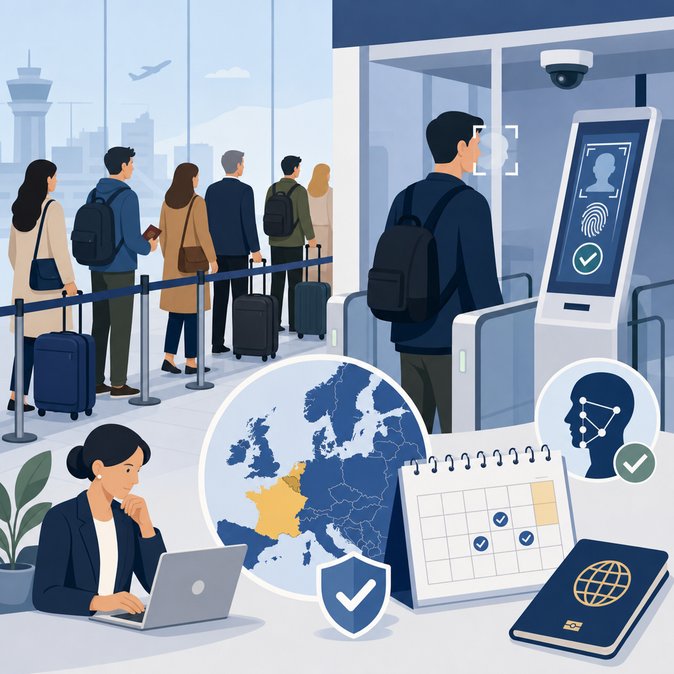
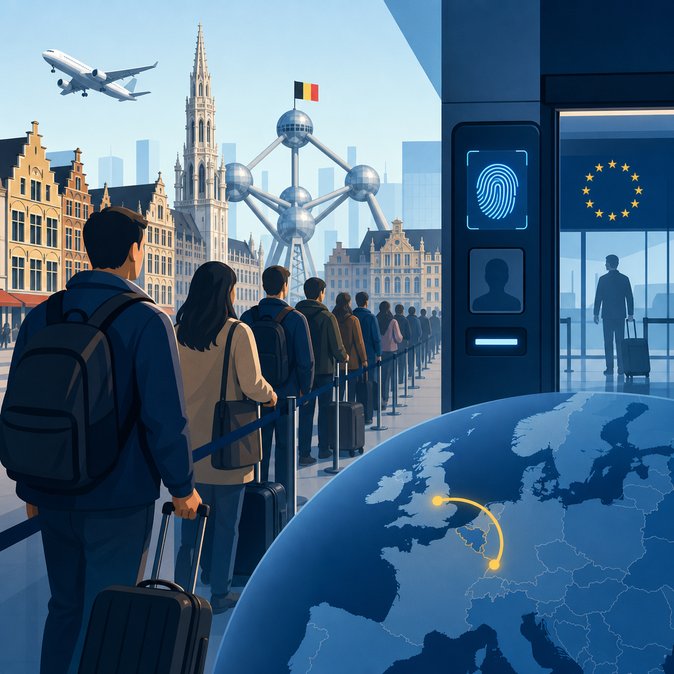
British and other non-EU travellers heading to Belgium this summer are being urged to factor in extra border-control time as the EU’s new Entry/Exit System (EES) beds in. Consumer group Which? reported on 15 May that airports across the Schengen zone have experienced multi-hour queues since the biometric programme went live on 10 April 2026, with Palma, Lisbon and Milan singled out for particular congestion. Because Eurostar and Eurotunnel perform Schengen exit controls before departure, the impact is already being felt at London St Pancras and in Calais, and Belgian gateway Brussels-Midi is next in line once full rollout begins. Under EES, third-country nationals must submit fingerprints and a facial image at an automated kiosk or manned booth the first time they cross the external border after 10 April. The data replace passport stamps and feed a central database that tracks the 90/180-day stay limit. Children under 12 are exempt from fingerprinting, but not from photos. Member states may suspend the system temporarily when queues become unmanageable; Greece has already announced a seasonal pause, and insiders at Brussels Airport say Belgium is considering similar fallback windows around the Ascension–Pentecost holiday peak.
![EES Biometric Checks Trigger Summer Queue Warnings for UK–Belgium Travel]()
For travellers who want to make sure their documentation is in order before facing the new kiosks, VisaHQ’s Belgium portal (https://www.visahq.com/belgium/) can help you confirm current entry rules, pre-apply for ETIAS once it launches, and organise any supporting paperwork for business or leisure trips. The service’s reminders on passport validity and stay limits offer an extra safety net for companies and individuals adjusting to the EES era.
For Belgian employers the new rules carry two practical risks. First, visiting colleagues from visa-waiver countries could miss meetings if biometric kiosks malfunction or lines grow. Second, frequent commuters based in the UK but working part-week in Belgium will see each crossing recorded precisely, ending the leeway once afforded by inconsistent passport stamping. Travel-risk teams should alert staff to arrive earlier, keep proof of onward tickets handy and ensure passports have at least two blank pages in case manual stamps are still issued during the transition period. Longer term, EES will feed directly into ETIAS, the €20 electronic travel authorisation due in late 2026. Once ETIAS is mandatory, Belgium’s federal police will be able to deny boarding to travellers who lack pre-authorisation or whose EES record shows an over-stay. Companies should therefore audit duty-of-care policies, update traveller-tracking software to import EES timestamps, and brief employees on the 90/180-day rule—especially contractors who split time between Belgium and other EU hubs. The European Commission maintains that “teething problems are normal” and that EES will ultimately speed up border crossings by enabling e-gates for repeat visitors. Nevertheless, mobility managers should plan on at least six months of operational turbulence—and build contingency time into travel schedules—until airports, rail terminals and ferry ports in Belgium and neighbouring countries reach full biometric capacity.
For travellers who want to make sure their documentation is in order before facing the new kiosks, VisaHQ’s Belgium portal (https://www.visahq.com/belgium/) can help you confirm current entry rules, pre-apply for ETIAS once it launches, and organise any supporting paperwork for business or leisure trips. The service’s reminders on passport validity and stay limits offer an extra safety net for companies and individuals adjusting to the EES era.
For Belgian employers the new rules carry two practical risks. First, visiting colleagues from visa-waiver countries could miss meetings if biometric kiosks malfunction or lines grow. Second, frequent commuters based in the UK but working part-week in Belgium will see each crossing recorded precisely, ending the leeway once afforded by inconsistent passport stamping. Travel-risk teams should alert staff to arrive earlier, keep proof of onward tickets handy and ensure passports have at least two blank pages in case manual stamps are still issued during the transition period. Longer term, EES will feed directly into ETIAS, the €20 electronic travel authorisation due in late 2026. Once ETIAS is mandatory, Belgium’s federal police will be able to deny boarding to travellers who lack pre-authorisation or whose EES record shows an over-stay. Companies should therefore audit duty-of-care policies, update traveller-tracking software to import EES timestamps, and brief employees on the 90/180-day rule—especially contractors who split time between Belgium and other EU hubs. The European Commission maintains that “teething problems are normal” and that EES will ultimately speed up border crossings by enabling e-gates for repeat visitors. Nevertheless, mobility managers should plan on at least six months of operational turbulence—and build contingency time into travel schedules—until airports, rail terminals and ferry ports in Belgium and neighbouring countries reach full biometric capacity.