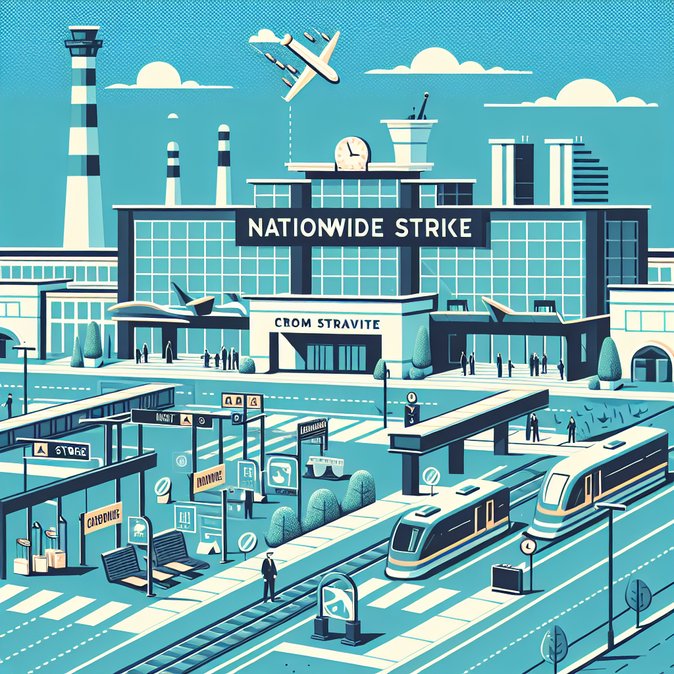
Belgium’s three main union confederations—FGTB/ABVV, CSC/ACV and CGSLB/ACLVB—have called a 24-hour general strike for Tuesday 12 May. Although the action is still four days away, transport operators have begun publishing contingency plans. Eurostar’s disruption feed, updated on 8 May, says it expects to run a normal international timetable but warns of ‘disruption on public transport in Brussels and connecting flights in and out of Brussels airports.’ At Brussels Airport the Operations Centre has activated its adverse-events protocol and is liaising with ground-handling companies and security providers, some of whose employees may join the walk-out. Airlines have been asked to prepare for longer check-in queues and to encourage passengers to travel with carry-on luggage only.
![Transport providers issue early warning for 12 May Belgian national strike]()
For employees and travellers who discover they need to adjust their visa dates or apply for a different Belgian entry document at short notice, VisaHQ offers a streamlined online service. Its Belgium page (https://www.visahq.com/belgium/) consolidates the latest requirements and lets users complete applications, schedule courier pick-ups and track approvals in real time—valuable flexibility when strikes threaten to upend itineraries.
The Flemish public-transport operator De Lijn anticipates a ‘severely reduced’ bus schedule in the capital region, while Belgian Rail (SNCB/NMBS) will publish an emergency timetable 48 hours before the strike. The day of action targets the Federal Government’s cost-of-living measures and a planned revision of Belgium’s wage-indexation model. Previous strikes of similar scope have led to baggage pile-ups at Brussels Airport and sporadic road blockades around the Port of Antwerp. Global mobility teams with travellers or assignees in Belgium next week should: • advise arriving staff to build in at least three hours for airport formalities; • switch meetings to virtual wherever feasible; • confirm hotel reservations, as housekeeping and catering staff are also unionised and may walk out; • remind employees that wild-cat pickets sometimes form at motorway on-ramps, delaying taxis and ride-shares. Employers unable to guarantee safe passage to a worksite can invoke Belgium’s ‘force majeure’ provisions to grant paid leave, but must document the disruption thoroughly.
For employees and travellers who discover they need to adjust their visa dates or apply for a different Belgian entry document at short notice, VisaHQ offers a streamlined online service. Its Belgium page (https://www.visahq.com/belgium/) consolidates the latest requirements and lets users complete applications, schedule courier pick-ups and track approvals in real time—valuable flexibility when strikes threaten to upend itineraries.
The Flemish public-transport operator De Lijn anticipates a ‘severely reduced’ bus schedule in the capital region, while Belgian Rail (SNCB/NMBS) will publish an emergency timetable 48 hours before the strike. The day of action targets the Federal Government’s cost-of-living measures and a planned revision of Belgium’s wage-indexation model. Previous strikes of similar scope have led to baggage pile-ups at Brussels Airport and sporadic road blockades around the Port of Antwerp. Global mobility teams with travellers or assignees in Belgium next week should: • advise arriving staff to build in at least three hours for airport formalities; • switch meetings to virtual wherever feasible; • confirm hotel reservations, as housekeeping and catering staff are also unionised and may walk out; • remind employees that wild-cat pickets sometimes form at motorway on-ramps, delaying taxis and ride-shares. Employers unable to guarantee safe passage to a worksite can invoke Belgium’s ‘force majeure’ provisions to grant paid leave, but must document the disruption thoroughly.