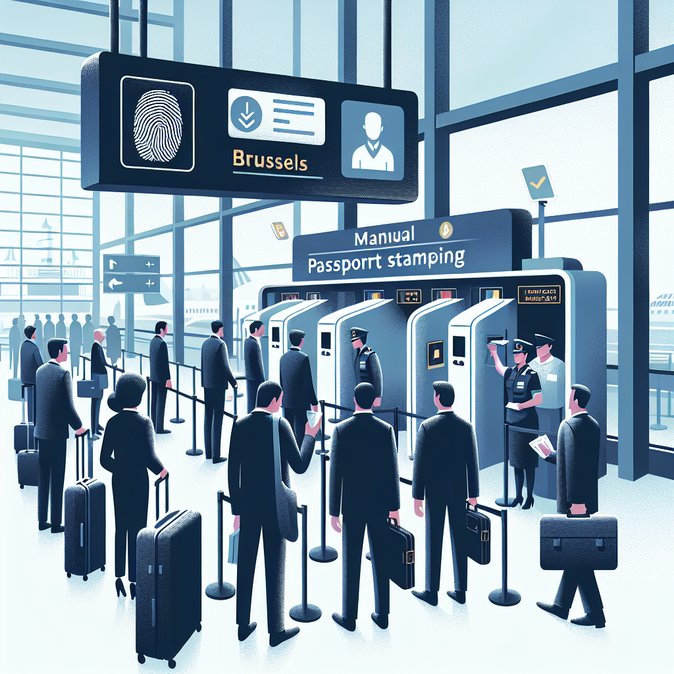
The European Commission has activated an emergency ‘flex-mode’ for the new Entry/Exit System (EES), allowing Schengen border guards to skip fingerprint and facial-image collection when passenger queues surpass set thresholds. The decision, finalised in Brussels on 4 May and published on 5 May, is already being applied at Brussels Airport. Under the measure, officers may revert to manual passport stamping while the EES database silently logs crossings via advance passenger information.
![EU authorises temporary pause on biometric checks, relieving Brussels Airport EES queues]()
If you’re unsure how these evolving border-control rules could affect your visa status or future ETIAS obligations, VisaHQ can help. The service’s dedicated Belgium portal (https://www.visahq.com/belgium/) provides real-time guidance and can manage the entire application process on your behalf, making it easier for both individual and corporate travellers to stay compliant.
Belgian federal police say the workaround will be used during the morning and evening long-haul banks, when first-time biometric enrolments had pushed processing times beyond 45 minutes. For corporate travellers the pause is welcome: missed connections had increased duty-of-care incidents, with several multinationals reporting overnight stays due to outbound delays to the US and the Middle East. Travel managers should nevertheless instruct employees to arrive early, because biometric capture remains the default at off-peak times and random sampling will continue. The Commission will review the flex-mode weekly, and officials hinted that full biometrics could resume once software patches are deployed. Longer-term, travellers should prepare for the launch of ETIAS in late 2026, which will add a pre-arrival travel-authorisation layer for visa-exempt visitors to Belgium.

If you’re unsure how these evolving border-control rules could affect your visa status or future ETIAS obligations, VisaHQ can help. The service’s dedicated Belgium portal (https://www.visahq.com/belgium/) provides real-time guidance and can manage the entire application process on your behalf, making it easier for both individual and corporate travellers to stay compliant.
Belgian federal police say the workaround will be used during the morning and evening long-haul banks, when first-time biometric enrolments had pushed processing times beyond 45 minutes. For corporate travellers the pause is welcome: missed connections had increased duty-of-care incidents, with several multinationals reporting overnight stays due to outbound delays to the US and the Middle East. Travel managers should nevertheless instruct employees to arrive early, because biometric capture remains the default at off-peak times and random sampling will continue. The Commission will review the flex-mode weekly, and officials hinted that full biometrics could resume once software patches are deployed. Longer-term, travellers should prepare for the launch of ETIAS in late 2026, which will add a pre-arrival travel-authorisation layer for visa-exempt visitors to Belgium.