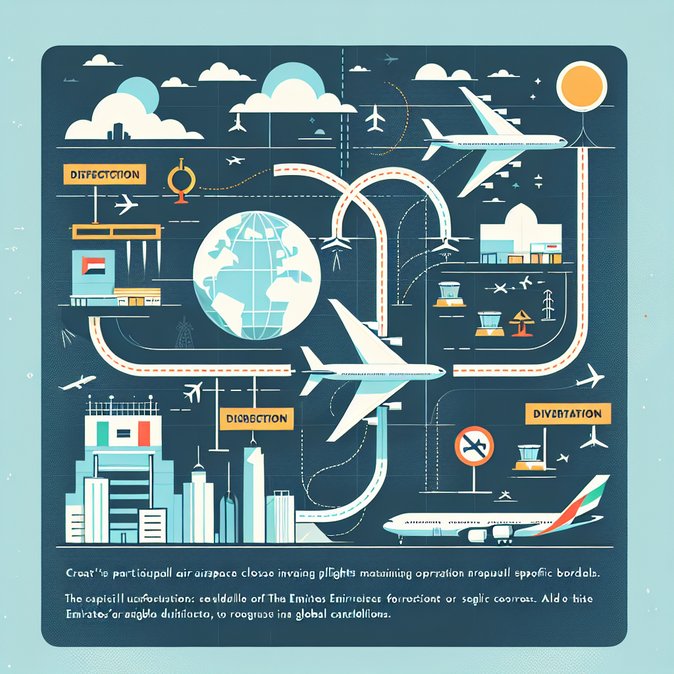
The United Arab Emirates reinstated emergency restrictions on its flight information region (FIR) at 09:30 UTC on May 5 after its air-defence forces intercepted a wave of Iranian missiles and drones aimed at Abu Dhabi and Dubai. A Notice to Airmen (NOTAM) issued by the General Civil Aviation Authority (GCAA) designates the Emirates FIR as “partially closed”, permitting traffic only through a handful of entry and exit points and capping hourly movements to manage congestion. The measures apply to all passenger, cargo, business-jet and overflight operations and are currently scheduled to remain in force until at least May 11. For corporate mobility managers, the timing is awkward: the restrictions were re-imposed barely 48 hours after the UAE had celebrated the full reopening of its skies following weeks of regional conflict disruption.
Airlines are scrambling to re-file flight plans along the approved corridors, and several wide-body services from Europe and South-East Asia were forced to divert to Muscat or hold over Saudi airspace while clearances were obtained. Although cancellations have been minimal, travellers should brace for longer routings and rolling delays over the next week. Passenger-rights specialists warn that compensation under EU261 or similar regimes is unlikely because the trigger was an external armed attack—a classic “extraordinary circumstance”.
![UAE Re-imposes Partial Airspace Closure After Iranian Missile and Drone Barrage]()
In this fluid environment, VisaHQ can be an invaluable partner. The company’s platform (https://www.visahq.com/united-arab-emirates/) provides real-time visa and entry-requirement updates for the UAE and other countries, and its team can expedite applications or renewals when itineraries shift unexpectedly—helping both individual travelers and corporate mobility desks stay compliant despite the airspace turmoil.
Nevertheless, carriers must still offer rebooking, refunds, meals and accommodation where needed. Mobility teams should monitor real-time NOTAM updates, advise employees to check the status of connecting flights before departure, and build extra slack into tight itineraries. The episode underscores the importance of robust crisis-management protocols for businesses with large populations in the Gulf. It also highlights the UAE’s balancing act: maintaining its reputation as a safe, reliable global hub while navigating the security fallout of regional tensions. While the current notice is temporary, analysts caution that further flare-ups could trigger additional airspace curbs through the summer peak. In the medium term, insurers may raise premiums on overflights and the GCAA could fast-track alternative routing infrastructure to make the network more resilient. Companies with critical supply-chain or project timelines linked to the Emirates should review contingency gateways—particularly Jeddah, Doha and Muscat—to keep people and goods moving if restrictions tighten again.
Airlines are scrambling to re-file flight plans along the approved corridors, and several wide-body services from Europe and South-East Asia were forced to divert to Muscat or hold over Saudi airspace while clearances were obtained. Although cancellations have been minimal, travellers should brace for longer routings and rolling delays over the next week. Passenger-rights specialists warn that compensation under EU261 or similar regimes is unlikely because the trigger was an external armed attack—a classic “extraordinary circumstance”.

In this fluid environment, VisaHQ can be an invaluable partner. The company’s platform (https://www.visahq.com/united-arab-emirates/) provides real-time visa and entry-requirement updates for the UAE and other countries, and its team can expedite applications or renewals when itineraries shift unexpectedly—helping both individual travelers and corporate mobility desks stay compliant despite the airspace turmoil.
Nevertheless, carriers must still offer rebooking, refunds, meals and accommodation where needed. Mobility teams should monitor real-time NOTAM updates, advise employees to check the status of connecting flights before departure, and build extra slack into tight itineraries. The episode underscores the importance of robust crisis-management protocols for businesses with large populations in the Gulf. It also highlights the UAE’s balancing act: maintaining its reputation as a safe, reliable global hub while navigating the security fallout of regional tensions. While the current notice is temporary, analysts caution that further flare-ups could trigger additional airspace curbs through the summer peak. In the medium term, insurers may raise premiums on overflights and the GCAA could fast-track alternative routing infrastructure to make the network more resilient. Companies with critical supply-chain or project timelines linked to the Emirates should review contingency gateways—particularly Jeddah, Doha and Muscat—to keep people and goods moving if restrictions tighten again.