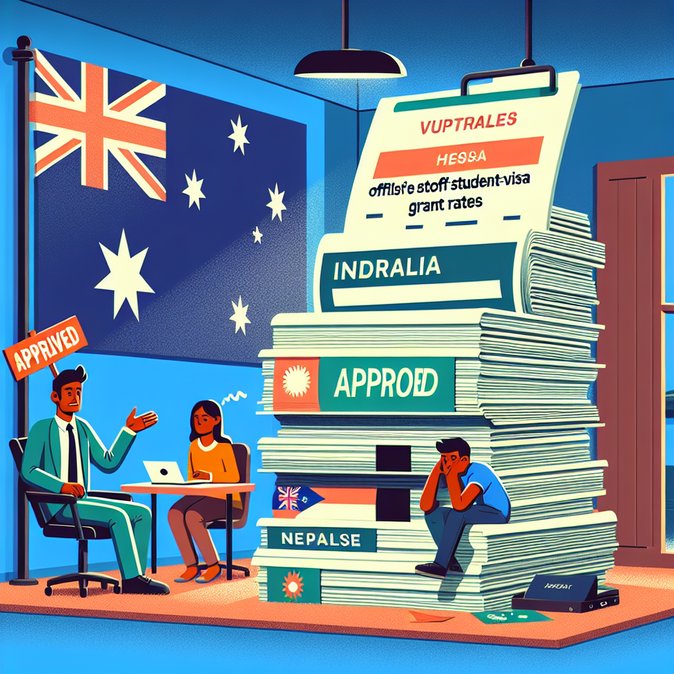
SBS News has obtained confirmation from the Department of Home Affairs that 32.5 percent of offshore higher-education student-visa applications lodged in February 2026 were refused—the highest monthly rejection rate since the early 2000s. The story, broadcast on 3 May 2026 and widely syndicated across SBS’s multilingual platforms, highlights stark disparities: refusal rates were 65 percent for Nepal, 51 percent for Bangladesh, 40 percent for India but only 3 percent for China. Officials tell SBS the spike reflects the government’s Genuine Student (GS) test introduced last year to replace the Genuine Temporary Entrant requirement. Under GS, case officers undertake “holistic financial assessments” and scrutinise the authenticity of education and employment documents. Providers with poor visa-compliance records now face slower processing under Ministerial Direction 107.
![Home Affairs data confirm student-visa refusal rate hits highest level in two decades]()
Amid these tightening rules, VisaHQ’s Australia desk offers step-by-step guidance on the latest financial thresholds, document-verification standards and GS interview tips, helping applicants reduce the risk of a costly refusal; details are available at https://www.visahq.com/australia/
Universities Australia CEO Luke Sheehy warns that the surge in refusals is already disrupting revenue forecasts and campus-housing demand. Some institutions have paused agent contracts in high-risk markets, while others are deploying verification teams offshore. Migration agents say families must now show proof of funds for the entire degree—often A$80,000 or more—rather than one-year costs. Policy experts expect the 14 May federal budget to embed the tougher stance, possibly through even higher application fees and a cap on sectors with poor completion rates. For corporate mobility teams the fallout is significant: fewer dependants of student-visa holders will enter the labour market, and regional areas that rely on international students for part-time staffing may struggle to fill shifts. In the near term, aspirants are advised to front-load detailed financial evidence, sit higher-level English tests, and avoid third-party document brokers. Failure to do so can be costly—application charges are non-refundable even when visas are refused.

Amid these tightening rules, VisaHQ’s Australia desk offers step-by-step guidance on the latest financial thresholds, document-verification standards and GS interview tips, helping applicants reduce the risk of a costly refusal; details are available at https://www.visahq.com/australia/
Universities Australia CEO Luke Sheehy warns that the surge in refusals is already disrupting revenue forecasts and campus-housing demand. Some institutions have paused agent contracts in high-risk markets, while others are deploying verification teams offshore. Migration agents say families must now show proof of funds for the entire degree—often A$80,000 or more—rather than one-year costs. Policy experts expect the 14 May federal budget to embed the tougher stance, possibly through even higher application fees and a cap on sectors with poor completion rates. For corporate mobility teams the fallout is significant: fewer dependants of student-visa holders will enter the labour market, and regional areas that rely on international students for part-time staffing may struggle to fill shifts. In the near term, aspirants are advised to front-load detailed financial evidence, sit higher-level English tests, and avoid third-party document brokers. Failure to do so can be costly—application charges are non-refundable even when visas are refused.