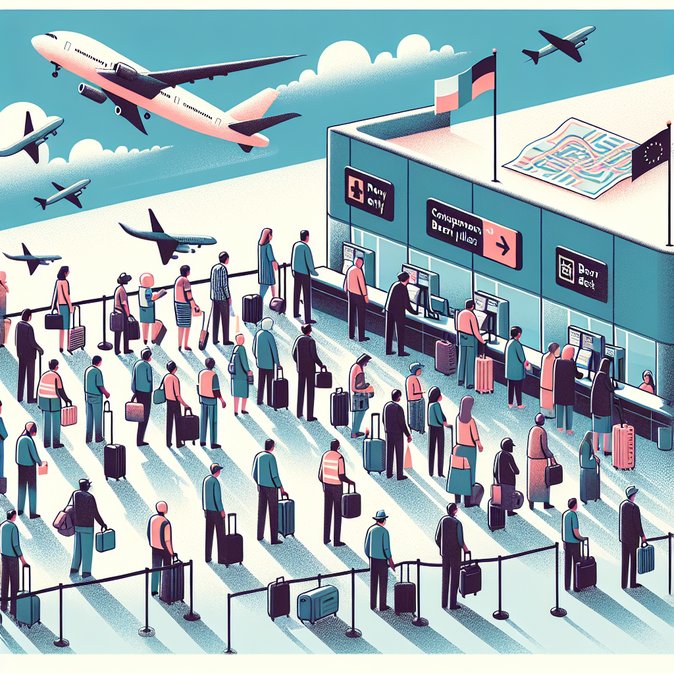
Low-cost carrier Ryanair has written to Italy’s interior minister Matteo Piantedosi demanding an immediate suspension of the European Union’s new Entry/Exit System (EES) at Italian borders until September. The airline says the biometric registration scheme—fully activated on 10 April—has already produced passport-control queues exceeding two hours at Bergamo, Malpensa, Fiumicino, Ciampino, Venice, Turin, Palermo, Pisa and Naples. In several cases, the delays have caused passengers to miss flights and crews to breach duty-time limits. Under EES, third-country nationals must provide fingerprints and facial images at their first Schengen entry in a rolling 90-day period. Ryanair argues that Italian airports lack both the hardware and staff to process peak-summer volumes, accusing authorities of failing to use the three-year implementation window effectively. The carrier points to Greece—whose government has postponed enforcement until after the high season—as a model Italy should copy.
For mobility managers, the warning is significant. Summer assignment start-dates often coincide with a surge in family travel, making predictable border-throughput times critical for relocation planning. Immigration advisers are already telling clients to leave four hours between scheduled landing and onward domestic connections, and to budget for potential overnight stays at gateway cities.
![Ryanair Urges Italy to Suspend EU Entry/Exit System After Passport-Control Chaos]()
At this juncture, many travellers are seeking practical help to navigate the shifting rules. VisaHQ, an online visa consultancy, can streamline the process by clarifying Schengen visa requirements, scheduling fingerprint appointments, and supplying real-time updates on Italy’s EES roll-out. Its dedicated Italy portal (https://www.visahq.com/italy/) also lets mobility managers oversee multiple applications from a single dashboard, reducing the risk of last-minute surprises.
If Rome defers the system, companies may face a patchwork of rules elsewhere in the EU. Travellers could clear Italian controls without biometric capture only to be stopped for full enrolment when transiting Germany or France. Employers should therefore brief staff on possible secondary inspections and ensure they carry assignment letters and proof of accommodation. In the longer term, postponement would give Italian airports time to test self-service kiosks, integrate airline-data pre-checks and recruit additional Border Police officers. But it would also delay the security benefits Brussels expects: automated ‘over-stay’ alerts and faster statistical data on migration flows—information increasingly vital to Schengen-border governance.
For mobility managers, the warning is significant. Summer assignment start-dates often coincide with a surge in family travel, making predictable border-throughput times critical for relocation planning. Immigration advisers are already telling clients to leave four hours between scheduled landing and onward domestic connections, and to budget for potential overnight stays at gateway cities.

At this juncture, many travellers are seeking practical help to navigate the shifting rules. VisaHQ, an online visa consultancy, can streamline the process by clarifying Schengen visa requirements, scheduling fingerprint appointments, and supplying real-time updates on Italy’s EES roll-out. Its dedicated Italy portal (https://www.visahq.com/italy/) also lets mobility managers oversee multiple applications from a single dashboard, reducing the risk of last-minute surprises.
If Rome defers the system, companies may face a patchwork of rules elsewhere in the EU. Travellers could clear Italian controls without biometric capture only to be stopped for full enrolment when transiting Germany or France. Employers should therefore brief staff on possible secondary inspections and ensure they carry assignment letters and proof of accommodation. In the longer term, postponement would give Italian airports time to test self-service kiosks, integrate airline-data pre-checks and recruit additional Border Police officers. But it would also delay the security benefits Brussels expects: automated ‘over-stay’ alerts and faster statistical data on migration flows—information increasingly vital to Schengen-border governance.