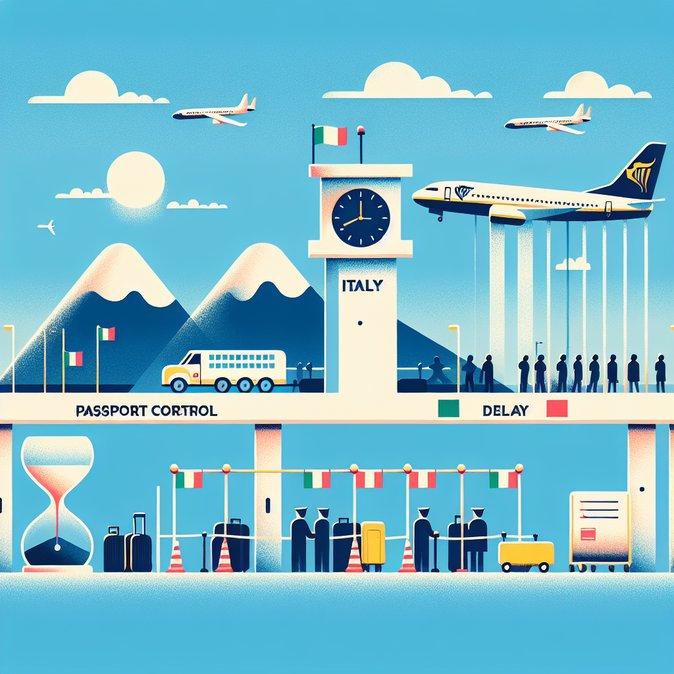
The stand-off between Europe’s largest low-cost carrier and the Italian government escalated on 30 April after Ryanair sent a formal letter to Interior Minister Matteo Piantedosi demanding that Rome freeze implementation of the EU Entry/Exit System (EES) until 1 September. The Irish airline claims queues of one- to two-hours are already commonplace at nine major Italian airports – including Rome-Fiumicino, Milan-Malpensa and Venice – because biometric kiosks are still missing or malfunctioning and border-police staffing levels have not been increased.
Ryanair warns that the delays will peak once summer traffic surges, leading to missed connections and potential EU 261 compensation claims that carriers may resist by arguing that border bottlenecks are “extraordinary circumstances”. The company cites Greece’s recent decision to postpone EES as evidence that member states have the legal flexibility to put the system on hold.
Brussels has flatly rejected the request. A European Commission spokesperson insisted that EES is “fully operational” across the Schengen area and said average processing times are around 70 seconds, with some crossings as low as 30 seconds. Any residual problems, the spokesperson added, are “predictable teething issues” that national authorities must solve locally.
![Ryanair urges Italy to halt new biometric passport system; EU rejects call]()
Amid this regulatory flux, VisaHQ can serve as a safety net for both individual travellers and corporate mobility teams. Its portal (https://www.visahq.com/italy/) consolidates the latest updates on Italian visa rules, EES implementation timelines and biometric enrolment options, offering tools to book appointments and receive real-time alerts—helping users sidestep exactly the kind of airport delays now under scrutiny.
For business travellers the dispute creates immediate uncertainty. Airlines may advise arriving at Italian airports three hours before departure, while travel managers should monitor airline communications for revised minimum connection times. Multinationals relocating staff this summer may need to build extra layover cushions into itineraries or shift entry points to less-congested hubs such as Bologna or Naples.
Longer-term, the incident highlights the need for closer coordination between border agencies and carriers as Europe moves to fully digital frontiers, including the forthcoming ETIAS travel-authorisation scheme now scheduled for 2027.
Practical tips: (1) Encourage mobile workers to pre-enrol fingerprints where local consulates offer the service; (2) remind non-EU assignees that a first EES capture resets the Schengen-clock calculation; (3) add realtime queue-tracking apps (Fiumicino Airport, SEA Milano) to corporate travel dashboards.
Ryanair warns that the delays will peak once summer traffic surges, leading to missed connections and potential EU 261 compensation claims that carriers may resist by arguing that border bottlenecks are “extraordinary circumstances”. The company cites Greece’s recent decision to postpone EES as evidence that member states have the legal flexibility to put the system on hold.
Brussels has flatly rejected the request. A European Commission spokesperson insisted that EES is “fully operational” across the Schengen area and said average processing times are around 70 seconds, with some crossings as low as 30 seconds. Any residual problems, the spokesperson added, are “predictable teething issues” that national authorities must solve locally.
Amid this regulatory flux, VisaHQ can serve as a safety net for both individual travellers and corporate mobility teams. Its portal (https://www.visahq.com/italy/) consolidates the latest updates on Italian visa rules, EES implementation timelines and biometric enrolment options, offering tools to book appointments and receive real-time alerts—helping users sidestep exactly the kind of airport delays now under scrutiny.
For business travellers the dispute creates immediate uncertainty. Airlines may advise arriving at Italian airports three hours before departure, while travel managers should monitor airline communications for revised minimum connection times. Multinationals relocating staff this summer may need to build extra layover cushions into itineraries or shift entry points to less-congested hubs such as Bologna or Naples.
Longer-term, the incident highlights the need for closer coordination between border agencies and carriers as Europe moves to fully digital frontiers, including the forthcoming ETIAS travel-authorisation scheme now scheduled for 2027.
Practical tips: (1) Encourage mobile workers to pre-enrol fingerprints where local consulates offer the service; (2) remind non-EU assignees that a first EES capture resets the Schengen-clock calculation; (3) add realtime queue-tracking apps (Fiumicino Airport, SEA Milano) to corporate travel dashboards.