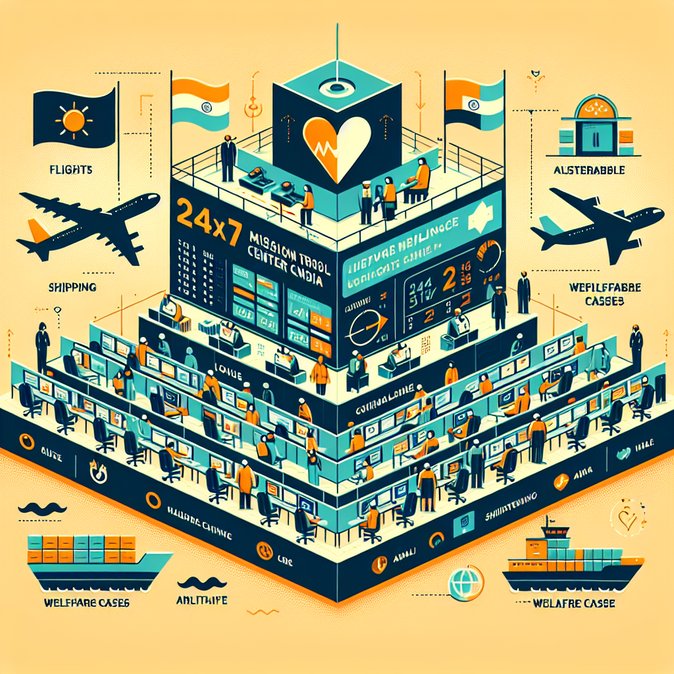
India’s Ministry of External Affairs (MEA) on 26 April announced an “enhanced outreach” plan to safeguard the estimated nine million Indian citizens who live and work across the Gulf and wider West Asia region. Round-the-clock helplines have been reinforced at missions in the United Arab Emirates, Saudi Arabia, Oman, Qatar, Kuwait, Bahrain, Iraq and Israel, while a dedicated crisis cell in New Delhi is now mapping the real-time movement of flights and seafarers. According to the ministry, 1.296 million passengers have travelled from the region to India since 28 February despite periodic air-space closures.
Travellers juggling shifting visa rules, transit permissions and sudden route alterations may find relief in professional documentation services. VisaHQ, for example, provides Indian citizens and their employers with an online platform to obtain or renew visas, handle document legalisations and monitor application status in real time—support that can soften the operational shocks described above. More information is available at https://www.visahq.com/india/
![MEA Ramps Up 24×7 Helplines as West Asia Tensions Disrupt Gulf-India Mobility Corridor]()
About 110 commercial flights were scheduled between the UAE and India on Sunday alone, although services via Iranian airspace remain curtailed. Special attention has shifted to Indian seafarers after Houthi drone activity in the Red Sea and tanker-insurance surcharges pushed some shipping lines to re-route via the Cape. The Directorate-General of Shipping confirmed it had handled over 7,700 emergency calls and 16,500 e-mails since its war-risk control room was activated in March.
For employers the immediate impact is on rotation planning and cost. “Seat prices on the Dubai–Kerala corridor are oscillating between ₹48,000 and ₹65,000 and change twice a day,” said a relocation manager for a large IT services firm. Some companies are now splitting rosters so that critical maintenance staff can travel on shorter notice once capacities stabilise.
The MEA reiterated its ‘do-not-travel’ warning for Iran and urged Indians still in the country to leave via land borders coordinated by the embassy in Tehran. So far, 2,445 departures have been facilitated. Mobility teams with project personnel in the region should keep contingency budgets for last-minute route changes and brief travellers on varying local curfews, especially in Saudi eastern provinces and parts of southern Iraq. With the crisis showing no sign of immediate resolution, experts say Indian policy has shifted from evacuation mode to managed resilience—keeping commercial links open while ensuring that welfare mechanisms, from wage-dispute redress to emergency medical evacuation, remain fully funded.
Travellers juggling shifting visa rules, transit permissions and sudden route alterations may find relief in professional documentation services. VisaHQ, for example, provides Indian citizens and their employers with an online platform to obtain or renew visas, handle document legalisations and monitor application status in real time—support that can soften the operational shocks described above. More information is available at https://www.visahq.com/india/

About 110 commercial flights were scheduled between the UAE and India on Sunday alone, although services via Iranian airspace remain curtailed. Special attention has shifted to Indian seafarers after Houthi drone activity in the Red Sea and tanker-insurance surcharges pushed some shipping lines to re-route via the Cape. The Directorate-General of Shipping confirmed it had handled over 7,700 emergency calls and 16,500 e-mails since its war-risk control room was activated in March.
For employers the immediate impact is on rotation planning and cost. “Seat prices on the Dubai–Kerala corridor are oscillating between ₹48,000 and ₹65,000 and change twice a day,” said a relocation manager for a large IT services firm. Some companies are now splitting rosters so that critical maintenance staff can travel on shorter notice once capacities stabilise.
The MEA reiterated its ‘do-not-travel’ warning for Iran and urged Indians still in the country to leave via land borders coordinated by the embassy in Tehran. So far, 2,445 departures have been facilitated. Mobility teams with project personnel in the region should keep contingency budgets for last-minute route changes and brief travellers on varying local curfews, especially in Saudi eastern provinces and parts of southern Iraq. With the crisis showing no sign of immediate resolution, experts say Indian policy has shifted from evacuation mode to managed resilience—keeping commercial links open while ensuring that welfare mechanisms, from wage-dispute redress to emergency medical evacuation, remain fully funded.