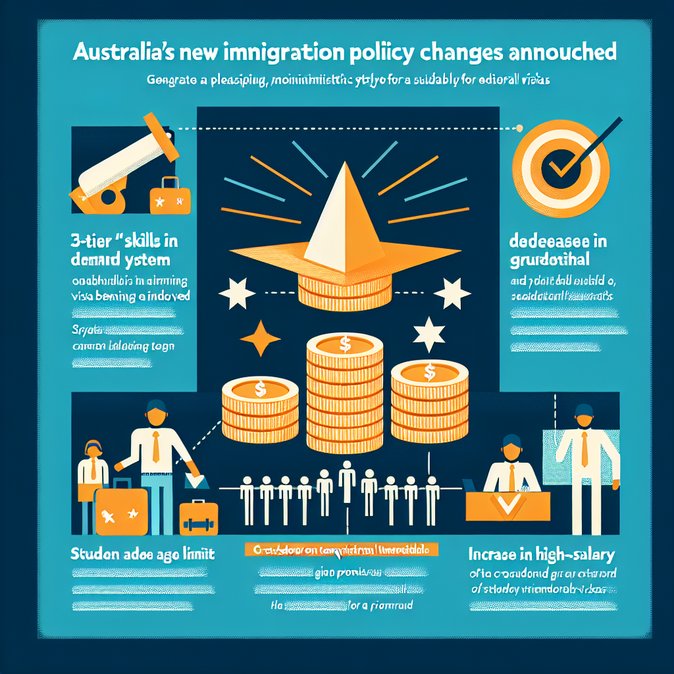
The Albanese Government has signed off on the most sweeping rewrite of Australia’s migration framework in three decades, with final details released overnight. From 1 May 2026 the Temporary Skill Shortage (TSS) visa will be replaced by a three-tier Skills in Demand (SID) visa; the Graduate (Subclass 485) age limit will fall from 50 to 35; and a strict ‘Genuine Student’ test will gatekeep Subclass 500 entrants. Under the SID model, applicants earning above AUD 135,000 jump into a fast-track “Specialist” lane capped at 21-day processing, while mainstream occupations remain in a “Core” stream and sectoral deals—covering care, agriculture and tourism—sit in an “Essential Skills” bucket.
![May mega-reform: Australia unveils Skills in Demand visa and clamps down on ‘visa hopping’]()
Employers and prospective migrants navigating these impending changes can streamline the process through VisaHQ’s dedicated Australia portal (https://www.visahq.com/australia/), which provides real-time updates on SID visa criteria, a document checklist builder, and concierge support to ensure error-free submissions—saving both time and compliance headaches.
Crucially, all SID holders will have 180 days to find a new sponsor if a job ends, up from the current 60-day window, cutting the risk of status loss for highly mobile talent. The reform package also slams the door on indefinite status-chaining. Multiple back-to-back temporary visas—colloquially called ‘visa hopping’—will trigger automated integrity flags unless each move forms part of a mapped pathway to permanent residence. International students face higher barriers: proof of AUD 31,200 in funds, higher English-language scores, and closer scrutiny of post-study intentions. Home Affairs projects the new architecture will cut net migration by 115,000 over four years while lifting GDP per capita via productivity gains. Universities are warning of revenue hits, but industry groups representing technology, mining and advanced manufacturing have welcomed faster access to premium talent. HR directors are urged to recalibrate global mobility budgets, update intra-company transfer policies, and invest in relocation support for younger graduates who now face tighter timelines. The overhaul aligns Australia with global peers tightening student and family routes while prioritising skilled and innovation-led entrants. For employers, the SID visa promises speed—provided salary bands and position descriptions are structured to fit the new criteria. For mobility managers, precision planning and early pipeline identification will become mission-critical in the post-May landscape.

Employers and prospective migrants navigating these impending changes can streamline the process through VisaHQ’s dedicated Australia portal (https://www.visahq.com/australia/), which provides real-time updates on SID visa criteria, a document checklist builder, and concierge support to ensure error-free submissions—saving both time and compliance headaches.
Crucially, all SID holders will have 180 days to find a new sponsor if a job ends, up from the current 60-day window, cutting the risk of status loss for highly mobile talent. The reform package also slams the door on indefinite status-chaining. Multiple back-to-back temporary visas—colloquially called ‘visa hopping’—will trigger automated integrity flags unless each move forms part of a mapped pathway to permanent residence. International students face higher barriers: proof of AUD 31,200 in funds, higher English-language scores, and closer scrutiny of post-study intentions. Home Affairs projects the new architecture will cut net migration by 115,000 over four years while lifting GDP per capita via productivity gains. Universities are warning of revenue hits, but industry groups representing technology, mining and advanced manufacturing have welcomed faster access to premium talent. HR directors are urged to recalibrate global mobility budgets, update intra-company transfer policies, and invest in relocation support for younger graduates who now face tighter timelines. The overhaul aligns Australia with global peers tightening student and family routes while prioritising skilled and innovation-led entrants. For employers, the SID visa promises speed—provided salary bands and position descriptions are structured to fit the new criteria. For mobility managers, precision planning and early pipeline identification will become mission-critical in the post-May landscape.