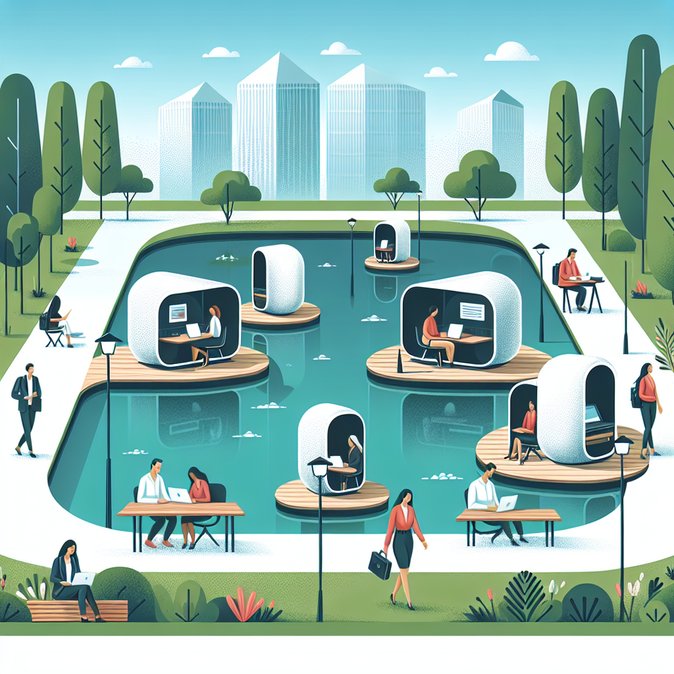
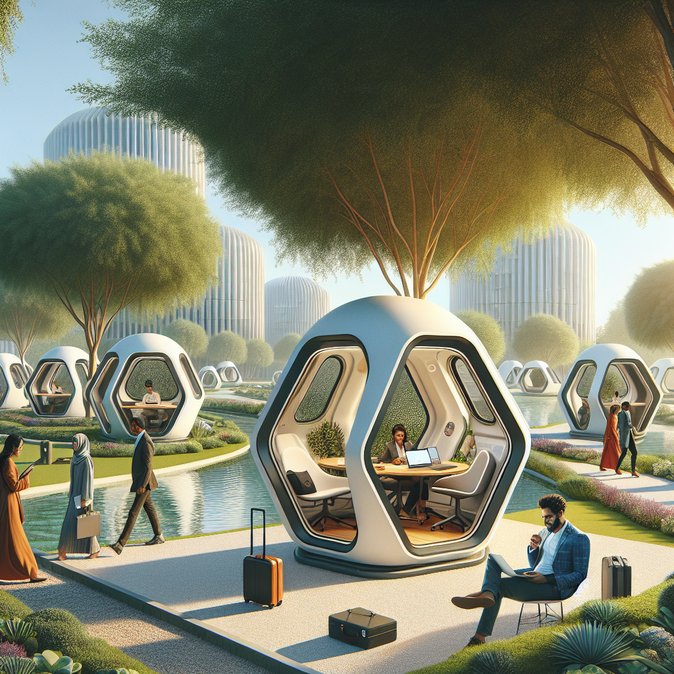
Dubai is once again re-imagining how – and where – people work. On 19 April 2026 Dubai Municipality formally unveiled “Work from Park”, a programme that will convert selected public parks into fully serviced co-working hubs beginning next month with a pilot site at Al Barsha Pond Park. The project is being delivered with modular-construction specialist Group Amana and local flexible-workspace platform Letswork. Purpose-built pods, manufactured off-site, will be craned into the park and fitted with high-speed Wi-Fi, power outlets, climate-controlled seating for individuals and small teams, and bookable meeting cubicles. Visitors will be able to reserve a desk through the Letswork app and pay by the hour or purchase day-passes, replicating the on-demand model popular in Dubai’s cafés and business centres. Officials say the scheme aligns with the Dubai Economic Agenda (D33) and the emirate’s Public Parks and Greenery Strategy, which together call for 310 new parks and more than 220 upgrades by 2040. Bader Anwahi, chief executive of the Public Facilities Agency, stressed that integrating productivity into leisure spaces “enhances quality of life while supporting economic activity.” By giving freelancers, start-ups and visiting business travellers an outdoor, pay-as-you-go office, the city hopes to cement its reputation as a magnet for mobile talent in the wake of its popular one-year Remote Work Visa.
![Dubai Municipality Launches ‘Work from Park’ Initiative to Transform Remote Working]()
Professionals eager to capitalise on the Remote Work Visa—and the newfound freedom of a desk in the park—can streamline the paperwork through VisaHQ. The company’s UAE specialists handle the entire application process, from income-proof documentation to insurance checks, and keep applicants updated in real time. Learn more at https://www.visahq.com/united-arab-emirates/
From a global-mobility perspective, the project removes a key friction point for foreign professionals who often struggle to find quiet, connected space between client meetings or while on reconnaissance trips before committing to relocation. Employers arranging short-term assignments can direct staff to a low-cost workspace that avoids hotel business-centre fees, while digital nomads gain an address-free alternative that dovetails with the Remote Work Visa’s six-month income-proof rules. Tourism operators are already packaging “Workation in the Park” day trips that pair morning desk time with afternoon wellness activities. The pods’ modular design gives Dubai Municipality the option to redeploy units to other parks or even to pop-up events such as GITEX or COP meetings. Early indicators point to rapid expansion: 35 additional parks are scheduled to open in 2026, and Letswork confirmed it is in discussions to roll out the concept across those sites as demand grows. If replicated nationwide, the model could influence urban-planning norms across the Gulf, where governments are racing to diversify economies and attract foreign knowledge workers. For HR and mobility managers the takeaway is clear: Dubai is doubling down on infrastructure that supports location-independent work. Companies with staff rotating through the emirate should update travel policies to include the new venues, and remote-work compliance teams should ensure employees using the pods remain within visa and tax parameters – a relatively straightforward task given the UAE’s benign personal-income-tax regime.
Professionals eager to capitalise on the Remote Work Visa—and the newfound freedom of a desk in the park—can streamline the paperwork through VisaHQ. The company’s UAE specialists handle the entire application process, from income-proof documentation to insurance checks, and keep applicants updated in real time. Learn more at https://www.visahq.com/united-arab-emirates/
From a global-mobility perspective, the project removes a key friction point for foreign professionals who often struggle to find quiet, connected space between client meetings or while on reconnaissance trips before committing to relocation. Employers arranging short-term assignments can direct staff to a low-cost workspace that avoids hotel business-centre fees, while digital nomads gain an address-free alternative that dovetails with the Remote Work Visa’s six-month income-proof rules. Tourism operators are already packaging “Workation in the Park” day trips that pair morning desk time with afternoon wellness activities. The pods’ modular design gives Dubai Municipality the option to redeploy units to other parks or even to pop-up events such as GITEX or COP meetings. Early indicators point to rapid expansion: 35 additional parks are scheduled to open in 2026, and Letswork confirmed it is in discussions to roll out the concept across those sites as demand grows. If replicated nationwide, the model could influence urban-planning norms across the Gulf, where governments are racing to diversify economies and attract foreign knowledge workers. For HR and mobility managers the takeaway is clear: Dubai is doubling down on infrastructure that supports location-independent work. Companies with staff rotating through the emirate should update travel policies to include the new venues, and remote-work compliance teams should ensure employees using the pods remain within visa and tax parameters – a relatively straightforward task given the UAE’s benign personal-income-tax regime.