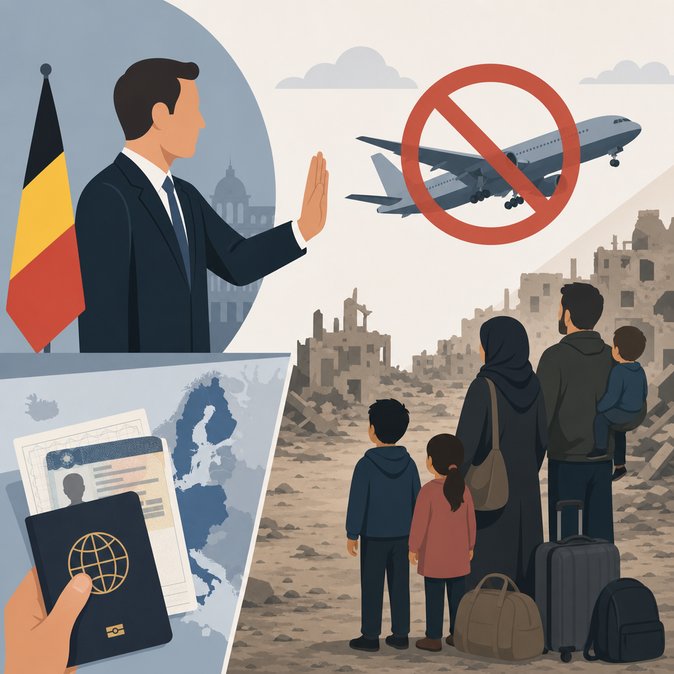
Belgium’s Foreign Minister Maxime Prévot told Parliament on 27 May 2026 that organising fresh evacuation flights from Gaza is “not a realistic option”, even though around 1,400 Palestinians currently hold visas authorising entry to Belgium. The minister was responding to fierce criticism from opposition MPs after De Standaard reported that the humanitarian corridor used last winter to airlift Belgian residents and family-reunion cases out of the enclave has been frozen since March. Prévot stressed that a Schengen visa is a *right of entry* once the traveller reaches an external EU border, but “does not create an obligation on the Belgian state to provide transport from a war zone”. He pointed to worsening security conditions around the Rafah crossing and to the sharp escalation of Israeli military operations as reasons the Defence Ministry has refused to sanction another extraction mission. The previous operation in January moved 237 people – mostly women and children – via Egypt to Brussels. Human-rights NGOs argue that Belgium’s stance undermines the credibility of its family-reunification policy. “If the state recognises the legitimacy of the visa, it should help holders exercise that right,” said Elias Saraf of Refugee Rights Europe. Several large employers with operations in Belgium’s life-sciences corridor have also raised concerns: expatriate staff on assignment in Flanders had planned to bring immediate relatives to safety, only to see those plans collapse. One pharmaceutical firm told *The Brussels Times* it may need to relocate key personnel to the Netherlands, where officials have left the Gaza evacuation mechanism formally open. Practically, mobility managers face a sensitive communications challenge. Visa endorsements issued by the Belgian consulate in Ramallah remain valid until at least January 2027, and the Foreign Ministry says it will extend those that expire before a safe exit route becomes available. However, companies must explain to affected employees that holding a Belgian visa does not guarantee government-arranged transport. Private-sector charter solutions have been mooted, but insurers are reluctant to underwrite flights into or out of Gaza’s immediate vicinity.
![Government Defends Halt to Gaza Evacuations Despite 1,400 Belgian Visa-Holders Stranded]()
For individuals and employers navigating these uncertainties, VisaHQ can be a valuable ally. The platform (https://www.visahq.com/belgium/) provides real-time updates on Schengen entry rules, assists with renewals and paperwork logistics, and helps applicants track validity periods—services that become crucial when governmental evacuation options are suspended.
In the longer term, the episode highlights a policy tension between humanitarian commitments and operational risk management. Belgium’s coalition agreement calls for “controlled pathways” for vulnerable groups, yet defence officials insist each evacuation requires ministerial sign-off and international military coordination. Unless the security calculus in Gaza improves, visa holders will remain in limbo – a situation that could affect Belgium’s reputation as a safe harbour for family reunification and skilled migration.

For individuals and employers navigating these uncertainties, VisaHQ can be a valuable ally. The platform (https://www.visahq.com/belgium/) provides real-time updates on Schengen entry rules, assists with renewals and paperwork logistics, and helps applicants track validity periods—services that become crucial when governmental evacuation options are suspended.
In the longer term, the episode highlights a policy tension between humanitarian commitments and operational risk management. Belgium’s coalition agreement calls for “controlled pathways” for vulnerable groups, yet defence officials insist each evacuation requires ministerial sign-off and international military coordination. Unless the security calculus in Gaza improves, visa holders will remain in limbo – a situation that could affect Belgium’s reputation as a safe harbour for family reunification and skilled migration.