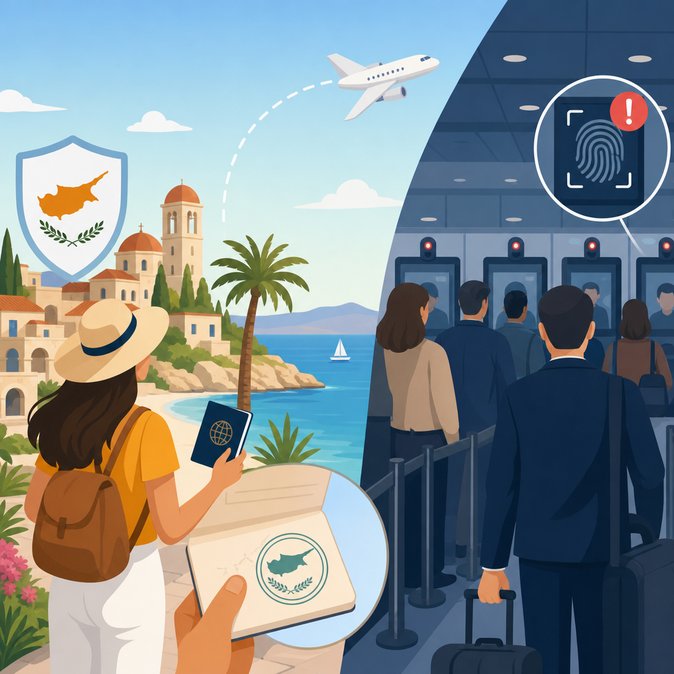
With the EU’s Entry/Exit System (EES) fully operational across the 29-member Schengen Area since 10 April 2026, travel-industry insiders are scrambling to steer customers towards destinations where new biometric queues can be avoided. A Holiday Extras advisory updated on 26 May lists Cyprus – alongside Ireland and several non-EU countries – as one of “seven places to go to escape EES.” Because Cyprus remains outside Schengen, visitors continue to receive traditional passport stamps rather than having fingerprints and facial images captured at automated kiosks. Industry associations ACI Europe and IATA have warned of potential four-hour waits this summer at busy Schengen hubs, fuelling demand for alternative Mediterranean sunshine spots.
![Cyprus marketed as ‘EES-free’ haven as biometric border regime triggers summer travel jitters]()
Travellers weighing up that sunshine swap can also lean on VisaHQ’s expertise: the company’s Cyprus portal (https://www.visahq.com/cyprus/) details current entry rules, visa options for non-EU nationals and practical airport tips, making it easier for both holidaymakers and business-trip planners to lock in a hassle-free getaway while the island remains outside the EES net.
The article notes that Cyprus formally confirmed in February it will not adopt EES in 2026 despite its longer-term aspiration to join Schengen, making the island a “savvy swap for Spain.” Tour operators say bookings from the UK and Gulf markets have spiked 18 percent year-on-year since April, with Larnaca and Paphos airports adjusting staffing rosters to handle additional charter capacity. Hoteliers, meanwhile, are leveraging the “no biometrics” message in social-media campaigns aimed at digital nomads and short-break travellers wary of summer disruption elsewhere in Europe. Policy analysts caution that the advantage may be short-lived. Brussels recently praised Cyprus’ technical progress towards Schengen adherence, and once full accession occurs – tentatively pencilled in for late 2027 – EES (and later ETIAS) will apply. For now, however, the island’s border-control status is translating directly into tourism and business-travel dividends. Corporate mobility managers are also taking note: executives attending Limassol’s EU Space Days or Nicosia’s Cultural Heritage Summit in late May reported “walk-through” immigration experiences, a stark contrast to anecdotal accounts of multi-hour waits at Charles de Gaulle and Barajas. Companies routing staff through Cyprus for Eastern Mediterranean assignments may find 2026 an opportune window before Schengen harmonisation closes the gap.

Travellers weighing up that sunshine swap can also lean on VisaHQ’s expertise: the company’s Cyprus portal (https://www.visahq.com/cyprus/) details current entry rules, visa options for non-EU nationals and practical airport tips, making it easier for both holidaymakers and business-trip planners to lock in a hassle-free getaway while the island remains outside the EES net.
The article notes that Cyprus formally confirmed in February it will not adopt EES in 2026 despite its longer-term aspiration to join Schengen, making the island a “savvy swap for Spain.” Tour operators say bookings from the UK and Gulf markets have spiked 18 percent year-on-year since April, with Larnaca and Paphos airports adjusting staffing rosters to handle additional charter capacity. Hoteliers, meanwhile, are leveraging the “no biometrics” message in social-media campaigns aimed at digital nomads and short-break travellers wary of summer disruption elsewhere in Europe. Policy analysts caution that the advantage may be short-lived. Brussels recently praised Cyprus’ technical progress towards Schengen adherence, and once full accession occurs – tentatively pencilled in for late 2027 – EES (and later ETIAS) will apply. For now, however, the island’s border-control status is translating directly into tourism and business-travel dividends. Corporate mobility managers are also taking note: executives attending Limassol’s EU Space Days or Nicosia’s Cultural Heritage Summit in late May reported “walk-through” immigration experiences, a stark contrast to anecdotal accounts of multi-hour waits at Charles de Gaulle and Barajas. Companies routing staff through Cyprus for Eastern Mediterranean assignments may find 2026 an opportune window before Schengen harmonisation closes the gap.