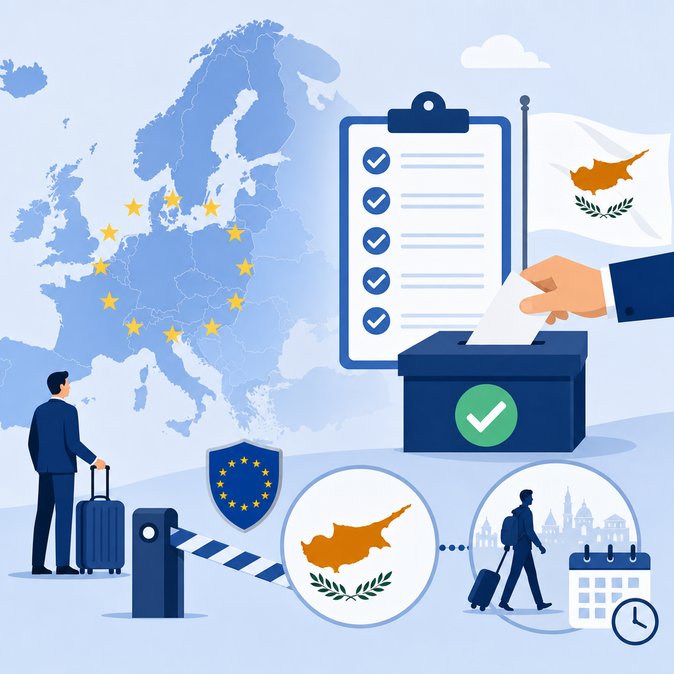
In its freshly released 2026 State of Schengen report, the European Commission singles out the completion of Cyprus’ accession as one of three flagship objectives for the next policy cycle. The iVisa analysis published on 19 May 2026 confirms that Cyprus has already integrated the Schengen Information System and the new biometric Entry/Exit System—-milestones independently verified during a December 2025 audit. Technically ready but still politically pending, Cyprus now awaits a unanimous Council vote. Diplomats say the earliest window is the Justice and Home Affairs Council in November 2026, after final EES resilience testing across high-volume external borders. Until then, travellers must continue using Cyprus’ national visa regime, although border-control officers have transitioned to Schengen-style document checks.
![EU Names Cyprus’ Schengen Entry a Top Priority for 2026-27 Cycle]()
For individuals and corporate travel departments trying to decipher those interim requirements, VisaHQ offers end-to-end Cyprus visa processing, document review and submission tracking, all handled online through a dedicated portal (https://www.visahq.com/cyprus/). Leveraging its global network, the service can also advise on future ETIAS filings and the impact of Schengen’s 90/180-day rules, ensuring that trips booked today remain compliant once Cyprus’ status changes.
For corporate mobility planners, the report’s timetable matters. From late 2026 or early 2027, visa-exempt travellers will need an ETIAS travel authorisation to reach Cyprus, while third-country assignees already holding Schengen multi-entry visas could move cross-border without additional paperwork once the island formally joins the zone. HR teams should therefore map out how Schengen rules on 90/180-day stay limits, posted-worker notifications and labour-market tests will affect assignment duration and compliance costs. The Commission also applauds Cyprus’ deployment of advance-passenger-information (API) feeds from airlines, a prerequisite for the upcoming European Passenger Name Record (PNR) directive upgrade. Businesses operating private or charter flights should ensure their brokers can transmit PNR data to Cypriot authorities to avoid fines once the directive becomes mandatory in mid-2027. Overall, the EU’s endorsement removes the last major uncertainty clouding Cyprus-bound investment projects that hinge on seamless intra-EU mobility. Forward-looking companies should treat Schengen entry as a baseline scenario when negotiating relocation packages, office leases and travel budgets for 2027 and beyond.

For individuals and corporate travel departments trying to decipher those interim requirements, VisaHQ offers end-to-end Cyprus visa processing, document review and submission tracking, all handled online through a dedicated portal (https://www.visahq.com/cyprus/). Leveraging its global network, the service can also advise on future ETIAS filings and the impact of Schengen’s 90/180-day rules, ensuring that trips booked today remain compliant once Cyprus’ status changes.
For corporate mobility planners, the report’s timetable matters. From late 2026 or early 2027, visa-exempt travellers will need an ETIAS travel authorisation to reach Cyprus, while third-country assignees already holding Schengen multi-entry visas could move cross-border without additional paperwork once the island formally joins the zone. HR teams should therefore map out how Schengen rules on 90/180-day stay limits, posted-worker notifications and labour-market tests will affect assignment duration and compliance costs. The Commission also applauds Cyprus’ deployment of advance-passenger-information (API) feeds from airlines, a prerequisite for the upcoming European Passenger Name Record (PNR) directive upgrade. Businesses operating private or charter flights should ensure their brokers can transmit PNR data to Cypriot authorities to avoid fines once the directive becomes mandatory in mid-2027. Overall, the EU’s endorsement removes the last major uncertainty clouding Cyprus-bound investment projects that hinge on seamless intra-EU mobility. Forward-looking companies should treat Schengen entry as a baseline scenario when negotiating relocation packages, office leases and travel budgets for 2027 and beyond.