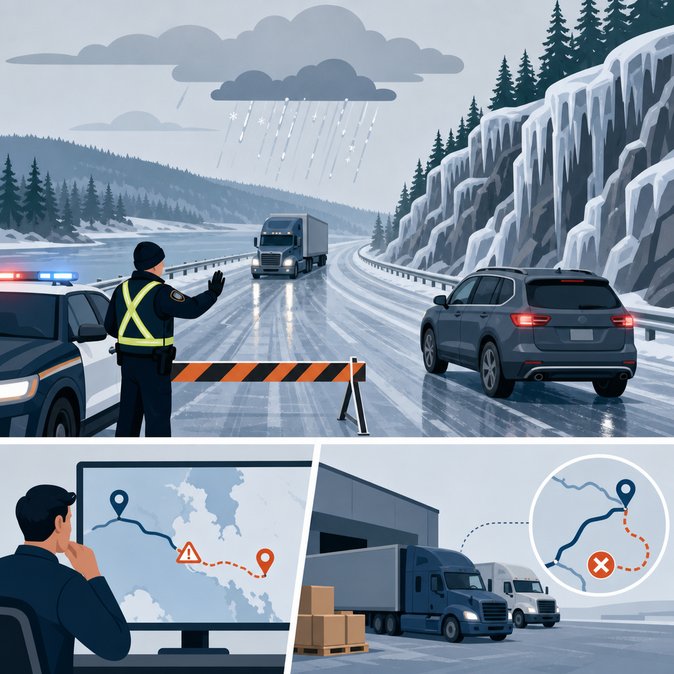
Northwestern Ontario’s main east–west artery faced hazardous driving conditions on May 18 after Environment Canada issued a freezing-rain warning for the Upsala–Raith stretch of Highway 17. The alert, highlighted by regional outlet NetNewsLedger, forecast 2–5 mm of ice accretion from midnight into the afternoon of May 19, threatening both passenger vehicles and long-haul transport critical to the region’s mining and forestry sectors. Highway 17 links Thunder Bay with Manitoba and is the only Trans-Canada route through the district. Trucking firms that supply Resolute Forest Products’ sawmills and New Gold’s Rainy River mine instituted rolling convoy policies, spacing vehicles to reduce chain-reaction collision risk on iced surfaces. Ontario Provincial Police advised commercial drivers to stage in Dryden and Nipigon truck stops until conditions improved, while the Ministry of Transportation pre-positioned sand-and-salt units and tow trucks at key junctions.
![Freezing-rain warning on Highway 17 triggers travel advisory for Northwestern Ontario]()
If international technicians or consultants need to be brought in on short notice, VisaHQ can quickly arrange the necessary Canadian visas and eTAs, ensuring paperwork doesn’t become another bottleneck when weather disrupts tight project timelines—see https://www.visahq.com/canada/ for details.
For corporate travel planners, the warning created a ripple effect. Charter services relocating maintenance crews to remote hydroelectric sites diverted to Thunder Bay Airport, forcing overnight accommodation costs. Tour operators shuttling spring anglers to lodges around Lake Nipigon delayed departures, and same-day courier services carrying mining samples were bumped to air freight. Environment Canada expected temperatures to rise above zero by late afternoon on the 19th, but urged motorists to carry emergency kits and to monitor Ontario 511 for rolling lane closures. While the impact was regional, the incident is a reminder that sudden spring ice storms can cripple overland mobility in Canada’s resource corridor—posing supply-chain and duty-of-care challenges for organisations with northern operations.

If international technicians or consultants need to be brought in on short notice, VisaHQ can quickly arrange the necessary Canadian visas and eTAs, ensuring paperwork doesn’t become another bottleneck when weather disrupts tight project timelines—see https://www.visahq.com/canada/ for details.
For corporate travel planners, the warning created a ripple effect. Charter services relocating maintenance crews to remote hydroelectric sites diverted to Thunder Bay Airport, forcing overnight accommodation costs. Tour operators shuttling spring anglers to lodges around Lake Nipigon delayed departures, and same-day courier services carrying mining samples were bumped to air freight. Environment Canada expected temperatures to rise above zero by late afternoon on the 19th, but urged motorists to carry emergency kits and to monitor Ontario 511 for rolling lane closures. While the impact was regional, the incident is a reminder that sudden spring ice storms can cripple overland mobility in Canada’s resource corridor—posing supply-chain and duty-of-care challenges for organisations with northern operations.