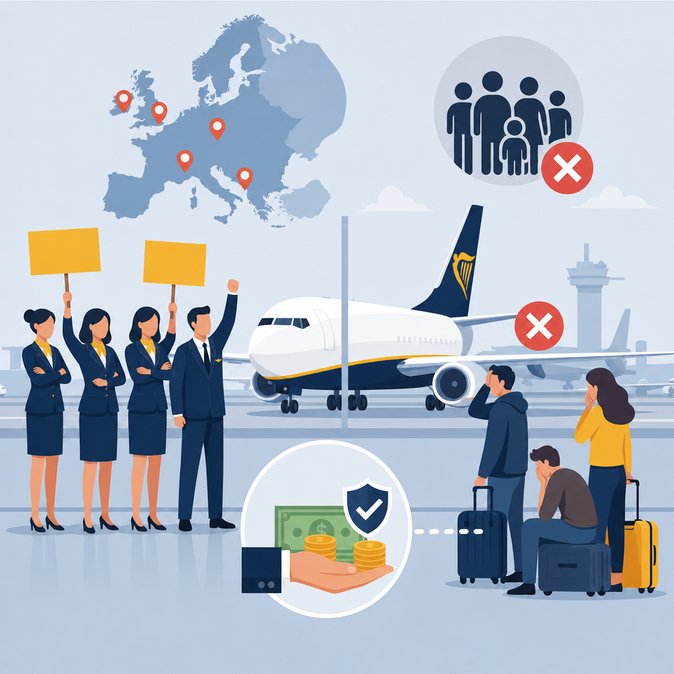
Ireland’s largest airline was once again at the centre of industrial turmoil on 16 May 2026 after cabin-crew unions in Germany, Spain, Belgium, the Netherlands, Portugal and Italy staged coordinated 24-hour walk-outs, forcing Ryanair to pre-emptively ground 190 services. The low-cost carrier confirmed that more than 34,000 passengers were directly affected, including thousands travelling on weekend minibreaks from Dublin, Cork and Belfast. Although Irish-based crews reported for duty—following last year’s collective agreement with the Fórsa union—network-wide rotations meant that crew shortages elsewhere still cascaded into the Republic. Dublin Airport saw cancellations to Barcelona, Rome, Brussels and Faro, with knock-on delays on Glasgow and Manchester shuttles as aircraft were swapped onto higher-yield Mediterranean routes.
Ryanair offered free moves or refunds, but warned that alternative seats on the same day were extremely limited because the stoppage coincided with both the Whit weekend and the Eurovision home-coming traffic. The airline urged customers with time-sensitive trips to “consider rail or ferry options” where feasible—an unusual concession that underlines the severity of the disruption.
![Ryanair cancels 190 flights on 16 May as pan-European cabin-crew strike hits Irish schedules]()
Travellers scrambling to rebook via alternative carriers or routings should also double-check any transit or destination visa requirements. Online specialists like VisaHQ can expedite eVisas, passport renewals and provide up-to-date entry-rule advice—particularly helpful when last-minute changes introduce new stopovers or jurisdictions. Irish passengers can access these services at https://www.visahq.com/ireland/
For corporate mobility teams, the strike revived questions about Ryanair’s reliability ahead of a summer marked by rising wage-inflation expectations. “We routinely use Ryanair for short-notice assignee visits, but every cancelled rotation erodes confidence,” said the EMEA travel manager of a US tech firm with a major Dublin hub. Under EU Regulation 261, passengers are eligible for €250–€400 compensation because crew strikes are deemed within an airline’s control—a potential €7–€9 million liability for Ryanair if all claims are lodged. While the company insisted negotiations with several unions are ‘progressing’, representatives for Italy’s UIL Trasporti warned of further strikes in June unless pay-scale harmonisation talks accelerate. HR departments have been advised to monitor union ballots closely and to build Slack or Teams channels for real-time traveller support when disruption hits.
Ryanair offered free moves or refunds, but warned that alternative seats on the same day were extremely limited because the stoppage coincided with both the Whit weekend and the Eurovision home-coming traffic. The airline urged customers with time-sensitive trips to “consider rail or ferry options” where feasible—an unusual concession that underlines the severity of the disruption.

Travellers scrambling to rebook via alternative carriers or routings should also double-check any transit or destination visa requirements. Online specialists like VisaHQ can expedite eVisas, passport renewals and provide up-to-date entry-rule advice—particularly helpful when last-minute changes introduce new stopovers or jurisdictions. Irish passengers can access these services at https://www.visahq.com/ireland/
For corporate mobility teams, the strike revived questions about Ryanair’s reliability ahead of a summer marked by rising wage-inflation expectations. “We routinely use Ryanair for short-notice assignee visits, but every cancelled rotation erodes confidence,” said the EMEA travel manager of a US tech firm with a major Dublin hub. Under EU Regulation 261, passengers are eligible for €250–€400 compensation because crew strikes are deemed within an airline’s control—a potential €7–€9 million liability for Ryanair if all claims are lodged. While the company insisted negotiations with several unions are ‘progressing’, representatives for Italy’s UIL Trasporti warned of further strikes in June unless pay-scale harmonisation talks accelerate. HR departments have been advised to monitor union ballots closely and to build Slack or Teams channels for real-time traveller support when disruption hits.