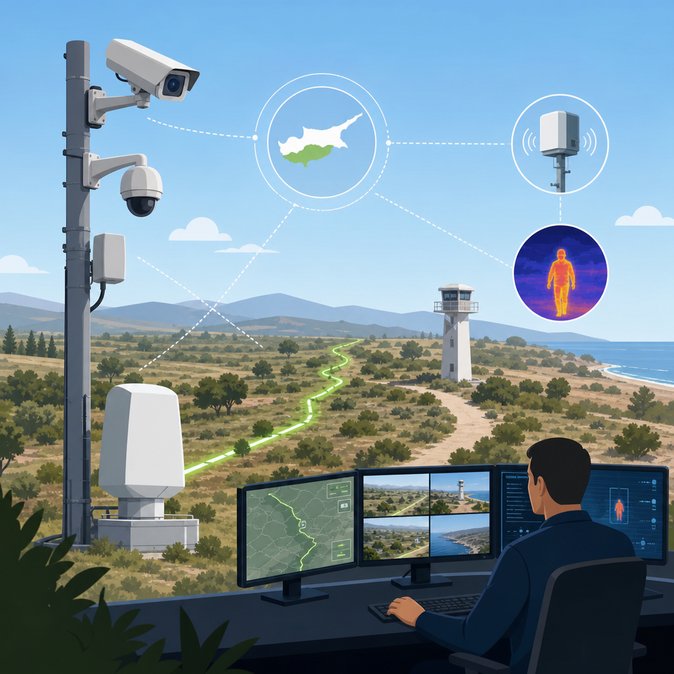
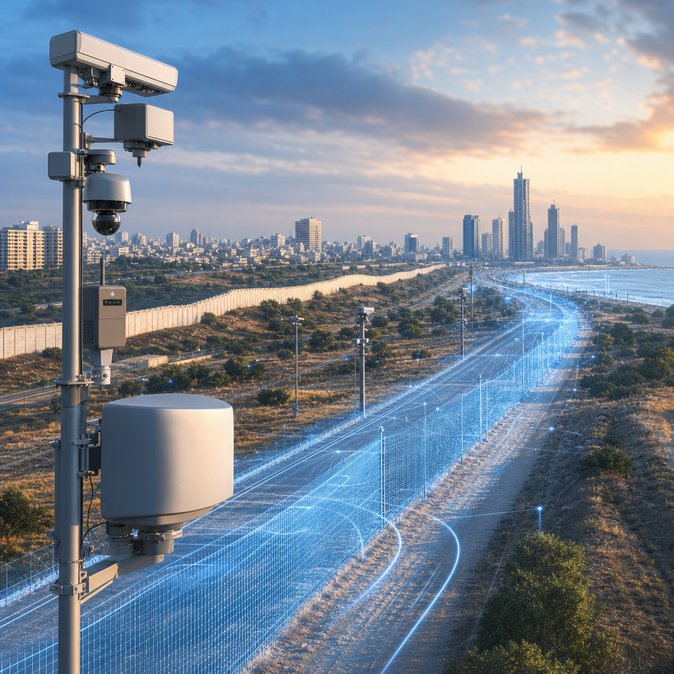
The Republic of Cyprus has completed the first phase of a multi-year project to modernise monitoring of the 180-kilometre Green Line that separates the government-controlled south from the Turkish-occupied north. Speaking to local media on 14 May, officials from the defence ministry and the National Guard confirmed that more than 100 day-night cameras, thermal sensors and motion-detection radars are now fully operational at strategic points along the buffer zone. The sensors feed real-time images to a joint command centre staffed by the police, army and migration service, allowing officers to dispatch patrols within minutes when suspicious movement is detected. The upgrade replaces wide stretches of razor wire that were hurriedly installed in 2021 to slow a spike in irregular migration but which drew criticism from farmers, UNFICYP peacekeepers and the European Commission. Most of that fencing has now been dismantled except in steep ravines where ground sensors are impractical. Authorities say the electronic shield is both more humane—because it does not physically block communities—and more efficient, with incident response times already cut by 40 per cent compared with last year. Border management experts note that Cyprus remains outside the Schengen Area, so the Green Line constitutes an external frontier of the EU’s visa-free zone once the island joins Schengen in 2026. By investing early in an integrated sensor network and encrypted links to EU databases such as SIS II and EURODAC, Nicosia hopes to demonstrate that it can police that frontier to Brussels’ standards.
![Cyprus Deploys High-Tech Surveillance Along the Green Line to Curb Irregular Crossings]()
For travellers who need clarity on entry requirements while these changes unfold, VisaHQ offers a convenient one-stop service: its Cyprus portal (https://www.visahq.com/cyprus/) lists the latest visa rules, processes online applications and provides expert support—ensuring business visitors, tourists and journalists can move smoothly through official checkpoints without surprises.
For multinational companies with staff shuttling between offices in Nicosia, Limassol and client sites near the buffer zone, the practical impact should be positive. Officials insist that the surveillance net targets only unauthorised crossings; the nine official checkpoints used by business travellers and commuters will remain open under existing procedures. Nevertheless, employers are advised to brief mobile workers that ad-hoc identity checks may increase on adjoining roads while the system’s algorithms are calibrated over the summer. The project’s €27 million price tag is being financed through the EU Internal Security Fund 2021-2027 and a bilateral grant from Slovakia, whose soldiers patrol Sector 4 of the buffer zone. A second phase—due to start in November—will integrate automatic number-plate recognition and drone support, putting Cyprus on par with the ‘smart borders’ concept already piloted in Estonia and Finland.
For travellers who need clarity on entry requirements while these changes unfold, VisaHQ offers a convenient one-stop service: its Cyprus portal (https://www.visahq.com/cyprus/) lists the latest visa rules, processes online applications and provides expert support—ensuring business visitors, tourists and journalists can move smoothly through official checkpoints without surprises.
For multinational companies with staff shuttling between offices in Nicosia, Limassol and client sites near the buffer zone, the practical impact should be positive. Officials insist that the surveillance net targets only unauthorised crossings; the nine official checkpoints used by business travellers and commuters will remain open under existing procedures. Nevertheless, employers are advised to brief mobile workers that ad-hoc identity checks may increase on adjoining roads while the system’s algorithms are calibrated over the summer. The project’s €27 million price tag is being financed through the EU Internal Security Fund 2021-2027 and a bilateral grant from Slovakia, whose soldiers patrol Sector 4 of the buffer zone. A second phase—due to start in November—will integrate automatic number-plate recognition and drone support, putting Cyprus on par with the ‘smart borders’ concept already piloted in Estonia and Finland.