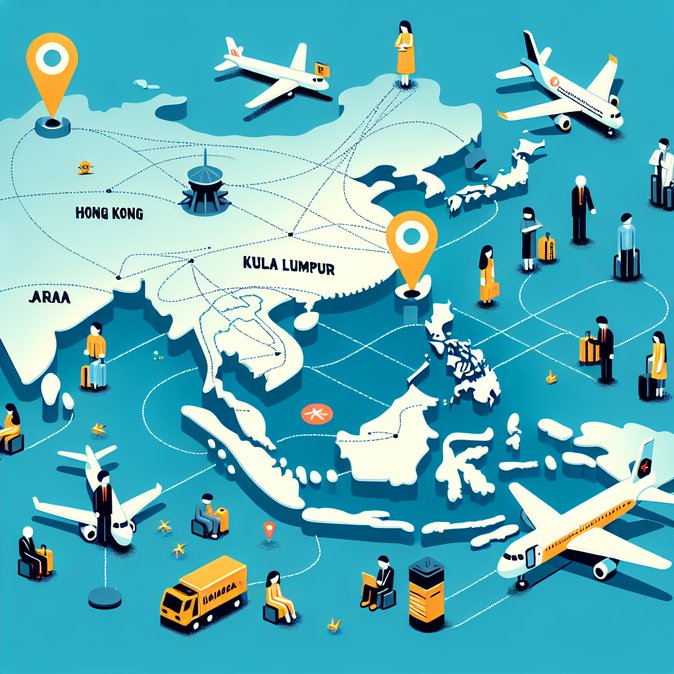
More than sixty scheduled services were cancelled on 9 May across key Asian hubs—including Hong Kong International Airport—leaving business and leisure passengers scrambling for alternative routings. Data collated from airport departure boards, airline schedule updates and passenger-tracking forums shows regional carriers Batik Air, multiple AirAsia affiliates, Garuda Indonesia and hybrid operators in Malaysia and Taiwan trimming short-haul frequencies with little notice. Knock-on effects hit long-haul partners such as United Airlines and Saudia, disrupting onward connections to San Francisco and Jeddah. At Hong Kong International Airport, clusters of departures to popular Southeast-Asian business centres were withdrawn or merged, a pattern mirrored in Taipei, Kuala Lumpur and Jakarta. Aviation analysts attribute the sudden cuts to a cocktail of surging jet-fuel prices, softer shoulder-season demand and uncertainty created by ongoing Middle-East airspace restrictions. Budget carriers, whose razor-thin margins are especially sensitive to fuel swings, have been pruning thinner routes first—often those feeding larger hubs like Hong Kong. For corporate mobility managers, the episode is a warning that regional feeder flights underpinning Hong Kong’s role as a gateway can unravel quickly. Employees heading to board meetings in Singapore or onward to North America may now face multi-hour groundings or forced overnight stays if a single short sector is removed.
![Wave of flight cancellations strands travellers in Hong Kong and across Asia]()
If a change of routing suddenly forces you through a country that requires a visa, VisaHQ’s Hong Kong portal (https://www.visahq.com/hong-kong/) can fast-track the necessary paperwork for transit or short-stay entry, sparing travellers from additional delays and helping travel managers keep itineraries on track.
Experts suggest booking longer layovers, monitoring airline apps hourly, and purchasing ‘flexi-fare’ options that allow same-day rerouting without penalties. Airlines are expected to keep fine-tuning networks over the next few weeks; published timetables already show seasonal suspensions extending into early summer on selected Hong Kong–Taiwan and Hong Kong–Indonesia pairs. Travellers should therefore treat flight-status confirmation as a continual process rather than a one-off checklist item. On a positive note, Hong Kong’s airport authority confirmed that key airport systems functioned normally during the disruption and that automated e-Channel gates remained fully operational—minimising immigration queues for those who did arrive. Still, with cost pressures and geopolitical headwinds unlikely to ease soon, Asia-bound corporates may need to bake greater schedule volatility into assignment planning through 2026.

If a change of routing suddenly forces you through a country that requires a visa, VisaHQ’s Hong Kong portal (https://www.visahq.com/hong-kong/) can fast-track the necessary paperwork for transit or short-stay entry, sparing travellers from additional delays and helping travel managers keep itineraries on track.
Experts suggest booking longer layovers, monitoring airline apps hourly, and purchasing ‘flexi-fare’ options that allow same-day rerouting without penalties. Airlines are expected to keep fine-tuning networks over the next few weeks; published timetables already show seasonal suspensions extending into early summer on selected Hong Kong–Taiwan and Hong Kong–Indonesia pairs. Travellers should therefore treat flight-status confirmation as a continual process rather than a one-off checklist item. On a positive note, Hong Kong’s airport authority confirmed that key airport systems functioned normally during the disruption and that automated e-Channel gates remained fully operational—minimising immigration queues for those who did arrive. Still, with cost pressures and geopolitical headwinds unlikely to ease soon, Asia-bound corporates may need to bake greater schedule volatility into assignment planning through 2026.