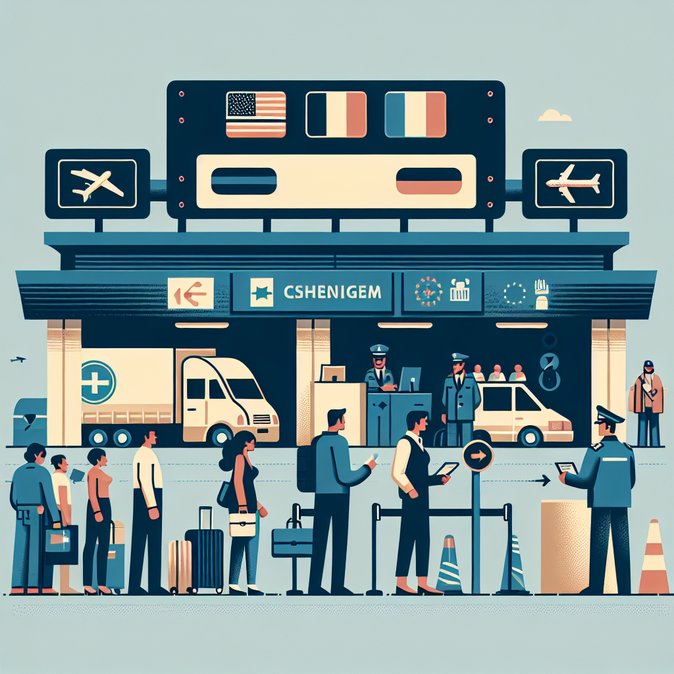
Germany’s Interior Minister Alexander Dobrindt (CSU) used a series of media appearances on 4 May 2026 to make it clear that he intends to maintain the temporary checks that Germany has re-introduced at all of its land borders with Austria, the Czech Republic, Poland, Switzerland, Denmark, France, Luxembourg and the Netherlands. The minister argues that the controls are a necessary security tool while Europe’s common asylum system is still being reformed, pointing to a 70 percent fall in irregular entries since 2023 as evidence of success. His announcement comes at an awkward moment. Administrative courts in Koblenz and Munich have recently ruled individual controls unlawful because the government could not show a “serious threat to public order”, the strict legal test under the Schengen Borders Code. Migration researchers, including Gerald Knaus of the European Stability Initiative, dispute the ministry’s statistics and warn that controls merely displace migration routes rather than reduce overall numbers. For globally mobile staff and their employers the continuation of controls means that travel by road or rail across what are normally invisible borders will remain unpredictable.
![Interior Minister Dobrindt vows to keep Germany’s internal Schengen border checks despite court rulings]()
At this juncture, services such as VisaHQ can take much of the guesswork out of cross-border travel planning. Its Germany portal (https://www.visahq.com/germany/) tracks official notices in real time and generates customised entry-document checklists for employees, enabling HR teams to react quickly to shifting requirements at temporary checkpoints.
Cross-border commuters from the Czech Republic and Poland have reported queues of up to 45 minutes at peak times, and international assignees living in Salzburg or Strasbourg face similar delays on their daily journeys into Germany. HR managers need to budget extra travel time for meetings and insist that non-EU assignees carry hard copies of residence cards to avoid secondary screening. German industry federations are split. Automotive suppliers in Bavaria praise the deterrent effect on smugglers, while logistics firms along the Dutch and Belgian borders complain about late deliveries and higher fuel costs caused by stop-and-go traffic. The German Chamber of Commerce and Industry (DIHK) is urging the interior ministry to publish real-time statistics so companies can plan shifts more efficiently. Although the federal government can prolong the checks in six-month increments, Brussels has made clear that the temporary derogation cannot become permanent. Unless the EU Court of Justice validates the controls, Germany could face infringement proceedings later this year. Companies should therefore prepare for a policy environment that may swing from hard controls to sudden liberalisation – and back – in the next 12 months.

At this juncture, services such as VisaHQ can take much of the guesswork out of cross-border travel planning. Its Germany portal (https://www.visahq.com/germany/) tracks official notices in real time and generates customised entry-document checklists for employees, enabling HR teams to react quickly to shifting requirements at temporary checkpoints.
Cross-border commuters from the Czech Republic and Poland have reported queues of up to 45 minutes at peak times, and international assignees living in Salzburg or Strasbourg face similar delays on their daily journeys into Germany. HR managers need to budget extra travel time for meetings and insist that non-EU assignees carry hard copies of residence cards to avoid secondary screening. German industry federations are split. Automotive suppliers in Bavaria praise the deterrent effect on smugglers, while logistics firms along the Dutch and Belgian borders complain about late deliveries and higher fuel costs caused by stop-and-go traffic. The German Chamber of Commerce and Industry (DIHK) is urging the interior ministry to publish real-time statistics so companies can plan shifts more efficiently. Although the federal government can prolong the checks in six-month increments, Brussels has made clear that the temporary derogation cannot become permanent. Unless the EU Court of Justice validates the controls, Germany could face infringement proceedings later this year. Companies should therefore prepare for a policy environment that may swing from hard controls to sudden liberalisation – and back – in the next 12 months.