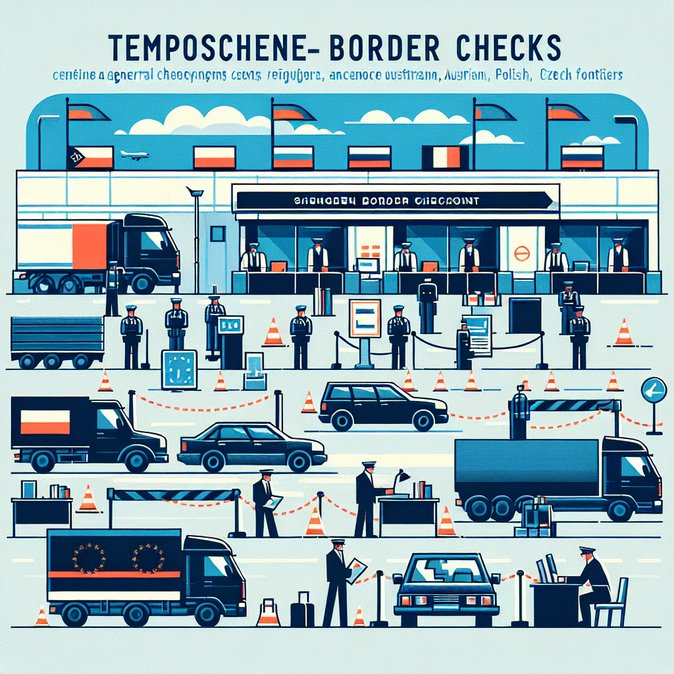
Speaking on ARD’s ‘Bericht aus Berlin’ on the evening of 3 May 2026, Federal Interior Minister Alexander Dobrindt (CSU) confirmed that Germany will maintain the temporary checks it re-introduced on its land borders with Austria, Poland, and the Czech Republic in 2023. Although the number of irregular border crossings has fallen sharply since the peak of late-2025, Dobrindt said that 8 000 outstanding arrest warrants had been executed at the frontier in the past twelve months—proof, in his view, that the controls remain necessary. The minister argued that Germany cannot rely on EU-level reforms alone until the revamped Common European Asylum System (GEAS) becomes fully operational in mid-2026. Until then, officers from the Federal Police will continue to carry out spot checks on trains, motorway crossings, and rural back-roads.
![Interior Minister Dobrindt Vows to Keep Temporary Border Checks in Place]()
For travellers who want to be certain their documents meet the latest German entry rules, VisaHQ can help. The service’s Germany page (https://www.visahq.com/germany/) provides instant visa requirement checks, online application support, and timely updates on border procedures, giving both business and leisure visitors extra confidence when approaching spot controls.
Critics inside the Bundestag say the practice is gradually normalising what should be an exceptional measure and risks infringing on the Schengen principle of free movement. For corporate mobility managers the announcement means that door-to-door travel times for cross-border commuters and truck drivers will remain unpredictable. Logistics firms operating “just-in-time” supply chains between Bavarian factories and suppliers in the Czech Republic have already built in buffer times of up to 45 minutes per journey. Business travellers should therefore continue to carry passports (or national ID cards for EU citizens) as well as proof of accommodation and onward travel when entering Germany by road or rail. Employers with large numbers of frontier workers should review their posted-worker documentation and ensure that A1 certificates and EU social-security paperwork are up to date; spot audits have increased in parallel with the border checks. Dobrindt reiterated that once GEAS screening centres at the EU’s external borders prove effective the domestic controls will be lifted, but he gave no concrete timeline.
For travellers who want to be certain their documents meet the latest German entry rules, VisaHQ can help. The service’s Germany page (https://www.visahq.com/germany/) provides instant visa requirement checks, online application support, and timely updates on border procedures, giving both business and leisure visitors extra confidence when approaching spot controls.
Critics inside the Bundestag say the practice is gradually normalising what should be an exceptional measure and risks infringing on the Schengen principle of free movement. For corporate mobility managers the announcement means that door-to-door travel times for cross-border commuters and truck drivers will remain unpredictable. Logistics firms operating “just-in-time” supply chains between Bavarian factories and suppliers in the Czech Republic have already built in buffer times of up to 45 minutes per journey. Business travellers should therefore continue to carry passports (or national ID cards for EU citizens) as well as proof of accommodation and onward travel when entering Germany by road or rail. Employers with large numbers of frontier workers should review their posted-worker documentation and ensure that A1 certificates and EU social-security paperwork are up to date; spot audits have increased in parallel with the border checks. Dobrindt reiterated that once GEAS screening centres at the EU’s external borders prove effective the domestic controls will be lifted, but he gave no concrete timeline.