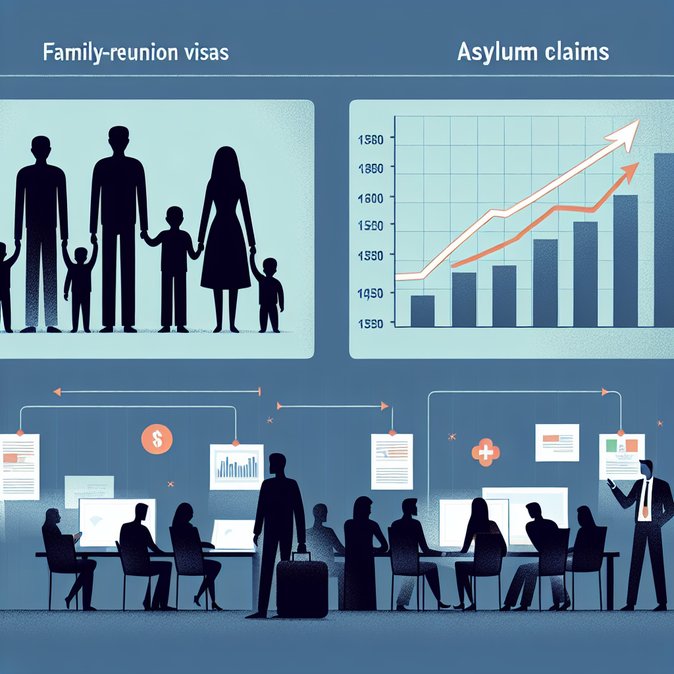
Fresh visa-issuance and asylum statistics released on 18 April 2026 have reopened the debate about Germany’s migration policy. The figures, first reported by the financial portal Kettner Edelmetalle, reveal that 49,400 third-country nationals entered the country through family-reunion visas or first-time asylum claims between January and March 2026. Family-reunion visas accounted for roughly 27,000 of those arrivals, a number virtually unchanged from the same period in 2025 despite the change of government last May. Turkish citizens remained the largest beneficiary group (4,400 visas), followed by applicants from Kosovo, India, Syria and Albania. Visa officers noted a pronounced shift away from Syrian applicants and a doubling of demand from Kosovars, a trend migration scholars link to improved economic prospects in the Western Balkans coupled with stricter Syrian return policies. On the asylum side, 22,491 first-time applications were lodged in the first quarter. While the headline figure is lower than the 36,000 cases recorded a year earlier, applications from Afghan nationals surged by nearly 570 percent after an October 2024 European Court of Justice ruling classified gender-based persecution under the Taliban as grounds for protection.
![Official data show almost 50,000 new arrivals in Germany in Q1 2026 despite promised ‘migration turnaround’]()
At this juncture, individuals and employers seeking clarity on Germany’s fast-moving visa rules may find practical assistance through VisaHQ. The service’s dedicated Germany page (https://www.visahq.com/germany/) aggregates current requirements, forms, and processing timelines for family-reunion, skilled-worker and other visa categories, helping private applicants and corporate mobility teams streamline compliance.
Interior-ministry officials privately concede that follow-on claims by Afghan women could keep overall asylum numbers elevated throughout 2026. Extrapolated over the full year, the Q1 trajectory would translate into around 200,000 humanitarian or family arrivals—roughly the population of Hannover—calling into question Chancellor Friedrich Merz’s campaign promise of a “migration turnaround.” Opposition parties argue the data prove that tougher rhetoric has not yet been matched by administrative reforms, while employer federations warn that any abrupt clamp-down could choke off much-needed labour supply in a market already missing an estimated 450,000 skilled workers. For global-mobility and HR managers the message is nuanced: processing times at German consulates remain stable for family visas, but case law changes can trigger sudden spikes in specific nationalities, complicating workforce-planning models. Companies should monitor forthcoming amendments to the Skilled Immigration Act—expected before the summer recess—that may further recalibrate Germany’s balance between humanitarian protection and labour-market needs.

At this juncture, individuals and employers seeking clarity on Germany’s fast-moving visa rules may find practical assistance through VisaHQ. The service’s dedicated Germany page (https://www.visahq.com/germany/) aggregates current requirements, forms, and processing timelines for family-reunion, skilled-worker and other visa categories, helping private applicants and corporate mobility teams streamline compliance.
Interior-ministry officials privately concede that follow-on claims by Afghan women could keep overall asylum numbers elevated throughout 2026. Extrapolated over the full year, the Q1 trajectory would translate into around 200,000 humanitarian or family arrivals—roughly the population of Hannover—calling into question Chancellor Friedrich Merz’s campaign promise of a “migration turnaround.” Opposition parties argue the data prove that tougher rhetoric has not yet been matched by administrative reforms, while employer federations warn that any abrupt clamp-down could choke off much-needed labour supply in a market already missing an estimated 450,000 skilled workers. For global-mobility and HR managers the message is nuanced: processing times at German consulates remain stable for family visas, but case law changes can trigger sudden spikes in specific nationalities, complicating workforce-planning models. Companies should monitor forthcoming amendments to the Skilled Immigration Act—expected before the summer recess—that may further recalibrate Germany’s balance between humanitarian protection and labour-market needs.