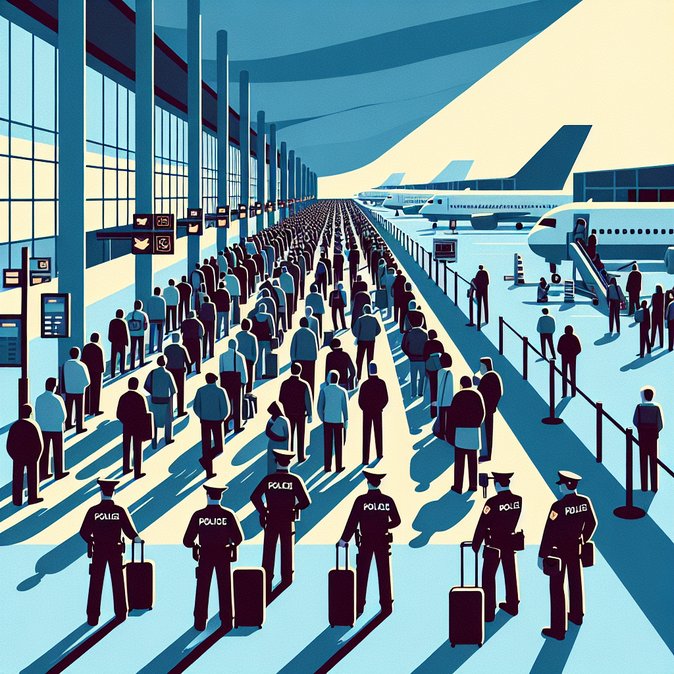
Barely hours after the new Entry/Exit System went live, Spain’s airports were urging Brussels for help. A joint statement issued on 10 April by Airports Council International Europe (ACI Europe) and Airlines 4 Europe (A4E) warned that some flights left half-empty because passengers were still stuck in passport-control lines when gates closed. At Palma de Mallorca, border police reported wait times of up to 150 minutes for UK leisure passengers whose biometrics failed at the kiosk, forcing manual intervention. The aviation bodies want the European Commission to reinstate a derogation that allowed border forces to “switch off” the biometric capture during exceptional peaks. That waiver expired the moment the system became fully operational.
![Spanish airports call for emergency flexibility after first-day EES queues hit three hours]()
For individual passengers, services such as VisaHQ can help take the uncertainty out of pre-travel preparation by providing up-to-date guidance on Spain’s entry requirements, facilitating any necessary visa applications and sending alerts on procedural changes; the dedicated Spain page (https://www.visahq.com/spain/) is a useful one-stop resource that can spare travellers unpleasant surprises at the border.
Without it, police must collect fingerprints and a face image for every third-country national who has not yet been registered, even if the queue snakes into the baggage hall. Spain’s Interior Ministry says it is deploying 100 mobile enrolment teams to relieve pressure at Alicante, Málaga and Tenerife Sur, the three airports with the highest ratio of leisure travellers. It also authorised carriers to reopen check-in counters earlier so that holidaymakers reach border control in staggered waves rather than all at once. For businesses, the disruption is a timely reminder to build slack into travel schedules. Multinationals moving project teams or equipment through Spain in April should allow at least four hours’ ground time between a trans-Atlantic arrival and any onward domestic sector. Travel managers are also being advised to pre-brief assignees: fingerprints must be captured on the first trip; taking off rings and using moisturiser can speed up the process. The call for flexibility is politically sensitive. Member States spent the past decade arguing that a digital border would be both more secure and more efficient. ACI Europe’s director general Olivier Jankovec insists the industry still supports EES but says “security gains will be overshadowed if passengers simply choose non-Schengen hubs.” The Commission is expected to respond next week, but sources in Brussels hinted any concession will be temporary and conditional on airports publishing real-time performance data.

For individual passengers, services such as VisaHQ can help take the uncertainty out of pre-travel preparation by providing up-to-date guidance on Spain’s entry requirements, facilitating any necessary visa applications and sending alerts on procedural changes; the dedicated Spain page (https://www.visahq.com/spain/) is a useful one-stop resource that can spare travellers unpleasant surprises at the border.
Without it, police must collect fingerprints and a face image for every third-country national who has not yet been registered, even if the queue snakes into the baggage hall. Spain’s Interior Ministry says it is deploying 100 mobile enrolment teams to relieve pressure at Alicante, Málaga and Tenerife Sur, the three airports with the highest ratio of leisure travellers. It also authorised carriers to reopen check-in counters earlier so that holidaymakers reach border control in staggered waves rather than all at once. For businesses, the disruption is a timely reminder to build slack into travel schedules. Multinationals moving project teams or equipment through Spain in April should allow at least four hours’ ground time between a trans-Atlantic arrival and any onward domestic sector. Travel managers are also being advised to pre-brief assignees: fingerprints must be captured on the first trip; taking off rings and using moisturiser can speed up the process. The call for flexibility is politically sensitive. Member States spent the past decade arguing that a digital border would be both more secure and more efficient. ACI Europe’s director general Olivier Jankovec insists the industry still supports EES but says “security gains will be overshadowed if passengers simply choose non-Schengen hubs.” The Commission is expected to respond next week, but sources in Brussels hinted any concession will be temporary and conditional on airports publishing real-time performance data.