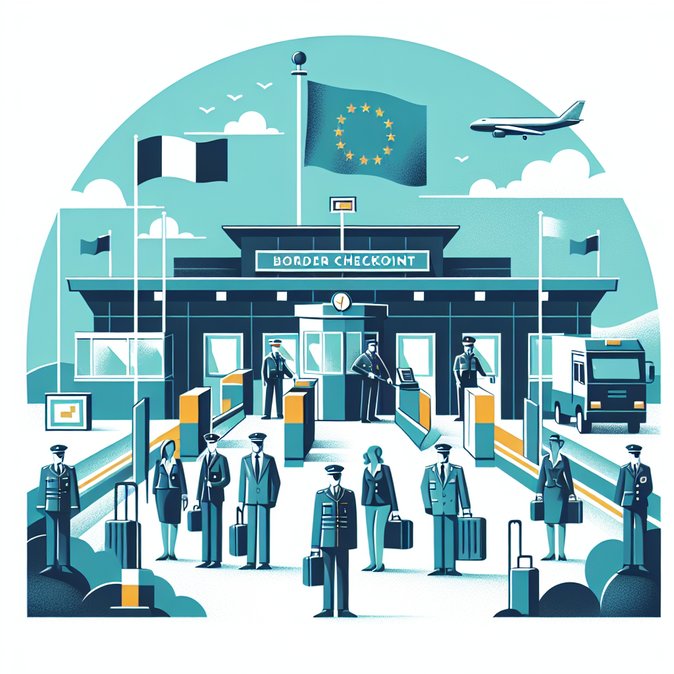
The European Union’s Committee of Permanent Representatives (Coreper) formally endorsed on 1 April the draft agreement that will convert Gibraltar’s air, land and sea frontiers into an external border of the Schengen area managed by Spanish authorities. The text—negotiated over three years by Madrid, London and the European Commission—will now be applied provisionally from 15 July 2026 while the legal-linguistic review is finalised, ending months of uncertainty for the roughly 14,000 cross-frontier workers and the 300,000 Andalusians who depend on fluid access to the Rock. Under the deal, Gibraltar will join Schengen “by proxy”. Spanish Policía Nacional officers, seconded to the British Overseas Territory, will carry out biometric checks at the port and airport, while the land crossing at La Línea becomes a joint control zone with drive-through lanes—removing the queues that routinely stretch for hours. British and Gibraltarian passports will be scanned against the EU’s new Entry/Exit System (EES), which replaces manual stamping on 10 April 2026, guaranteeing interoperability from day one. Exemption periods have been built in so that local residents holding frontier worker permits are pre-enrolled before the summer peak. For businesses the agreement is transformative. Trucks carrying fashion goods from Cádiz to Gibraltar’s booming e-commerce warehouses will move under a “green lane”, while day-trip tourism—worth an estimated €1 billion a year to neighbouring municipalities—will face Schengen-standard facilitation rather than full customs declarations. Airlines such as easyJet and British Airways, which had warned of possible capacity cuts if the border bottleneck persisted, have welcomed the clarity and are already loading additional frequencies for the winter schedule. Spanish Foreign Minister José Manuel Albares hailed the accord as “a win-win that reconciles Brexit with the daily life of the Campo de Gibraltar”. In London, the Foreign Office called it a “pragmatic outcome that protects UK sovereignty while delivering frictionless mobility”. Critics in the UK Parliament’s European Scrutiny Committee want guarantees that data collected by Spanish officers will not be used for non-immigration purposes, an issue the joint committee must resolve before full ratification. Companies with staff shuttling between Málaga tech hubs and Gibraltar’s gaming sector should prepare for the EES transition: ensure employees’ passports are machine-readable, schedule enrolment appointments, and update travel-management systems to capture four-day overstay alerts generated by EES. Failure to comply could result in fines or re-entry bans, even for regular commuters.
![EU gives final nod to Gibraltar border-free deal, clearing path for Schengen-style controls from 15 July]()
VisaHQ can help businesses and individual travellers navigate these upcoming requirements: through our Spain resource page (https://www.visahq.com/spain/) we offer real-time updates on Schengen border policies, pre-travel document checks, and appointment scheduling assistance for biometric enrolment, ensuring that cross-frontier workers and frequent flyers can cross into Gibraltar smoothly once the new rules take effect.

VisaHQ can help businesses and individual travellers navigate these upcoming requirements: through our Spain resource page (https://www.visahq.com/spain/) we offer real-time updates on Schengen border policies, pre-travel document checks, and appointment scheduling assistance for biometric enrolment, ensuring that cross-frontier workers and frequent flyers can cross into Gibraltar smoothly once the new rules take effect.