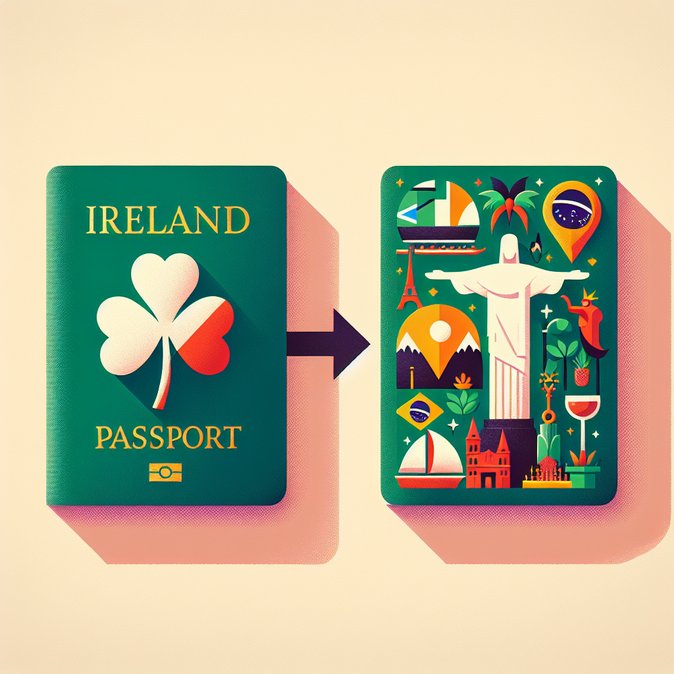
Brazil has taken its biggest step towards liberalising travel in a decade by waiving short-stay visa requirements for Irish passport holders, alongside visitors from seven other countries. Industry journal ITIJ reported that Inter-Ministerial Ordinance 18/2026 entered into force on 24 February and was confirmed by the foreign ministry on 28 February, allowing Irish tourists and business visitors to stay up to 30 days per trip (extendable to 90 days within a 12-month period).
![Brazil grants visa-free entry to Irish citizens under ‘Open Doors 2026’ strategy]()
To simplify planning even further, VisaHQ offers Irish travellers an online resource that details Brazil’s latest entry requirements alongside real-time guidance for other Latin American destinations; its streamlined platform (https://www.visahq.com/ireland/) can generate personalised check-lists, track cumulative days in country and alert users when a formal work or temporary residence permit is required.
The decision eliminates a US $120 e-visa fee and two-week processing time that previously deterred many Irish travellers. Although Ireland attracts only around 15,000 visitors to Brazil each year, tour operators predict a 25 % upswing, citing pent-up demand for Carnival packages and eco-tourism in the Pantanal. For corporates, the change removes a logistical hurdle for engineers and agritech consultants serving Irish-Brazilian joint ventures in São Paulo, Rio Grande do Sul and Bahia. Airlines are already reacting. TAP Air Portugal and Air France-KLM—whose Lisbon and Paris hubs handle most Ireland-to-Brazil traffic—have applied for extra summer frequencies. LATAM is reportedly evaluating a seasonal Dublin–São Paulo charter if demand materialises. Travel-policy teams should update visa matrices immediately and remind staff that paid work remains prohibited under the waiver; longer assignments still require a Temporary V work visa. Irish citizens must arrive with a passport valid for six months, an onward-or-return ticket and proof of sufficient funds. Immigration officials retain the right to refuse entry if they suspect undeclared work. Travellers intending multiple trips should track cumulative days to avoid breaching the 90-day annual cap. Analysts view the move as part of President Lula’s ‘Open Doors 2026’ strategy to revive visitor numbers to pre-pandemic levels. With Ireland now enjoying the same visa-free status as most EU members, Enterprise Ireland expects enhanced opportunities for food-tech and renewable-energy exporters targeting Latin America’s largest market.

To simplify planning even further, VisaHQ offers Irish travellers an online resource that details Brazil’s latest entry requirements alongside real-time guidance for other Latin American destinations; its streamlined platform (https://www.visahq.com/ireland/) can generate personalised check-lists, track cumulative days in country and alert users when a formal work or temporary residence permit is required.
The decision eliminates a US $120 e-visa fee and two-week processing time that previously deterred many Irish travellers. Although Ireland attracts only around 15,000 visitors to Brazil each year, tour operators predict a 25 % upswing, citing pent-up demand for Carnival packages and eco-tourism in the Pantanal. For corporates, the change removes a logistical hurdle for engineers and agritech consultants serving Irish-Brazilian joint ventures in São Paulo, Rio Grande do Sul and Bahia. Airlines are already reacting. TAP Air Portugal and Air France-KLM—whose Lisbon and Paris hubs handle most Ireland-to-Brazil traffic—have applied for extra summer frequencies. LATAM is reportedly evaluating a seasonal Dublin–São Paulo charter if demand materialises. Travel-policy teams should update visa matrices immediately and remind staff that paid work remains prohibited under the waiver; longer assignments still require a Temporary V work visa. Irish citizens must arrive with a passport valid for six months, an onward-or-return ticket and proof of sufficient funds. Immigration officials retain the right to refuse entry if they suspect undeclared work. Travellers intending multiple trips should track cumulative days to avoid breaching the 90-day annual cap. Analysts view the move as part of President Lula’s ‘Open Doors 2026’ strategy to revive visitor numbers to pre-pandemic levels. With Ireland now enjoying the same visa-free status as most EU members, Enterprise Ireland expects enhanced opportunities for food-tech and renewable-energy exporters targeting Latin America’s largest market.