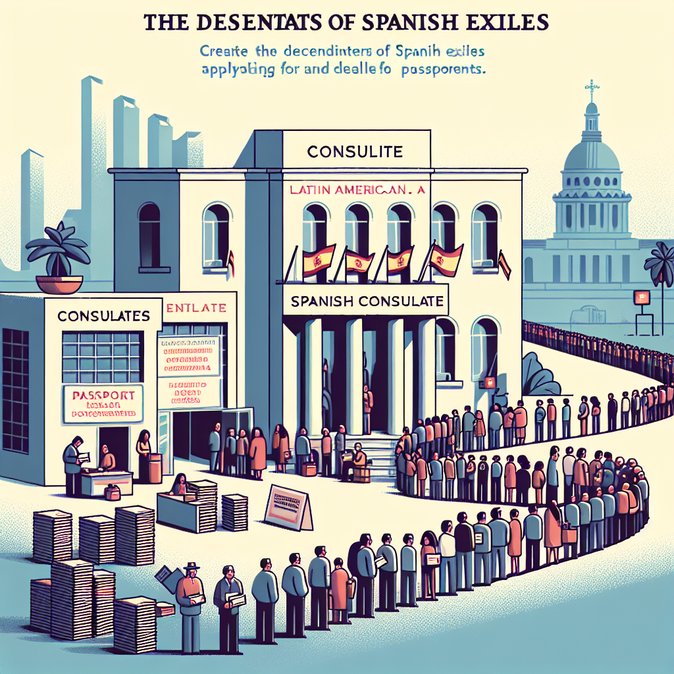
Spain’s Democratic Memory Law, designed to redress the exile of Spaniards during the 20th century, has triggered an unprecedented surge in nationality applications. According to the General Council of Spanish Citizenship Abroad (CGCEE), more than one million descendants of Spanish emigrants have already filed for citizenship and a further 1.3 million have secured appointments that consulates are struggling to honour. The avalanche peaked in the weeks before the 21 October deadline, overwhelming the 178 missions that make up Spain’s global consular network.
Under the law, grandchildren (and in some cases great-grandchildren) of Spaniards who fled for political, ideological, religious or LGBTQ+ persecution may obtain nationality within a two-year window, extendable to three. While just 2 % of the one million dossiers processed so far have been refused, half are still awaiting formal registration, delaying the issuance of passports and national-ID numbers needed for travel and work. The bottleneck is most acute in Latin America: Argentina alone accounts for 40 % of filings, while Havana, Mexico City and São Paulo each handle six-figure caseloads.
![Spain’s Consular Network Buckles as 2.3 Million Descendants Rush to Claim Spanish Citizenship]()
Diplomats warn that the workload jeopardises other routine services, from registering new births to issuing emergency travel documents. The CGCEE has urged the government to second staff from Spain’s 7,000 civil registries, rent larger premises and outsource data-entry tasks to prevent multiyear backlogs. A 2024 study by the Association of Spanish Diplomats found that dozens of posts already operate at or beyond capacity and many fail to meet Spain’s own health-and-safety rules, underscoring the urgency of structural investment.
For businesses, the consequences are tangible. Multinationals with Latin-American talent pipelines count on the Spanish passport for intra-EU mobility; delays could postpone secondments or force employers to arrange alternative work-permit routes. Law firms report a spike in enquiries about power-of-attorney filings, courier services and fast-track appointments as applicants seek to shorten waiting times. Airlines and relocation providers likewise anticipate higher demand for one-way fares and shipping once paperwork finally clears.
Looking ahead, Spain could see its diaspora swell from three to five million citizens abroad, placing permanent demand on consular services. Companies with mobile workforces should watch for future staffing announcements and build extra lead-time into assignment planning when employees rely on Spanish nationality applications to underpin EU moves.
Under the law, grandchildren (and in some cases great-grandchildren) of Spaniards who fled for political, ideological, religious or LGBTQ+ persecution may obtain nationality within a two-year window, extendable to three. While just 2 % of the one million dossiers processed so far have been refused, half are still awaiting formal registration, delaying the issuance of passports and national-ID numbers needed for travel and work. The bottleneck is most acute in Latin America: Argentina alone accounts for 40 % of filings, while Havana, Mexico City and São Paulo each handle six-figure caseloads.

Diplomats warn that the workload jeopardises other routine services, from registering new births to issuing emergency travel documents. The CGCEE has urged the government to second staff from Spain’s 7,000 civil registries, rent larger premises and outsource data-entry tasks to prevent multiyear backlogs. A 2024 study by the Association of Spanish Diplomats found that dozens of posts already operate at or beyond capacity and many fail to meet Spain’s own health-and-safety rules, underscoring the urgency of structural investment.
For businesses, the consequences are tangible. Multinationals with Latin-American talent pipelines count on the Spanish passport for intra-EU mobility; delays could postpone secondments or force employers to arrange alternative work-permit routes. Law firms report a spike in enquiries about power-of-attorney filings, courier services and fast-track appointments as applicants seek to shorten waiting times. Airlines and relocation providers likewise anticipate higher demand for one-way fares and shipping once paperwork finally clears.
Looking ahead, Spain could see its diaspora swell from three to five million citizens abroad, placing permanent demand on consular services. Companies with mobile workforces should watch for future staffing announcements and build extra lead-time into assignment planning when employees rely on Spanish nationality applications to underpin EU moves.