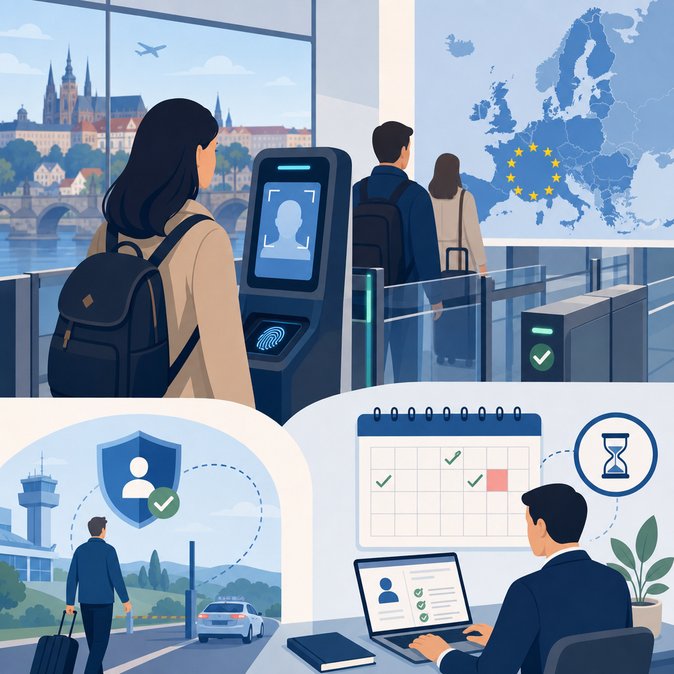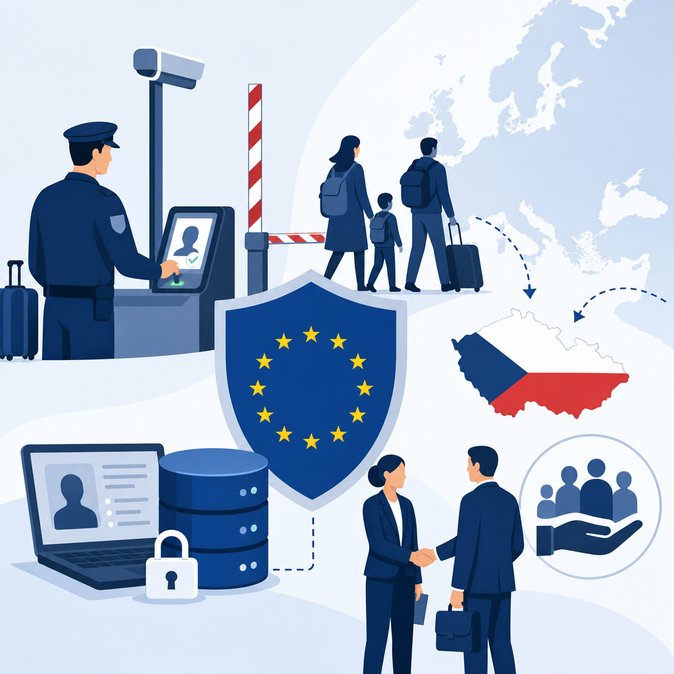
After six years of negotiations, the European Union’s Pact on Migration and Asylum will begin its phased roll-out on 12 June 2026, following the text’s formal publication in the EU’s Official Journal this weekend. Although much of the media focus has been on frontline states such as Greece and Italy, the new rules bind all 27 member countries—including Czechia—and will reshape the compliance landscape for companies that move staff across borders. The pact is built on four pillars: (1) mandatory pre-entry screening of all irregular arrivals, (2) a 12-week fast-track asylum procedure at external borders, (3) an expanded, fully-biometric Eurodac database to track movements inside Schengen, and (4) a burden-sharing mechanism that obliges each member state either to accept relocations or to pay a financial contribution. For Czechia, which has often been a transit rather than a destination country, the biggest operational change is the Eurodac overhaul: the police foreigner service (Cizinecká policie) must be able to capture fingerprints and facial images for all categories of migrants and upload them in real time. Procurement of extra kiosks and secure data lines for Prague’s Václav Havel Airport and the land crossings with Slovakia, Poland and Germany is already under way, according to the Interior Ministry.
![EU Migration & Asylum Pact Enters Into Force on 12 June: What Czech Employers and Travelers Must Prepare For]()
For organisations and individual travellers who would rather outsource the paperwork that these technological upgrades entail, VisaHQ offers comprehensive Czech visa and residence-permit processing, appointment booking and document-pre-check services. Their local specialists monitor changes such as the Eurodac expansion and carrier-interface roll-outs, helping clients avoid costly errors and meet tight submission windows. More information is available at https://www.visahq.com/czech-republic/
Corporate mobility teams will feel the impact in two ways. First, the pact tightens carrier-liability rules: airlines operating from non-Schengen points must use the new eu-LISA Carrier Interface to verify that passengers are not subject to re-admission decisions and that their passport data match Eurodac records. Czech‐based travel managers booking tickets for assignees arriving from branches in Kyiv, Tbilisi or Hanoi will therefore need to upload passport images earlier and double-check that exit records were correctly stamped on previous trips. Second, the shortened asylum and return deadlines increase the probability that rejected applicants will be removed quickly; employers sponsoring humanitarian hires should ensure that appeals are filed within the new seven-day window and that staff remain in authorised accommodation or reception centres while their case is pending. The pact also contains solidarity clauses that could require Czechia to accept up to 1 % of annual irregular arrivals recorded at the EU’s external borders. With Frontex projecting 300 000 irregular entries this year, that would translate into around 3 000 relocations. The Interior Ministry has already indicated that it prefers the alternative option of paying into the new EU Solidarity Fund—budgeted at €600 million for the first cycle—but Parliament must still approve the relevant credit line, probably before the summer recess. From a practical travel perspective, the pact dovetails with the existing Entry/Exit System (EES) that began operating in April. While Germany and Austria briefly paused the biometric capture for Pentecost-weekend traffic, Czech border police have kept the system running and are now processing about 7 500 non-EU passengers per day at Prague Airport. Once Eurodac 2.0 goes live, those records will automatically feed into the asylum database, enabling authorities to spot ‘absconders’ who lodge applications in multiple states. In the short term, mobility managers should update policy documents to reflect: stricter document-retention periods, potential carrier fines for data mismatches, and new relocation or financial-solidarity obligations that could influence public opinion and, by extension, parliamentary debate on labour-migration quotas. Legal teams should track secondary legislation that will clarify appeal rights and data-protection safeguards—particularly important for Czech companies that process employee biometrics under EU GDPR and the local Act on the Protection of Personal Data.

For organisations and individual travellers who would rather outsource the paperwork that these technological upgrades entail, VisaHQ offers comprehensive Czech visa and residence-permit processing, appointment booking and document-pre-check services. Their local specialists monitor changes such as the Eurodac expansion and carrier-interface roll-outs, helping clients avoid costly errors and meet tight submission windows. More information is available at https://www.visahq.com/czech-republic/
Corporate mobility teams will feel the impact in two ways. First, the pact tightens carrier-liability rules: airlines operating from non-Schengen points must use the new eu-LISA Carrier Interface to verify that passengers are not subject to re-admission decisions and that their passport data match Eurodac records. Czech‐based travel managers booking tickets for assignees arriving from branches in Kyiv, Tbilisi or Hanoi will therefore need to upload passport images earlier and double-check that exit records were correctly stamped on previous trips. Second, the shortened asylum and return deadlines increase the probability that rejected applicants will be removed quickly; employers sponsoring humanitarian hires should ensure that appeals are filed within the new seven-day window and that staff remain in authorised accommodation or reception centres while their case is pending. The pact also contains solidarity clauses that could require Czechia to accept up to 1 % of annual irregular arrivals recorded at the EU’s external borders. With Frontex projecting 300 000 irregular entries this year, that would translate into around 3 000 relocations. The Interior Ministry has already indicated that it prefers the alternative option of paying into the new EU Solidarity Fund—budgeted at €600 million for the first cycle—but Parliament must still approve the relevant credit line, probably before the summer recess. From a practical travel perspective, the pact dovetails with the existing Entry/Exit System (EES) that began operating in April. While Germany and Austria briefly paused the biometric capture for Pentecost-weekend traffic, Czech border police have kept the system running and are now processing about 7 500 non-EU passengers per day at Prague Airport. Once Eurodac 2.0 goes live, those records will automatically feed into the asylum database, enabling authorities to spot ‘absconders’ who lodge applications in multiple states. In the short term, mobility managers should update policy documents to reflect: stricter document-retention periods, potential carrier fines for data mismatches, and new relocation or financial-solidarity obligations that could influence public opinion and, by extension, parliamentary debate on labour-migration quotas. Legal teams should track secondary legislation that will clarify appeal rights and data-protection safeguards—particularly important for Czech companies that process employee biometrics under EU GDPR and the local Act on the Protection of Personal Data.