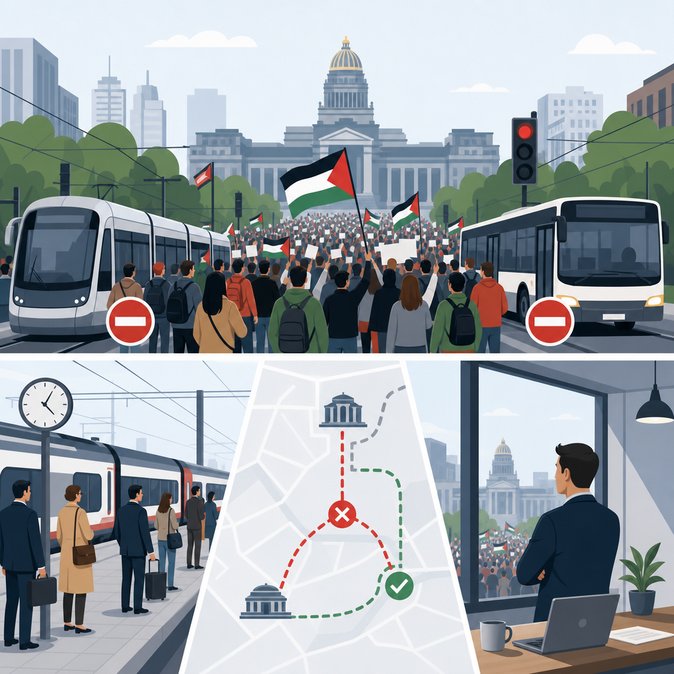
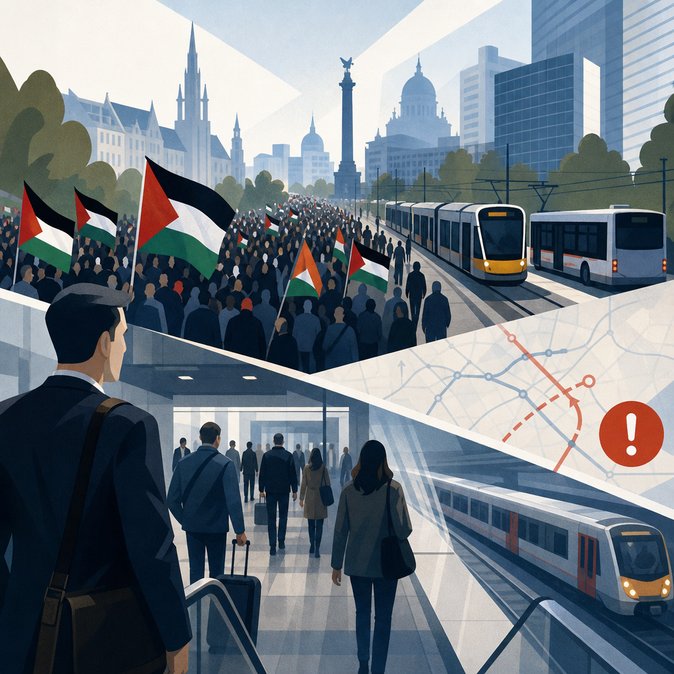
Brussels’ historic North–South axis was brought to a stand-still for much of Sunday, 17 May 2026, as an estimated 12,000 demonstrators marched from Brussels-North station to Central Station to protest Israel’s military campaign in Gaza. Organisers deliberately chose the corridor that carries most regional and inter-city trains as well as the principal tram and bus routes through the capital. Police closed Rue du Progrès, Boulevard Botanique and adjoining streets from noon, diverting STIB trams 3 and 4 and more than a dozen De Lijn and TEC bus lines. SNCB warned of platform changes and 10- to 20-minute delays on services crossing the city tunnel.
![Gaza solidarity march clogs Brussels city centre, forcing detours and delaying rail traffic]()
Executives planning last-minute entries to Belgium may also need to verify that their travel documents are in order; for those who still require a Schengen visa or simply want a streamlined extension service, VisaHQ’s Belgium portal (https://www.visahq.com/belgium/) offers rapid online processing, status tracking and dedicated support—particularly handy when demonstrations threaten to close consulates or lengthen embassy queues.
For visiting executives, the practical impact was immediate: taxis were banned from the inner ring for three hours; several hotels in the Botanique district advised guests to arrive on foot; and Eurostar travellers walking from Midi to EU quarter meetings reported 30-minute detours. While Brussels Airport operations were unaffected, the airport rail link experienced knock-on delays as northbound rolling-stock could not reach the city in time for turn-round. Belgian police deployed a mobile command post at Place de Brouckère and requested companies in the Central Station area to keep employees indoors until 18:00. No major incidents were reported, but business-travel security providers, including International SOS, issued alerts citing an elevated risk of opportunistic pick-pocketing and advised travellers to avoid wearing visible corporate badges. The demonstration highlights how quickly civil-society actions in Belgium can spill over into mobility networks. Employers with short-lead assignments in Brussels are urged to build extra transit time into meeting schedules, monitor STIB and SNCB feeds, and keep ride-share alternatives handy in case trams are diverted again. With further Middle-East-related protests expected around the June EU Council, travel-risk managers should brief assignees on alternative walking routes between the main rail stations and the EU institutions.
Executives planning last-minute entries to Belgium may also need to verify that their travel documents are in order; for those who still require a Schengen visa or simply want a streamlined extension service, VisaHQ’s Belgium portal (https://www.visahq.com/belgium/) offers rapid online processing, status tracking and dedicated support—particularly handy when demonstrations threaten to close consulates or lengthen embassy queues.
For visiting executives, the practical impact was immediate: taxis were banned from the inner ring for three hours; several hotels in the Botanique district advised guests to arrive on foot; and Eurostar travellers walking from Midi to EU quarter meetings reported 30-minute detours. While Brussels Airport operations were unaffected, the airport rail link experienced knock-on delays as northbound rolling-stock could not reach the city in time for turn-round. Belgian police deployed a mobile command post at Place de Brouckère and requested companies in the Central Station area to keep employees indoors until 18:00. No major incidents were reported, but business-travel security providers, including International SOS, issued alerts citing an elevated risk of opportunistic pick-pocketing and advised travellers to avoid wearing visible corporate badges. The demonstration highlights how quickly civil-society actions in Belgium can spill over into mobility networks. Employers with short-lead assignments in Brussels are urged to build extra transit time into meeting schedules, monitor STIB and SNCB feeds, and keep ride-share alternatives handy in case trams are diverted again. With further Middle-East-related protests expected around the June EU Council, travel-risk managers should brief assignees on alternative walking routes between the main rail stations and the EU institutions.