France is bracing for three days of severe air-travel disruption after the National Union of Air-Traffic Controllers (SNCTA) confirmed that its members will walk out from Thursday 14 May through Saturday 16 May 2026, coinciding with the Ascension Day long-weekend.
1. Background and scope
More than 60 % of France’s 4,000 controllers belong to the SNCTA, giving the union the power to shut—or severely curtail—operations at every civilian airport and en-route control centre in metropolitan France. Under French labour law, each control tower must publish a minimum-service timetable 48 hours before a strike, but past disputes show that up to 70 % of flights can still be cancelled once rosters are finalised. The Directorate-General for Civil Aviation (DGAC) is already drafting a nationwide « reduction de programme » that will force airlines to pre-cancel services rather than gamble on day-of-operation staffing levels.
2. Why the timing matters
Ascension (a public holiday that falls on a Thursday in 2026) traditionally triggers one of France’s heaviest leisure-travel peaks. Both domestic business travellers—keen to squeeze in meetings before the four-day bridge—and short-haul holiday-makers rely on the same airport slots. Forward-booking data from Amadeus shows load-factors above 90 % on routes from Paris-Orly to Toulouse, Marseille and Nice, and near-full long-haul flights to North America and the Gulf. Any mass cancellation will force airlines into expensive overnight accommodation and EU261 compensation at the very moment that summer schedules ramp up.
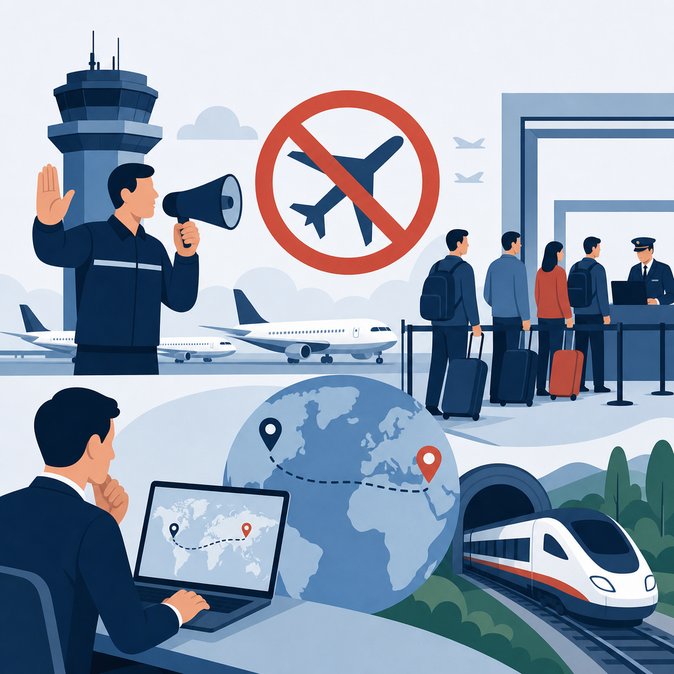
![French air traffic-control strike (14–16 May 2026) set to ground thousands of flights]()
3. Contingency plans for corporate mobility teams
• Shift meetings online or redirect executives to rail: SNCF’s TGV network can absorb some domestic traffic, but seats on the key Paris-Lyon and Paris-Bordeaux axes are already scarce.
• Consider alternative hubs: Lufthansa and KLM are adding capacity from Frankfurt and Amsterdam for 15–16 May, but travellers should expect longer total journey times.
• Check immigration-clearance windows: non-EU nationals re-entering France after meetings abroad could face lengthy queues because border-police staffing is also affected. Employers should ensure that employees carry proof of Schengen days-remaining under the new Entry/Exit System (EES).
Amid this uncertainty, VisaHQ can streamline any last-minute visa or passport formalities. Its dedicated France page (https://www.visahq.com/france/) lets travellers and mobility managers check entry rules, order rush renewals or transit visas, and track applications in real time—crucial when itineraries are being torn up by strike-related cancellations.
4. What happens next?
Talks between the SNCTA and the DGAC continued on 13 May without a breakthrough; pay-scale modernisation, 32-hour rosters and accelerated hiring are the core sticking-points. If no deal is reached, the DGAC will publish compulsory capacity-reduction targets airport-by-airport by 14 00 CET on 12 May. Airlines must then cancel the indicated percentage of flights and notify passengers within six hours. Travellers already ticketed for 14–16 May can rebook or refund free of charge, but seats later in May are selling fast—especially in premium cabins. Practical implication: global-mobility managers moving staff into or out of France during mid-May should build at least 48 hours of buffer, secure flexible tickets, and alert relocation suppliers to possible hand-over delays.
1. Background and scope
More than 60 % of France’s 4,000 controllers belong to the SNCTA, giving the union the power to shut—or severely curtail—operations at every civilian airport and en-route control centre in metropolitan France. Under French labour law, each control tower must publish a minimum-service timetable 48 hours before a strike, but past disputes show that up to 70 % of flights can still be cancelled once rosters are finalised. The Directorate-General for Civil Aviation (DGAC) is already drafting a nationwide « reduction de programme » that will force airlines to pre-cancel services rather than gamble on day-of-operation staffing levels.
2. Why the timing matters
Ascension (a public holiday that falls on a Thursday in 2026) traditionally triggers one of France’s heaviest leisure-travel peaks. Both domestic business travellers—keen to squeeze in meetings before the four-day bridge—and short-haul holiday-makers rely on the same airport slots. Forward-booking data from Amadeus shows load-factors above 90 % on routes from Paris-Orly to Toulouse, Marseille and Nice, and near-full long-haul flights to North America and the Gulf. Any mass cancellation will force airlines into expensive overnight accommodation and EU261 compensation at the very moment that summer schedules ramp up.

3. Contingency plans for corporate mobility teams
• Shift meetings online or redirect executives to rail: SNCF’s TGV network can absorb some domestic traffic, but seats on the key Paris-Lyon and Paris-Bordeaux axes are already scarce.
• Consider alternative hubs: Lufthansa and KLM are adding capacity from Frankfurt and Amsterdam for 15–16 May, but travellers should expect longer total journey times.
• Check immigration-clearance windows: non-EU nationals re-entering France after meetings abroad could face lengthy queues because border-police staffing is also affected. Employers should ensure that employees carry proof of Schengen days-remaining under the new Entry/Exit System (EES).
Amid this uncertainty, VisaHQ can streamline any last-minute visa or passport formalities. Its dedicated France page (https://www.visahq.com/france/) lets travellers and mobility managers check entry rules, order rush renewals or transit visas, and track applications in real time—crucial when itineraries are being torn up by strike-related cancellations.
4. What happens next?
Talks between the SNCTA and the DGAC continued on 13 May without a breakthrough; pay-scale modernisation, 32-hour rosters and accelerated hiring are the core sticking-points. If no deal is reached, the DGAC will publish compulsory capacity-reduction targets airport-by-airport by 14 00 CET on 12 May. Airlines must then cancel the indicated percentage of flights and notify passengers within six hours. Travellers already ticketed for 14–16 May can rebook or refund free of charge, but seats later in May are selling fast—especially in premium cabins. Practical implication: global-mobility managers moving staff into or out of France during mid-May should build at least 48 hours of buffer, secure flexible tickets, and alert relocation suppliers to possible hand-over delays.