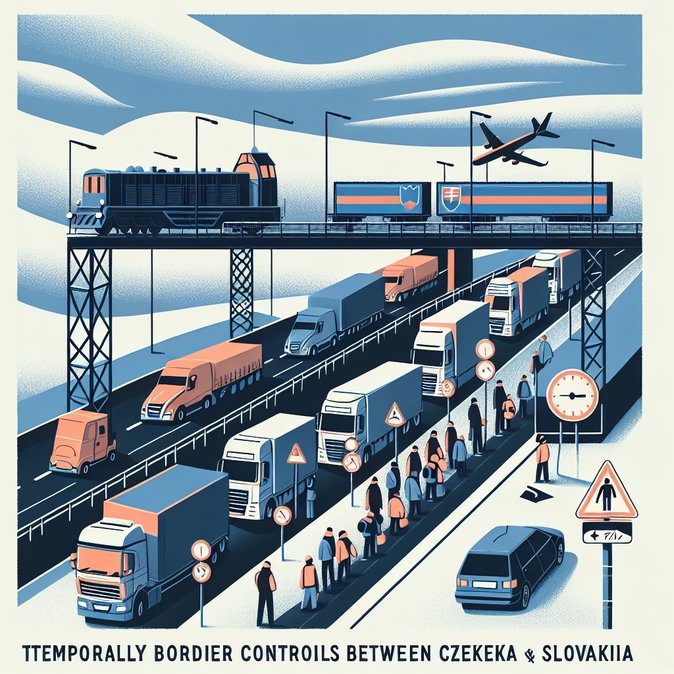
The Czech government has formally prolonged the re-introduced controls on its 251-kilometre land frontier with Slovakia, citing a renewed rise in irregular migration along the Western Balkan route. Interior Minister Vít Rakušan confirmed on Sunday, 12 April 2026, that all 27 designated road and rail crossings—as well as several green-border patrol zones—will now remain staffed until at least 3 January 2027. The decision mirrors a parallel Polish regulation that keeps its own Slovak border posts in place until 3 December 2026. Although the Czech–Slovak line is an internal Schengen boundary, Prague first re-activated spot checks in October 2025 when asylum applications tripled in three months. Data released last week show that more than 46,000 people were intercepted transiting Slovakia in the first quarter of 2026—six times the figure a year earlier. Most were Syrian, Afghan, or North-African nationals aiming for Germany. Officials say the smugglers’ switch from the previously monitored Czech–Austrian corridor back to Moravian routes justifies keeping police and customs officers on duty. For businesses the extension means that coach operators, freight forwarders and employees who cross daily will continue to face sporadic stops, document inspections and potential delays of 10–30 minutes at peak times.
![Czechia Extends Border Checks with Slovakia; Poland Follows Suit]()
If you are unsure whether the temporary checks affect your own travel or shipping plans, VisaHQ can simplify the process: its dedicated Czech Republic portal (https://www.visahq.com/czech-republic/) tracks up-to-the-minute border regulations, Schengen entry rules and carrier requirements, guiding individuals and companies through any paperwork they now need to prepare.
Companies with just-in-time supply chains are being advised to include at least a one-hour buffer on routes via Brno–Trenčín, Hodonín–Holíč and Břeclav–Kúty. Electronic pre-notification of cargo manifests—voluntary since January—will become compulsory from 1 May, easing clearance for compliant hauliers. The move also puts political pressure on Brussels ahead of next week’s informal meeting of interior ministers in Budapest, where Germany, Austria, Hungary and Slovakia will join Czechia and Poland to discuss a joint Schengen-area migration strategy. Prague says it will drop the checks only when “credible protection” of the EU’s external borders is in place. Until then, travellers should keep passports or national ID cards ready, even within Schengen, and allow extra time when flying from Brno or Ostrava airports that draw passengers from Slovakia.

If you are unsure whether the temporary checks affect your own travel or shipping plans, VisaHQ can simplify the process: its dedicated Czech Republic portal (https://www.visahq.com/czech-republic/) tracks up-to-the-minute border regulations, Schengen entry rules and carrier requirements, guiding individuals and companies through any paperwork they now need to prepare.
Companies with just-in-time supply chains are being advised to include at least a one-hour buffer on routes via Brno–Trenčín, Hodonín–Holíč and Břeclav–Kúty. Electronic pre-notification of cargo manifests—voluntary since January—will become compulsory from 1 May, easing clearance for compliant hauliers. The move also puts political pressure on Brussels ahead of next week’s informal meeting of interior ministers in Budapest, where Germany, Austria, Hungary and Slovakia will join Czechia and Poland to discuss a joint Schengen-area migration strategy. Prague says it will drop the checks only when “credible protection” of the EU’s external borders is in place. Until then, travellers should keep passports or national ID cards ready, even within Schengen, and allow extra time when flying from Brno or Ostrava airports that draw passengers from Slovakia.