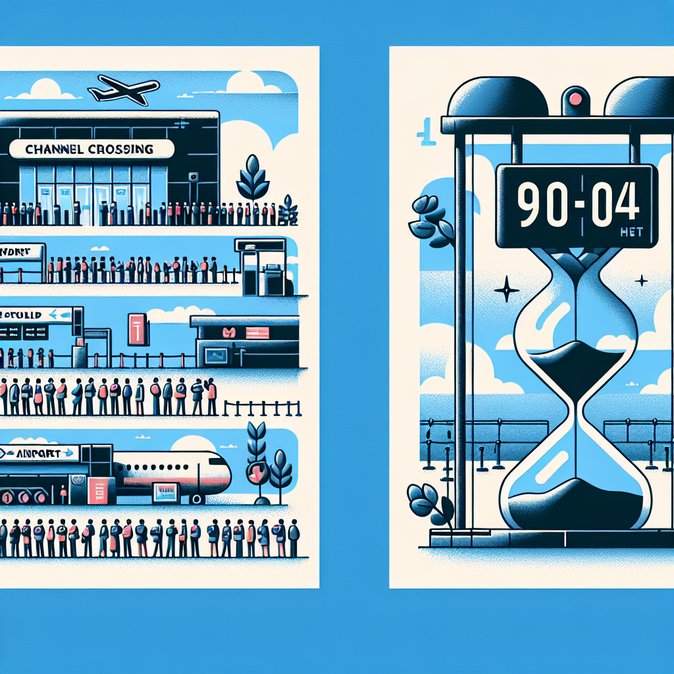
Barely 24 hours after the European Union flicked the switch on its long-awaited biometric Entry/Exit System (EES), French border posts found themselves at the sharp end of the continent-wide teething troubles. A roundup published at 08:00 on 11 April by specialist portal Schengen90 reported that passengers at Eurostar’s London St Pancras terminal, the Eurotunnel terminal in Folkestone and Paris-Charles-de-Gaulle faced waits of up to four hours as kiosks crashed and officers reverted to manual passport stamping. The EES replaces physical passport stamps with a digital record of entry and exit and automatically calculates whether non-EU visitors breach the 90 days in any 180-day rule. While the technology promises faster processing in the long term, France’s juxtaposed controls on UK soil were still awaiting fully-certified fingerprint scanners when the system went live, forcing police to create temporary work-arounds. Airports Council International (ACI) Europe and several airline groups have asked the European Commission to allow France to suspend biometric capture when queues exceed 45 minutes, citing the risk of missed connections and cascading delays across hub-and-spoke networks. Under EU rules, member states can invoke a 90-day grace period after launch, extendable once for 60 days, but industry leaders warn that may not cover the busy summer peak.
![France grapples with multi-hour queues as EU Entry/Exit System sparks 90/180-day rule confusion]()
For travellers and global mobility teams still trying to decipher what these changes mean in practice, VisaHQ offers step-by-step support—from calculating remaining Schengen days to securing the correct visas and travel authorisations ahead of departure. Its online platform (https://www.visahq.com/france/) consolidates country requirements, sends automated expiry reminders and lets companies track multiple employees in one dashboard, making EES-era compliance far less daunting.
For mobility managers the implications are immediate. Automated overstay detection means staff on short-term postings must keep pristine records of time spent in Schengen, and business-visitor trips that bounce in and out of France will now be logged to the exact minute. Companies are already re-checking assignment schedules to avoid inadvertent breaches and advising travellers to carry proof of outbound bookings in case officers need to override system errors. Longer-term, EES data will feed ETIAS, the electronic travel authorisation that France expects to start testing in late 2026. The two systems together will shift compliance from paper to pixels, making advance education for employees and assignees critical to avoid fines or refused entry.

For travellers and global mobility teams still trying to decipher what these changes mean in practice, VisaHQ offers step-by-step support—from calculating remaining Schengen days to securing the correct visas and travel authorisations ahead of departure. Its online platform (https://www.visahq.com/france/) consolidates country requirements, sends automated expiry reminders and lets companies track multiple employees in one dashboard, making EES-era compliance far less daunting.
For mobility managers the implications are immediate. Automated overstay detection means staff on short-term postings must keep pristine records of time spent in Schengen, and business-visitor trips that bounce in and out of France will now be logged to the exact minute. Companies are already re-checking assignment schedules to avoid inadvertent breaches and advising travellers to carry proof of outbound bookings in case officers need to override system errors. Longer-term, EES data will feed ETIAS, the electronic travel authorisation that France expects to start testing in late 2026. The two systems together will shift compliance from paper to pixels, making advance education for employees and assignees critical to avoid fines or refused entry.