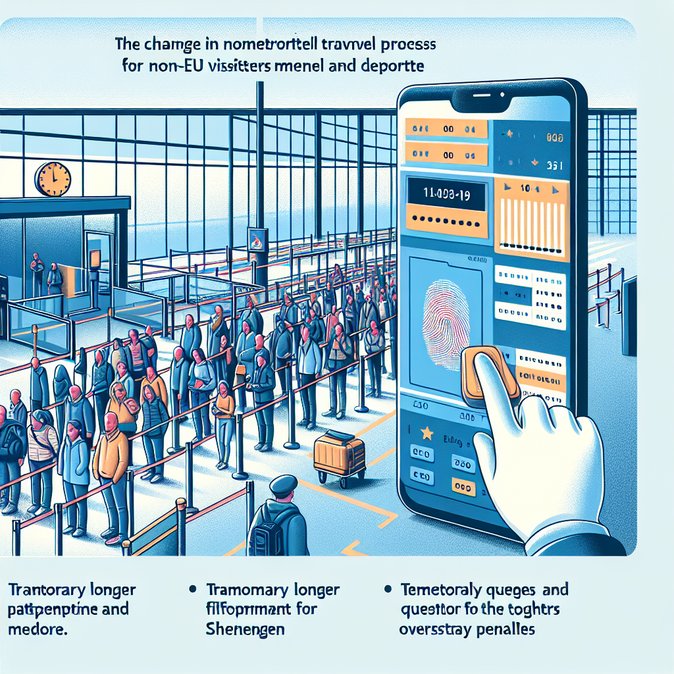
Belgium woke up yesterday to the biggest change in Schengen border management since the passport-free zone was created. At 00:00 on 10 April 2026 the European Union’s long-awaited Entry/Exit System (EES) moved from pilot phase to full operation at every Belgian external border crossing—including Brussels Airport, Liège Cargo, the Port of Zeebrugge and the Eurostar terminal at Brussels-Midi. The new platform records the entry and exit of every non-EU traveller (including Britons, Americans and other visa-exempt visitors) by scanning travel-document data and capturing a live facial image—and, in most cases, four fingerprints. The digital file replaces the rubber passport-stamp and automatically calculates how many days a traveller has spent inside the Schengen Area, closing long-standing loopholes that allowed some visitors to overstay the 90-in-180-day rule.
![EU’s Biometric Entry/Exit System Replaces Passport Stamps at Belgian Borders]()
If you’re unsure how these changes affect your next trip, VisaHQ can help. The company’s Belgium hub (https://www.visahq.com/belgium/) tracks the latest EES and forthcoming ETIAS requirements and provides step-by-step assistance with visas, travel authorisations and passport renewals—so both individual travellers and corporate mobility teams stay compliant without the guesswork.
For business-mobility managers the change is more than cosmetic. Companies must now assume that any excess stay—even a single day—will trigger an automated alert, a potential re-entry ban and a fine that Belgium can enforce at its discretion. Employers that cycle staff in and out of EU projects are being urged to audit historical travel records, validate ‘‘Schengen day’’ calculators used in corporate booking tools and build longer dwell times at border control into flight-connection policies. Belgium’s Federal Police have installed 36 self-service EES kiosks in the non-Schengen concourse at Brussels Airport and redeployed 60 officers from landside patrols to immigration booths in anticipation of longer processing times. A spokesperson said the average enrolment takes 70 seconds ‘‘in laboratory conditions’’ but warned that real-world times vary widely depending on lighting, passenger familiarity and the need to remove hats or glasses. The European Commission insists the system will ultimately shorten queues because repeat visitors who have been enrolled once can in future use automatic e-gates. Yet officials concede that the first summer of full operation will be challenging—especially at land borders and rail terminals where space is tight and equipment is still being delivered. With the separate ETIAS travel-authorisation scheme due to start later this year, corporate travellers to Belgium face a radically different compliance landscape by year-end.

If you’re unsure how these changes affect your next trip, VisaHQ can help. The company’s Belgium hub (https://www.visahq.com/belgium/) tracks the latest EES and forthcoming ETIAS requirements and provides step-by-step assistance with visas, travel authorisations and passport renewals—so both individual travellers and corporate mobility teams stay compliant without the guesswork.
For business-mobility managers the change is more than cosmetic. Companies must now assume that any excess stay—even a single day—will trigger an automated alert, a potential re-entry ban and a fine that Belgium can enforce at its discretion. Employers that cycle staff in and out of EU projects are being urged to audit historical travel records, validate ‘‘Schengen day’’ calculators used in corporate booking tools and build longer dwell times at border control into flight-connection policies. Belgium’s Federal Police have installed 36 self-service EES kiosks in the non-Schengen concourse at Brussels Airport and redeployed 60 officers from landside patrols to immigration booths in anticipation of longer processing times. A spokesperson said the average enrolment takes 70 seconds ‘‘in laboratory conditions’’ but warned that real-world times vary widely depending on lighting, passenger familiarity and the need to remove hats or glasses. The European Commission insists the system will ultimately shorten queues because repeat visitors who have been enrolled once can in future use automatic e-gates. Yet officials concede that the first summer of full operation will be challenging—especially at land borders and rail terminals where space is tight and equipment is still being delivered. With the separate ETIAS travel-authorisation scheme due to start later this year, corporate travellers to Belgium face a radically different compliance landscape by year-end.