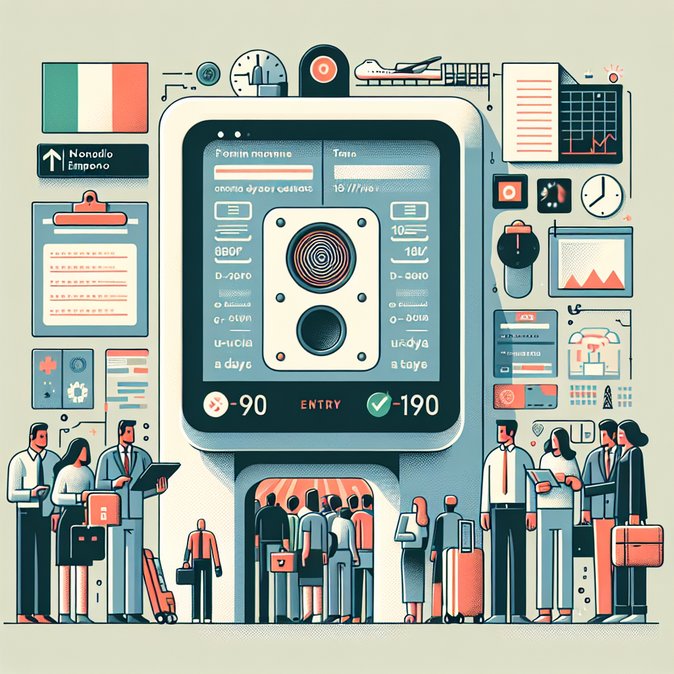
After eighteen months of phased deployment, the European Union’s Entry/Exit System (EES) will move to full operational status on 10 April 2026. For Italy—home to the Schengen Area’s fourth-busiest external frontier—the change replaces the familiar passport ink-stamp with an electronic record that stores a traveller’s facial image, four fingerprints and key biographical data for every short-stay entry and exit. Since the pilot launch in October 2025, Italian frontier posts at Rome Fiumicino, Milan Malpensa and 15 land and sea crossings have captured more than 6 million movements, according to EU-agency eu-LISA. The final ‘switch-on’ means all non-EU nationals, including frequent business travellers and posted workers, must now submit biometrics on first arrival after 10 April and will see their 90-days-in-180 entitlement calculated automatically. Border police have warned of teething delays during the Easter return rush. Milan Malpensa estimates enrolment adds 45-60 seconds per passenger; extra e-gates and mobile enrolment teams are being deployed.
![Schengen Entry/Exit System Becomes Fully Operational on 10 April—Italian Borders Switch to Biometric Checks]()
For travellers and HR teams looking to stay ahead of these new requirements, VisaHQ can help simplify compliance. The company’s Italy hub (https://www.visahq.com/italy/) provides real-time updates on EES and ETIAS, step-by-step visa support, and digital tools that let organisations track employee travel and receive deadline reminders—all from a single dashboard.
Companies running commuter shuttles from nearby Switzerland are advising staff to carry at least six months’ passport validity and to allow an extra hour at peak times. For global-mobility teams the EES is a double-edged sword. On one hand it reduces the risk of inadvertent over-stays—records will be indisputable—but it also leaves no room for ‘grey-area’ business trips that bleed into work. Employers should audit assignment calendars against the automated Schengen counter and review posted-worker notifications that rely on exact entry dates. The EES also paves the way for ETIAS, the electronic travel authorisation that will apply to U.S., UK, Canadian and other visa-waiver nationals from late 2026. HR departments are urged to begin budgeting for the €7 ETIAS fee and planning internal processes to ensure employees secure approval before booking travel.

For travellers and HR teams looking to stay ahead of these new requirements, VisaHQ can help simplify compliance. The company’s Italy hub (https://www.visahq.com/italy/) provides real-time updates on EES and ETIAS, step-by-step visa support, and digital tools that let organisations track employee travel and receive deadline reminders—all from a single dashboard.
Companies running commuter shuttles from nearby Switzerland are advising staff to carry at least six months’ passport validity and to allow an extra hour at peak times. For global-mobility teams the EES is a double-edged sword. On one hand it reduces the risk of inadvertent over-stays—records will be indisputable—but it also leaves no room for ‘grey-area’ business trips that bleed into work. Employers should audit assignment calendars against the automated Schengen counter and review posted-worker notifications that rely on exact entry dates. The EES also paves the way for ETIAS, the electronic travel authorisation that will apply to U.S., UK, Canadian and other visa-waiver nationals from late 2026. HR departments are urged to begin budgeting for the €7 ETIAS fee and planning internal processes to ensure employees secure approval before booking travel.
More From Italy
View all
Italian Air Traffic Controllers Set for 4-Hour National Strike on 10 April—Hundreds of Flights Already Cancelled

Ryanair Slashes European Network but Pledges Major Italian Expansion—40 New Aircraft & 250 Routes if Taxes Fall